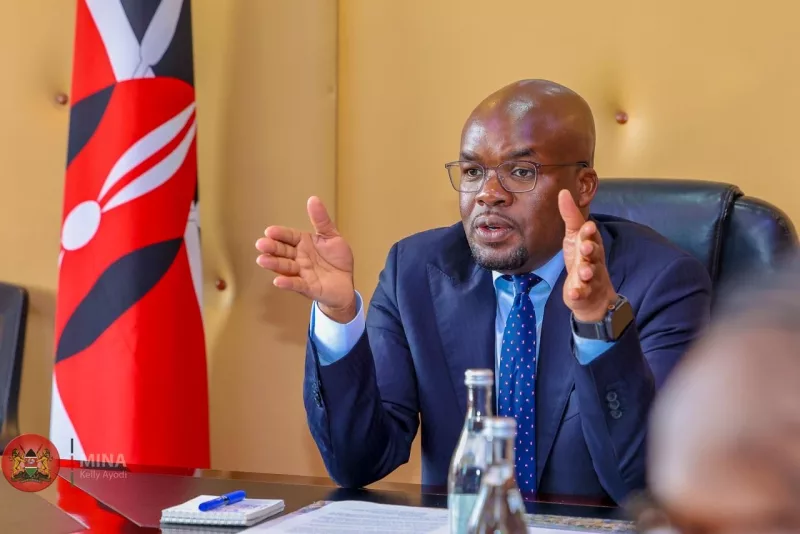
 Hon. Mustafa Abdirashid Ahmed MCA Iftin and current Deputy Speaker of Garissa County Assembly./COURTESY
There is a wisdom among pastoralists that the desert never rewards the loudest traveler. In the endless plains where the trees bends against the wind and the camel caravan stretches beyond the horizon like a moving prayer, survival belongs not to noise, but to patience, direction, and unity.
A lone herder can lose himself in the dunes, but a united caravan always finds water. For decades, Northern Kenya walked through history like a caravan forgotten by the empire of rain. Its people endured the scorching sun of neglect, the storms of political suspicion, and the silence of exclusion.
The old Northern Frontier District carried the burden of being viewed as distant, restless, and peripheral to the national imagination. Towns like Wajir were spoken of in whispers of insecurity and hardship, rarely in the language of possibility and national pride. Yet history, much like the desert wind, changes direction when least expected.
On June 1, 2026, Kenya turns its eyes northward as Wajir County hosts the 64th Madaraka Day celebrations. It is more than a ceremonial gathering. It is more than a parade of uniforms, speeches, and flags. It is a symbolic crossing of a historical river that once separated Northern Kenya from the psychological center of the republic. For the first time since independence, the footsteps of Madaraka enter the former NFD, carrying with them not only state power, but state recognition. And perhaps that is the greatest transformation of all.
For many generations, the people of the North grew up with an invisible emotional border. When one traveled to Nairobi or Mombasa, elders jokingly said they were “going to Kenya,” as though the homeland they inhabited existed outside the national embrace. It was not merely humor. It was the language of accumulated exclusion. Roads ended before reaching them. National projects bypassed them. Political seasons came and went like clouds that refused to rain on dry land. But Wajir today tells a different story.
The town that once stood as a remote administrative outpost has become the stage upon which the nation now performs its unity. Where dusty grounds once hosted community gatherings, a modern stadium now rises from the earth like an oasis built from ambition. The Sh900 million ultra-modern stadium, implemented under the Ministry of Defence through the Kenya Defence Forces, is not just concrete and steel; it is a monument announcing that the North, too, belongs to the future. Roads have been expanded and illuminated. Water systems strengthened. Electricity stabilized.
The airport modernized to receive dignitaries from across Kenya and beyond. The transformation feels almost poetic. It resembles the pastoralist who, after decades of drought, suddenly witnesses clouds gathering above his grazing fields. The land is the same, yet everything changes because hope has arrived. Still, infrastructure alone does not explain why Wajir’s moment matters so deeply.
Roads can be built anywhere. Stadiums can rise in any county. But what makes this occasion historically profound is the political maturity that made it possible. In Kenya’s political culture, competition often resembles rival clans fighting over a shrinking watering hole. Leaders expend enormous energy battling one another while their people remain thirsty for development. Counties rich in potential become trapped in endless cycles of supremacy wars, factional rivalries, and elite fragmentation.
The result is predictable; opportunities flee from instability the same way livestock flee from a burning plain. Wajir chose another path. Governor Ahmed Abdullahi and the county’s political leadership understood an ancient pastoralist truth; when hyenas surround the herd, survival depends on unity. Instead of amplifying divisions, they pursued consensus.
Senators, MPs, local leaders, elders, and professionals aligned around a common vision larger than individual ambition. They recognized that history rarely visits divided homes. That collective discipline transformed Wajir from a distant county into the national center stage. The significance becomes even greater when viewed through the lens of Kenya’s evolving political architecture. In the 2022 elections, Wajir largely supported the Azimio coalition led by Raila Odinga, yet today it stands comfortably within President William Ruto’s broad-based government framework.
Rather than deepening political bitterness, the broad-based arrangement has created space for inclusion and cooperation. In many ways, this mirrors Raila Odinga’s long-articulated ideals of devolution, inclusion, and equitable national belonging. It also reflects President Ruto’s realization that no part of Kenya should remain permanently outside the circle of state investment. The lesson is powerful; development should not be held hostage by electoral differences.
A nation matures when political competition ends at the ballot and governance begins afterward. Across Northern Kenya, counties like Garissa, Mandera, Marsabit, and Isiolo must study this moment carefully. Wajir has demonstrated that national attention gravitates toward regions that project stability, consensus, and strategic clarity. Investors avoid political earthquakes. Governments hesitate to pour resources into zones consumed by endless internal warfare.
Development follows predictability the same way pastoralists follow seasonal rivers. Garissa, particularly, stands at an important crossroads. It possesses immense intellectual capital, entrepreneurial resilience, and strategic geographic importance. Yet too often, political grapevine and elite wrangling threaten to overshadow collective progress. Leaders spend precious years fighting symbolic battles while opportunities quietly migrate elsewhere.
Wajir’s story offers a sobering reminder that counties do not rise because of louder politics; they rise because of coordinated purpose. Consensus is not weakness. In reality, it is the highest form of political sophistication. The camel itself teaches this lesson. In the desert, the camel survives not because it is the fastest animal, but because it conserves energy, adapts to harshness, and moves steadily toward its destination. Northern Kenya now faces a similar choice. It can exhaust itself in endless political races across the sand, or it can move deliberately as a united caravan toward prosperity.
There is also a deeper cultural significance in Wajir hosting Madaraka Day under the theme “Education, Skills and the Future.” For decades, Northern Kenya’s youth have battled stereotypes that portrayed pastoralist communities as disconnected from modernity. Yet the modern pastoralist is no longer merely a keeper of livestock; he is also a graduate, an innovator, a technologist, and a policymaker.
The children watching the celebrations in Wajir today will grow up believing that they, too, can stand at the center of the Kenyan story. That psychological shift may ultimately become more valuable than the roads or stadiums.
A nation is built not only through budgets and buildings, but through emotional belonging. Citizens must feel seen by the republic. They must believe the national flag waves for them as much as for anyone else.
By bringing Madaraka Day to Wajir, Kenya is symbolically stitching together a wound that has existed since independence. And perhaps this is how nations heal not through grand declarations alone, but through moments when forgotten places suddenly become visible.
When the drums beat in Wajir and the flags rise against the northern sky, they will not merely celebrate self-rule. They will celebrate arrival. The arrival of recognition. The arrival of dignity. The arrival of a region that has walked through decades of dust yet still carried hope like a lantern through the night. Wajir has become more than a host of Madaraka Day.
It has become a metaphor for Northern Kenya itself; resilient, patient, underestimated, and finally stepping into the sunlight of national history. The caravan has reached the oasis, and the bells of the camels can now be heard across the republic.