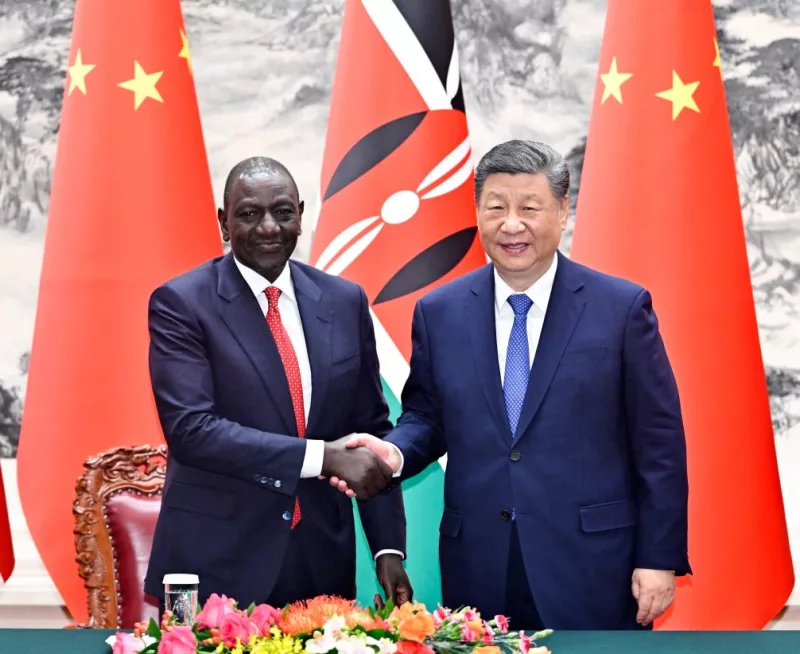
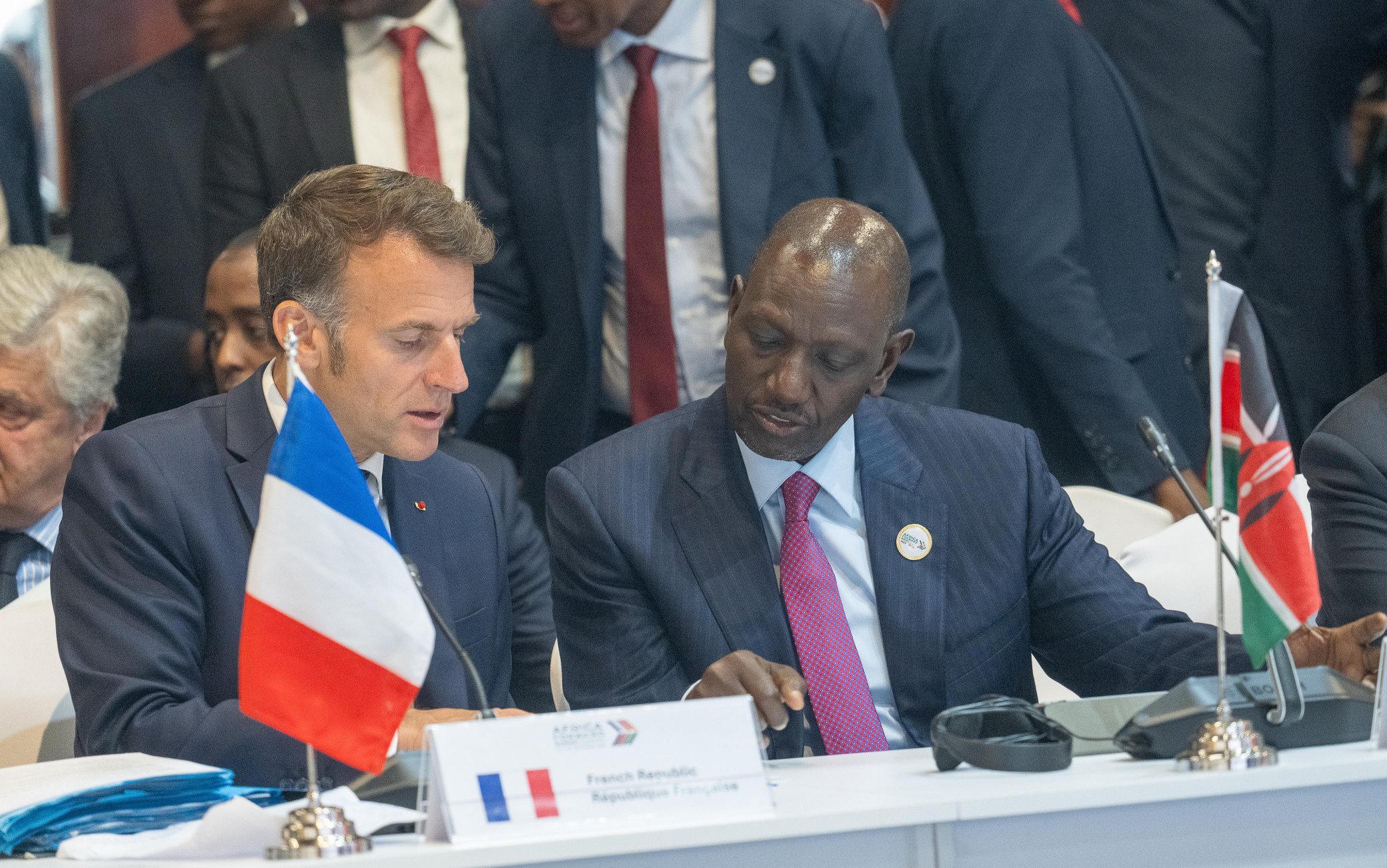
 Presidents Emmanuel Macron and William Ruto co-chair the Green Industrialisation and Energy Transition Session of the Africa Forward Summit at Kenyatta International Convention Centre, Nairobi, May 12, 2026 /PCS
That the concluded Africa Forward summit hosted in Nairobi by France and Kenya was a huge diplomatic coup in our favour as a country is a settled fact. Whether it is a helpful milestone for Kenya or a strategic problem that is being transferred by Paris from West Africa to Nairobi is where the debate begins.
I reckon that the pragmatic view should cautiously leverage the various strategic benefits the entry of the Frenchman into Kenya and the region holds.
First is the question of market. In a fervidly competitive world, the bulge of unemployed skilled youth threatens to blunt its potential strategic demographic dividend, enterprise and innovation.
There are 147.8 million French-speaking people in the East African Community alone, equivalent to the combined population of the DRC, Rwanda and Burundi combined.
The city with the world’s largest French-speaking population is in the EAC — Kinshasa in the DRC — not Paris. Kinshasa’s population is estimated at 18.5 million to almost 21.9 million people, while Paris has 2.04 million. The country is preparing for its first national census in 40 years.
Buttressed by the fact that French is now an official working language of the EAC, the opportunity is enormous for enterprising and innovative minds willing to stretch the borders and challenge the norm in the fight against poverty.
Corporate entities like Equity Bank were ahead of the game, having set up shop in Goma, North Kivu, in the eastern part of the DRC.
Other EAC member states, including Somalia, South Sudan, Uganda, Kenya and Tanzania, have a combined population of an estimated 210 million to 211 million people, making the region a formidable market.
To tap into this market, it would be a smart investment for any young person to sign up for French language classes. Even better, I would argue the Kenyan government should make French language mandatory in basic education to better equip our people for the renewed frontier of the French horizon in the region.
We would be at pole position if we are versatile in English, Kiswahili, French, as well as our ethnic languages, as many barriers would be unlocked not just in the EAC bloc but also in West and Southern Africa.
Further, with Paris playing an elevated role in Nairobi — whose profile as the capital of the African Global South is ascendant — Kenya is expected to attract more significant high-net-worth foreign investors to set up base here and create jobs through new ventures, manufacturing, and value addition.
This model has worked in other places. Countries such as China, Laos, Vietnam and Indonesia in Asia leapfrogged into higher levels of development when they opened up to major foreign economic players to set up manufacturing hubs within their territories, creating jobs and improving local economies in the process.
That is why most of the items you use — from toothpicks to major car brands — are manufactured in China, even though they are owned by Western companies. Even South Africa, our not-too-distant neighbour, has foreign players in the mix. Automotive brands such as BMW have manufacturing operations there.
More broadly, given the enduring global tensions, especially the rivalry between the United States and China, major Western manufacturing brands are diversifying away from China, seeking smaller countries to host parts of their production chains to insulate themselves from supply chain disruptions.
For example, the 2024 McKinsey report indicated that Indonesia and Vietnam are currently leading manufacturing and trade-flow shifts, as reflected in tangible metrics such as FDI and export volumes. In 2023, the report indicates that Indonesia received about $33 billion (Sh4.27 trillion) in greenfield manufacturing FDI, while Vietnam received about $16 billion, with exports reaching $290 billion and $440 billion, respectively.
While China remains the dominant global manufacturing leader, Vietnam has emerged as a premier hub for electronics, textiles, and furniture, serving as a “China+1” strategy hub for major global brands.
Kenya, a respected champion of green energy transition, with a robust legal system backed by an constitution capable of adjudicating disputes, plus a blossoming and cacophonous democratic culture that guarantees rights and freedoms, can be an opportunistic beneficiary in this diversification campaign.
But two facts can have internal contradictions and still be true.
While I welcome the potency of closer relations with France, it is wise to remain cautious. As Maya Angelou once said, when someone shows you who they are the first time, believe them.
During the recently concluded Africa Forward forum, many critics, including respected historians such as Wandia Njoya and Togolese human rights campaigner Farida Nabourema, among others, warned that Kenya was sleepwalking into the embrace of an imperialist charmer.
France’s imperialist tendencies are well documented. Unlike its colonial neighbour Britain, France pursued “assimilation” policies, imposing its language and administration on its colonies, the effects of which persist to this day. That is why French remains an official language in more than 20 countries, with Africa now holding 47 per cent of the world’s French speakers.
Further, the central banks of most of these countries have historically been managed from Paris, effectively influencing their monetary policies. Some changes have been enacted by Paris in recent years regarding Francophone Africa.
The names of currencies were changed, French representatives no longer sit in the governing agencies of the Central Bank of West African States and the obligation to deposit 50 per cent of foreign exchange reserves into the French Treasury was removed.
But the main link still remains. These countries still operate under the “convertibility guarantee”, which is France’s promise to provide as many euros as needed by the Central Bank of West African States.
Further, France has retained military bases in several of these countries since independence — Côte d’Ivoire, Gabon, Senegal, among others — and its military as well as intelligence networks have ensured Paris often gets the political outcomes it wants, including the removal of governments it does not favour.
This should give you a clue about the persistent coups and counter-coups in West Africa. France is not here for charity. I hope our leaders engaging them on our behalf negotiate from a position of strategic necessity, because they need us more than we need them.
The writer is a former Star reporter now living in the United States