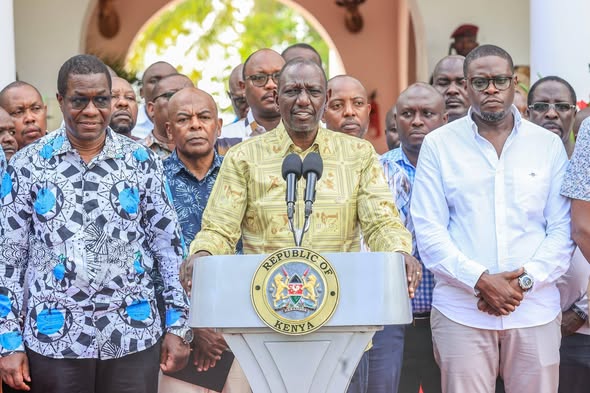
President William Ruto on Friday unveiled a raft of concessions to transport operators in a deal that persuaded operators to call off a looming nationwide strike.
At the centre of the deal is a further reduction in diesel prices, review of insurance and auction laws, protection of matatu graffiti culture and talks with banks over loan repayment relief.
The agreement followed hours of closed-door consultations between the President, Energy Cabinet Secretary Opiyo Wandayi and his Transport counterpart Davis Chirchir, Nairobi Governor Johnson Sakaja and leaders from the transport sector at State House, Mombasa, on Thursday evening.
Matatu operators had threatened fresh industrial action next week after a nationwide protest over soaring fuel prices paralysed transport services in major towns and cities earlier this month.
However, following the talks, the operators officially withdrew the strike notice, signalling a return to normal transport operations across the country.
The President announced that the government would further lower the price of diesel by Sh10 per litre in the June-July fuel review cycle.
The decision is aimed at cushioning consumers and businesses from the effects of rising global oil prices.
If implemented by the Energy and Petroleum Regulatory Authority, diesel prices in Nairobi will drop to about Sh222.86 per litre.
Ruto said the government had already spent billions of shillings through the Petroleum Development Fund to stabilise prices and shield Kenyans from the full impact of the global oil crisis triggered by tensions in the Middle East.
“These interventions have protected millions of Kenyans from even more severe economic hardship,” he said.
The latest fuel relief formed the centrepiece of the negotiations with transport operators, who had demanded a reduction of between Sh30 and Sh35 per litre following the sharp increase in diesel prices announced in the May 14 fuel review.
Epra had raised the price of super petrol by Sh16.65 per litre and diesel by Sh46.29, pushing pump prices in Nairobi to Sh214.25 and Sh242.92, respectively.
The increases sparked outrage among motorists and public transport operators, culminating in a two-day nationwide strike organised by the Transport Sector Alliance.
Thousands of commuters were left stranded as matatus, online taxi operators, cargo transporters and motorcycle riders withdrew services in protest over the rising cost of fuel.
Following Friday’s announcement, Matatu Owners Association chairman Albert Karakacha confirmed that operators had abandoned plans for further industrial action.
“We have called off the strike. We had suspended the strike, but we have called it off. We will not have a strike next week; we are going to work,” Karakacha said.
He said the government’s willingness to continue engaging transport stakeholders and address long-standing industry concerns had helped restore confidence within the sector.
Karakacha also credited Sakaja for mediating between operators and the national government during the crisis and helping avert prolonged disruption in Nairobi.
Beyond fuel prices, the President announced a series of structural reforms targeting challenges facing the transport industry.
Among the key measures is an immediate review of the Insurance Act and the Auctioneers Act within the next three months following complaints from matatu operators over delayed compensation claims, rising insurance costs and aggressive auction practices.
Ruto said the Ministry of Transport would work with the Insurance Regulatory Authority and other stakeholders to establish a more responsive framework for public service vehicle operators.
“There is a big issue about transport operators. Despite having insurance covers for their vehicles, passengers end up paying bills when accidents occur,” the President said.
“Insurance companies must understand that an insurance cover has to mean something when it is paid for by our transporters.”
Transport operators have for years accused some insurers of frustrating compensation claims through prolonged court battles, disputed liability claims and delayed settlements, exposing vehicle owners and passengers to heavy financial losses.
The government also pledged to intervene in the growing financial distress facing matatu owners who acquired vehicles through bank loans.
The head of state directed the Ministry of Transport to engage banks and financial institutions on possible temporary relief measures for operators struggling with loan repayments due to rising operating costs.
“The government of Kenya, through the Ministry of Transport, is going to engage financial institutions so that we can seek some relief for our transport sector as we all face the crisis ahead of us,” he said.
The President acknowledged that many operators risked defaulting on loans as fuel prices continue to eat into already shrinking profit margins.
Industry players had warned that continued financial pressure could trigger repossession of vehicles, fare hikes and reduction of transport services.
The deal also extended to Kenya’s ride-hailing sector, where digital taxi drivers have complained of exploitative pricing models and low earnings.
Ruto directed the National Transport and Safety Authority to engage transport network companies and drivers with a view to implementing minimum taxi fare regulations.
“Some of the people working in that space spend up to 16 hours daily just to sustain themselves,” he said.
In a move likely to excite matatu operators and youth in the transport industry, the President further directed NTSA to allow continued use of graffiti and artwork on public service vehicles.
“Recognising the important role of creativity and self-expression within our transport culture, I have directed NTSA to facilitate an enabling environment for matatu operators to continue utilising artwork and graffiti on their vehicles.”
The directive comes months after court battles over regulations governing graffiti, decorative lighting and tinted windows on matatus.
Ruto defended the government’s broader fuel management strategy, arguing that the current crisis was largely caused by global geopolitical tensions rather than domestic policy failures.
He said the conflict involving Iran had disrupted global oil supply routes and triggered one of the biggest energy shocks in recent years, affecting countries across the world.
The President also rejected calls for the complete removal of fuel taxes and levies, warning that such a move would cripple public services and infrastructure programmes.
“Do we stop funding roads, fertiliser subsidies, hospitals and schools?” he posed.
He maintained that the government-to-government fuel import arrangement introduced in 2023 had helped stabilise fuel supply and shield the economy from worse shocks.
At the same time, the President announced fresh measures aimed at reducing Kenya’s dependence on imported fossil fuels, including accelerated investment in electric mobility.
Ruto revealed that the government had ordered 3,000 electric vehicles for security and administration officers and declared that the first 100,000 electric vehicles imported into Kenya would be duty-free.
INSTANT ANALYSIS
President William Ruto used the fuel crisis to secure a political and economic truce with transport operators by combining immediate relief measures with long-term promises. The diesel price reduction, review of insurance and auction laws, loan repayment talks and protection of matatu graffiti culture addressed operators’ key grievances beyond fuel costs. The deal helped avert another nationwide shutdown, restored transport services and allowed the government to project responsiveness amid growing public anger over the high cost of living.