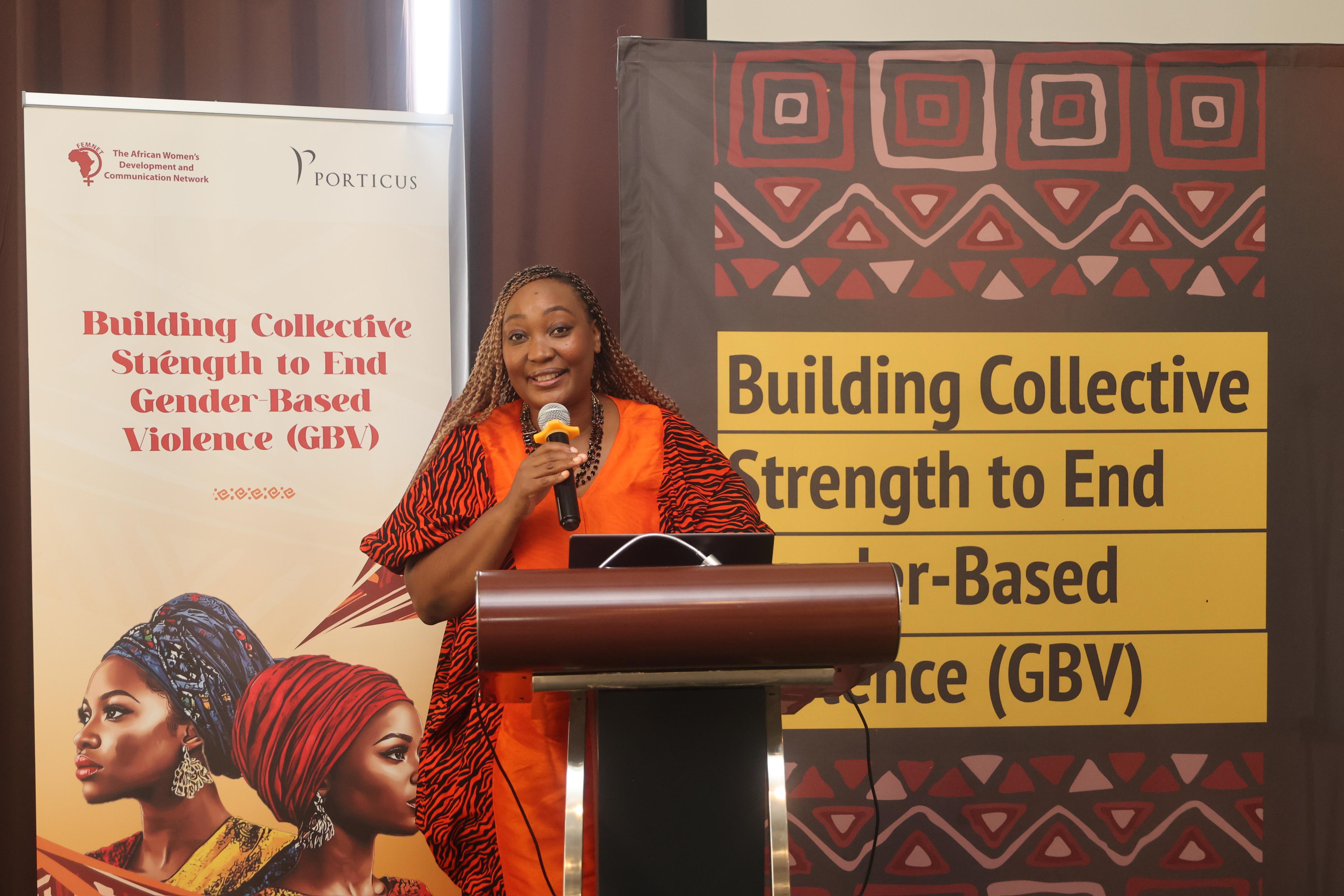
 Shanice Khaoya is a Gender and Development Studies student at the University of Nairobi who advocates for gender-based violence prevention, digital rights, and human rights./HANDOUT
Every day, there is a new case. Every day, a new name, a new story, another woman. Across Africa, gender-based violence is not receding; it is escalating. Yet something is also shifting,women are waking up. They are refusing to call abuse a norm. They are naming what was once unnamed; the silence is breaking.
In this moment when cases keep coming and silence keeps breaking, women's rights organisations and feminist movements from across the African continent have chosen to draw a line. Convening under Bold Circles, a multi-country feminist solidarity initiative supported by Porticus FEMNET (the African Women’s Development and Communication Network) brought together women's rights organisations and feminist actors from more than 15 countries for a three-day in-person gathering in Nairobi.
The shared aim is to strengthen collective knowledge on gender-based violence prevention, survivor-centred advocacy, and feminist legal approaches and to finalise a Shared African Feminist Gender-Based Violence (GBV) Action Agenda that movements across the continent could own, endorse, and act on together.
“We are not here merely to discuss the problem,” said Dr Phyllis Kedibone Chembe, a scholar in transformation and language at Walter Sisulu University. “We are here to share lived experiences and best practices, to galvanise one another, and to forge the partnerships necessary to confront this crisis head-on. Our goal is not simply to reduce gender-based violence; it is to eradicate it entirely.”
The stakes demand it. When women from Kenya to Nigeria to Libya are facing the same violence, the response cannot be scattered. It has to be collective; it has to be African.
But what does a continental agenda actually mean for a woman who has never seen gender-based violence named, challenged, or taken seriously in her own community? For the activists on the ground, it starts with people.
“Gender-based violence is not just a women’s issue; it involves every single person,” said Eunice Lumumba, a communications manager at Women Volunteers for Peace, Kenya. That means religious leaders, young men, families, entire communities. The agenda, Dr Chembe explained, only works when it reaches the grassroots, not just in policy language but in lived reality.
“It means that the woman in a rural village in Kenya, the activist in the townships of South Africa, and the survivor navigating fragile systems in the DRC are all covered by a unified framework of action, advocacy, and accountability.”
She added, "A unified agenda must never mean a uniform agenda. The agenda is developed from above, but it is built from below, shaped by the lived realities of women across the continent.”
Building one unified agenda across a continent as vast and diverse as Africa is not without its tensions. Culture remains one of the deepest obstacles. “Challenging harmful cultural norms feels, to many communities, like an erasure of identity itself even when those norms are fuelling gender-based violence,” said Eunice Lumumba, a communications manager at Women Volunteers for Peace. Harmful norms do not exist in isolation; they are held in place by patriarchal structures, religious institutions, and community silence.
The challenge runs deeper still. Across the continent, there is a vast gap between progressive laws on paper and the violent reality women face daily. “If a woman in a rural village or an informal settlement cannot access justice or protection, our agenda has failed,” said Daverose Mary Musuruba Tholley, vice chair for girls and young women on the FEMNET Board, speaking from her experience across conflict-affected regions.
The agenda, she insisted, must translate into local protection networks, clear legal guidance, and communication in local languages, including for communities with limited digital access.
There is also the threat that comes not from open opposition, but from within institutions themselves. “When feminist language is adopted by governments and institutions without feminist values, without accountability, and without the participation of the women most affected, the agenda is hollowed out,” Dr Chembe warned.
“Words like ‘gender equality’ and ‘women’s empowerment’ become decorative used solely to satisfy reporting requirements rather than drive real transformation.”
There is also the backlash; the civic space is shrinking and state crackdowns are intensifying. Increasingly, the fight has moved online through targeted digital harassment, account takedowns, doxxing, and coordinated pile-ons designed to silence feminist activists.
The biggest threat, participants at the convening agreed, is this combination: shrinking civic space, state crackdowns, and a massive organised backlash against women’s rights.
Yet even against this, there is determination.
“I have hope,” said Zeynab Abdille Hassan, who travelled from Ethiopia, where she founded the Mother and Child Development Organisation to support women and children in crisis. Sometimes, that is where collective power begins: accountability, not words.
Gathering is one thing; staying accountable is another. Organisations leaving this convening are walking away with a shared agenda they have collectively owned and endorsed.
“Collective action, commitment, and accountability for all will ensure one unified agenda,” said Zeynab. On the ground, that accountability has to be real and immediate.
“We need to replace slow, paper-heavy follow-ups with real-time solidarity knowing exactly who is doing what, where the bottlenecks are, and when a sister organization needs urgent resources or backing,” said Daverose
Collective feminist power in Africa today looks like this: women from over 15 countries, speaking different languages, carrying different wounds and different victories, choosing to sit together, think together, and act together. It is intergenerational , continental and it is determined.
“Gender-based violence will no longer be a crisis we are managing,” said Dr Chembe.
“It will be a chapter of history we have closed.” That chapter is not closed yet. But in Nairobi, a line has been drawn.
The writer is a Gender and Development Studies student at the University of Nairobi