He has spent the last seven years standing in other people's discarded wardrobes. Kantamanto market in Accra, where the Global North's unsold fast fashion arrives by the container, has in his hands become something else: a small, stubborn economy of upcycled work that has already pulled more than a million garments out of Ghana's landfills.
Last year, TIME named him one of the hundred most influential climate leaders alive. The H&M Foundation, whose industry he is in effect indicting, gave him its Global Change Award.
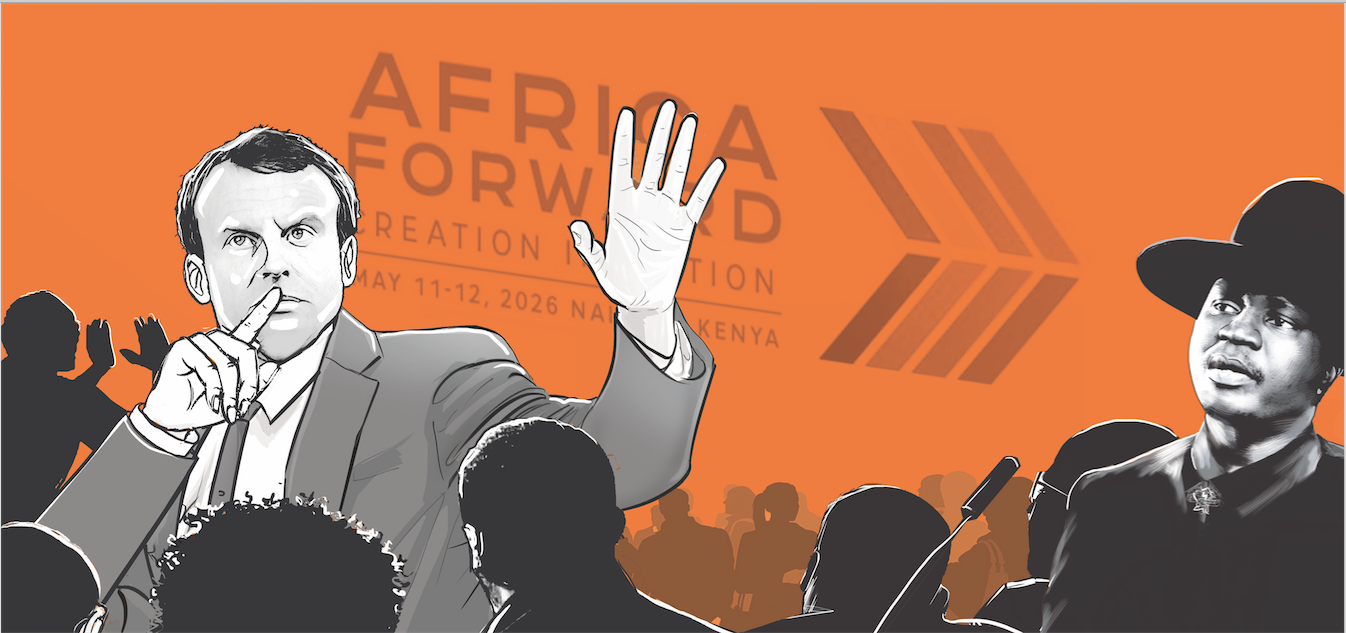
On Monday, he was flown into Nairobi, sat down at the Africa Forward Summit, and handed a microphone to speak about our culture, our innovation, our continent's answers to its own problems.
The room would not listen.
His name is Yayra Agbofah, and he was not alone on that stage. The panel around him was filled with other young African creatives and innovators, the kind of people the summit had been built to showcase, and the kind the audience would not quiet down for.
This is the most overlooked detail of the Macron moment in Nairobi, and it is also the most important.
The people Emmanuel Macron asked the room to listen to, at the summit Kenya was hosting, were Africans. Macron, awkwardly and uninvited, stood up and asked the audience to give its own people the floor.
The session's moderator, Marie Lora-Mungai, has since said publicly that the room was indeed too loud and that the moment has been widely misunderstood online.
Within hours, the online verdict had landed, and the verdict was about him. His tone. His manners. His nerve. Almost nothing was said about the audience that drowned out the speakers in the first place.
It is worth sitting with that asymmetry before we move on from it.
We had a panel of young Africans trying to be heard. We had a largely African audience that would not hear them. We had a foreign head of state, of all people, intervene to say these voices matter. And our response, as a continent online, was to be wounded by the intervention rather than by the indifference that made it necessary.
The discourtesy in that room was not Macron's. It was already in the air before he reached for a microphone. He simply named it. We have spent the days since performing offence at the naming, because the naming is easier to argue with than the thing named.
This is not a defence of Macron. France's record in Africa is its own long conversation, and on most days, I would happily have it. The CFA franc, the bases, the interventions, the choreography of a partnership Paris is only now beginning to unlearn. All of that is real. None of it was happening in that room on Monday. What was happening in that room was simpler and harder to admit.
Young Africans were speaking, and other Africans were not listening.
The instinct to reach for colonialism whenever a foreigner says something inconvenient is starting to do us a disservice. Colonialism explains a great deal about how we got here. It does not explain why an audience in 2026, in a free country, in a hall full of its own talent, could not be quiet for 10 minutes.
It does not explain the last two decades of governance on this continent either, and that is the conversation we keep avoiding by changing the subject to history.
Consider what the present actually looks like, closer to home first. According to the Kenya National Commission on Human Rights, at least 60 Kenyans were killed during the Gen Z protests of June and July 2024, with 74 forcibly disappeared in the months that followed and 26 still unaccounted for at the time of the commission's report.
The Saba Saba demonstrations of July 7, 2025, added at least 38 more deaths to the same commission's tally. None of those young people were killed by France.
The Finance Bill that put them on the streets was passed in our own Parliament. The unmarked vehicles that picked some of them up at night carried our own number plates. Two years on, families are still waiting for answers from a state that speaks their language.
The same is true of the slower, quieter violence of broken systems. Cancer patients have been turning up at the Kenyatta National Hospital oncology centre and being turned away because the Social Health Authority cannot generate an invoice in time, while the same drugs can be dispensed in 20 minutes at a private centre across the road.
The Kenya Network of Cancer Organizations has documented patient after patient locked out of chemotherapy because a presidential directive raising the oncology benefit has not been operationalised on the ground. These are not foreign decisions. They are ours.
Look further out, and the pattern repeats. In Cameroon last October, the Constitutional Council declared a 92-year-old Paul Biya the winner of an election his main opponent's own polling-station tally said he had lost, and at least 48 people were killed in the protests that followed.
In Sudan, a war between two of our own generals has killed an estimated 150,000 to 400,000 people and displaced more than 11 million, with United Nations investigators concluding that the fall of El Fasher in October 2025 bore the hallmarks of genocide. None of these men is French. None of them needed Macron's permission to ruin a continent's century.
The online mob did not assemble for any of them.
There is a reason for that, and it is worth being honest about. Distant villains are inexpensive. Macron is on a plane by Wednesday. He cannot deny a child a school place, end a tender, jail a cousin, or close a clinic.
The people who can do those things speak our languages and live on our streets. Aiming our anger at them carries a cost. Aiming it at him does not. So we aim it at him, and call the aim sovereignty.
The young people on that stage on Monday were the point. They deserved an audience and got a Frenchman instead, because we could not be bothered to be that audience ourselves.
The lesson we owe them, and ourselves, is not that foreigners should mind their manners on our continent. It is that we should learn to mind ours, especially toward each other, and especially toward the ones telling us something we need to hear.
We are not still being colonised. We are, in many places, being robbed by people we know by name, in languages we share, in institutions we built. That is a harder story to tell because it implicates us, but it is the true one.
And until we can spend our anger on the people actually doing the damage, the people doing it will keep doing it, undisturbed by our outrage and unbothered by our hashtags.
The microphone in Nairobi was always ours. We just kept handing it to the wrong person.