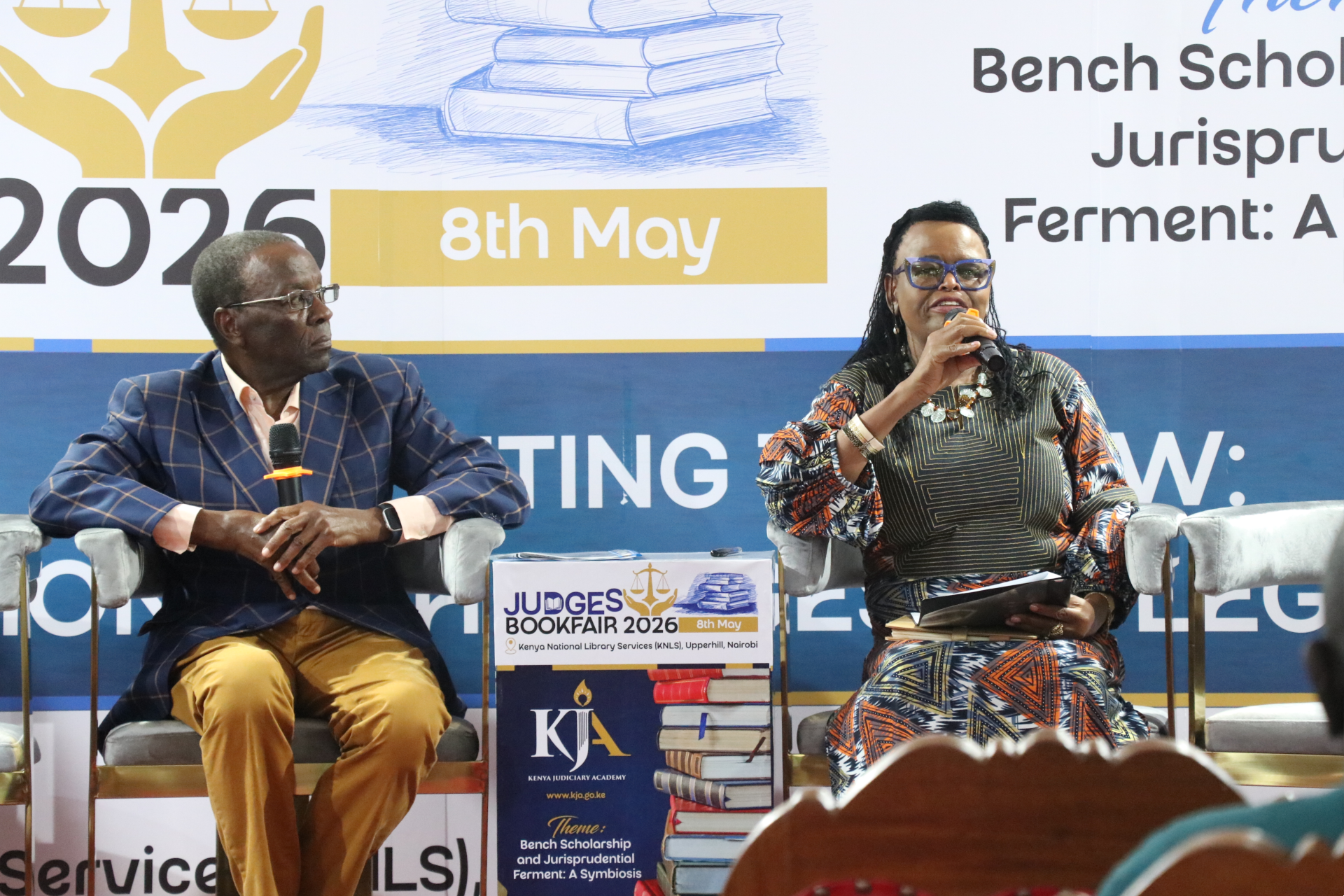
For a profession often associated with stern courtrooms, strict robes and tightly reasoned judgments, the sight of judges engaging the public through books and memoirs offered a rare and revealing contrast.
At the Kenya National Library Services building in Upper Hill, Nairobi, Kenya’s Judiciary staged its first-ever Judges’ Book Fair — a quiet but symbolic attempt to step out of legal formality and into public conversation.
The one-day exhibition brought together serving and retired judges, magistrates, legal scholars, students and members of the public, all gathered around something rarely associated with the bench: personal writing.
From memoirs and academic texts to reflections on justice, technology and society, the event turned pages into bridges between the Judiciary and the people it serves.
Opening the fair, Chief Justice Martha Koome described it as a deliberate shift in how the Judiciary presents itself to the public.
“For the first time in our Judiciary’s history, we are deliberately creating a platform where judges and judicial officers can engage the public not only through judgments delivered in courtrooms, but also through books, scholarship, memoirs, reflections and intellectual discourse,” she said.
Behind that statement lies a deeper institutional evolution — one that seeks to soften the distance between the Bench and the public, and to reposition judges not only as interpreters of law, but also as thinkers, writers and chroniclers of society.
Koome framed the initiative within the Judiciary’s Social Transformation through Access to Justice blueprint, which aims to make the justice system more accessible and responsive.
But on the ground, the fair felt less like policy and more like personality.
Judges who are often seen only through written rulings were now present as authors — discussing ideas, signing books, and engaging directly with readers.
The event also marked a cultural shift within the Judiciary itself.
Participants noted there was a time when judicial officers were discouraged from pursuing further academic writing. Now, scholarship is being actively encouraged and showcased.
That change was visible in the diversity of works on display.
From Supreme Court judge Smokin Wanjala’s writings to Justice Isaac Lenaola’s legal scholarship on complex areas such as reproductive rights and adoption law, the Judiciary is increasingly producing work that goes beyond court decisions and into legal thought leadership.
Justice Lenaola’s reflections, for example, have helped clarify sensitive legal processes such as adoption, including the importance of issuing new birth certificates while maintaining legal records — a technical area with deeply human consequences.
Elsewhere, Justice Charity Kipkorir explored digital trade and data protection, while Justice Wambui Macharia examined sentencing in relation to children and mothers — topics that reflect the changing social and technological landscape in Kenya.
One of the more reflective sessions, dubbed “Books and Bench Dialogue”, brought together Chief Justice Koome and retired Chief Justice Willy Mutunga.
Their discussion moved beyond law into philosophy — what it means for judges to write, and how writing changes the way justice is understood.
Mutunga drew a clear distinction between judgments and books, noting that while court rulings are constrained by facts and procedure, books allow judges to explore the deeper structure of law and society.
That idea echoed across the fair: that law is not only applied in court, but also interpreted, questioned and reimagined in writing.
Other judicial officers also used the platform to reflect on their journeys.
Justice Issack Hassan and Justice Hannah Okwengu shared memoirs that touched on institutional challenges and personal trials within the justice system — offering a rare glimpse into the human side of judicial service.
Beyond memoirs, the event also showcased academic works that connect law with everyday life.
From commercial law and criminal procedure to family law and succession, the Judiciary Authors Catalogue 2026 revealed a growing body of Kenyan legal scholarship.
Law Society of Kenya president Charles Kanjama, who attended the fair, welcomed the initiative but raised an important question about reach.
“As we write more, we need to ensure they are read more,” he said, underscoring a gap between production and public engagement.
That tension captures the broader challenge facing the Judiciary’s intellectual turn: visibility does not automatically translate into understanding.
Still, the fair offered something unusual — a Judiciary willing to be seen differently.
Not only as an institution of rulings and robes, but as a community of thinkers trying to explain themselves to the public in a different language: books, stories and ideas.
In many ways, the Judges’ Book Fair was less about literature alone, and more about trust — an attempt to make justice not only delivered, but also understood.
And in that sense, it was a reminder that behind every judgment is not just law, but a person trying to make sense of it.







Comments 0
Sign in to join the conversation
Sign In Create AccountNo comments yet. Be the first to share your thoughts!