

Somalia marked a significant political milestone on Sunday as South-West State conducted historic one-person-one-vote elections, while a small opposition protest unfolded quietly in parts of the capital, Mogadishu.
The contrasting scenes highlighted a country attempting to move beyond decades of political instability, clan-based power struggles, and conflict toward a more inclusive democratic system.
While a handful of demonstrators gathered in parts of Mogadishu to air grievances against the federal administration, voting activities in South-West State attracted widespread attention as residents participated in direct elections viewed as one of Somalia’s most important democratic developments in decades.
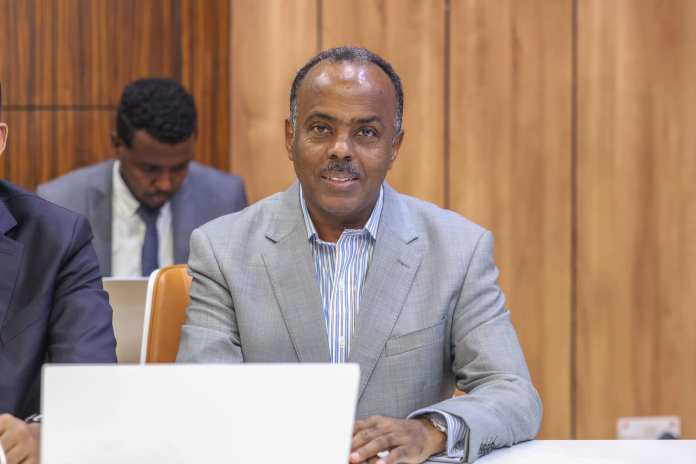
National Independent Electoral and Boundaries Commission Chairman Abdikarim Hassan praised the exercise, terming it a learning curve.
“We have pulled off another exercise where thousands came to select their leaders. It is a learning curve and we are on the right track,” he said.
The elections come weeks after similar one-person-one-vote polls were held in Mogadishu, marking a major shift from Somalia’s long-standing indirect electoral model, where clan delegates selected political leaders on behalf of citizens.
Political analyst Amad Muhammad said the developments reflected growing public support for democratic governance despite ongoing political tensions.
“Somalis are showing an increasing willingness to embrace democracy after decades of turmoil and uncertainty,” Amad Muhammad said.
“The fact that citizens are participating in direct elections while political disagreements remain largely restrained signals political maturity and hope for institutional progress.”
In Mogadishu, security remained tight but calm throughout the day. The opposition protests, which authorities had earlier warned could trigger instability, remained largely subdued, with only small gatherings reported in limited sections of the capital.
The federal government has continued to defend its electoral reform agenda, arguing that Somalia’s long-term stability depends on expanding direct public participation in governance.
Speaking during the elections, Somalia’s State Minister for Foreign Affairs Ali Omar Balcad reaffirmed the government’s commitment to universal suffrage.
“Somalia cannot be hijacked by those who fear the ballot box. The path forward is not confusion, pressure, or political hijacking; the right path is direct elections,” Balcad said.
Somalia has struggled for years to implement universal suffrage due to insecurity, political disputes, and weak state institutions following the collapse of the central government in 1991.
Most previous national elections relied on clan elders and delegates to elect lawmakers and leaders through indirect voting systems.
Recent electoral reforms pursued by the federal government aim to gradually transition the country toward a fully democratic system based on direct voting by citizens.
Authorities say similar direct elections are expected in other federal member states, including Galmudug State and Hirshabelle State, in the coming months.
Despite lingering tensions between the government and opposition leaders, Sunday’s developments were widely viewed as an important step in Somalia’s fragile democratic journey.







