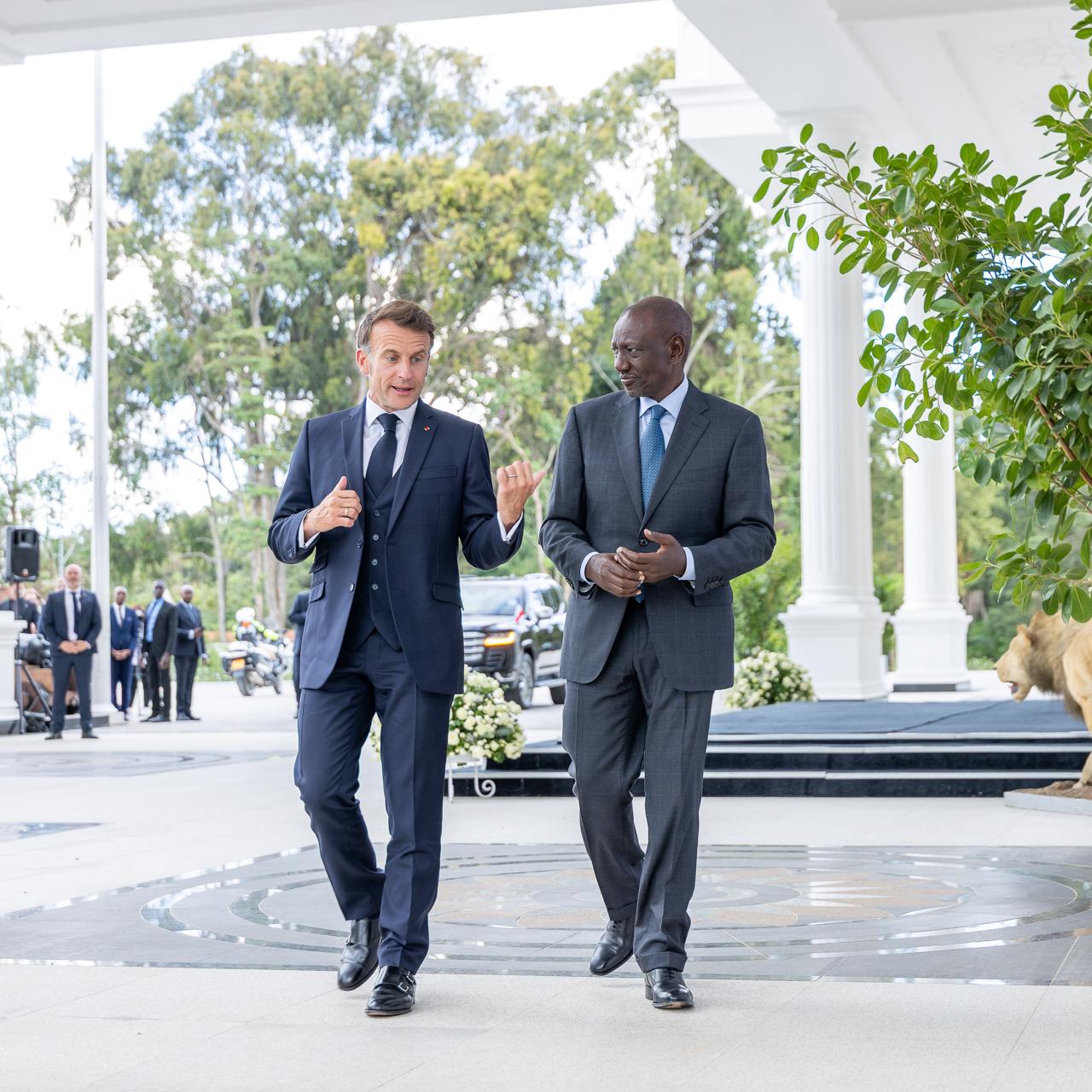
ALL eyes are on Kenya as it hosts the historic Africa Forward Summit, a two-day event that seeks to reset how African countries relate with France.
Already, more than 30 heads of state from the continent, senior French officials led by President Emmanuel Macron, investors, diplomats, and business leaders are in Nairobi for the high-level meeting starting today.
The forum, under the leadership of President William Ruto and his French counterpart, is expected to discuss trade, climate financing, infrastructure, security, and economic cooperation.
For President Ruto’s administration, the summit is more than a diplomatic gathering.
It is an opportunity to position Kenya as a regional economic powerhouse, attract fresh investments and strengthen Nairobi’s growing reputation as one of Africa’s leading diplomatic capitals.
The summit comes at a time African countries are demanding more equitable partnerships with global powers, while France seeks to redefine its role on the continent amid changing geopolitical dynamics and increasing competition from China, Russia, Turkey, the Gulf states and India.
Kenya has reaffirmed its commitment to delivering a world-class summit that positions Africa at the centre of conversations shaping the future of global growth, innovation, and partnerships.
Security has been beefed up in Nairobi and its environs as VVIPs, including President Macron, over 30 heads of state, the UN secretary general, the World Bank chief, top diplomats and business leaders follow major events at the University of Nairobi, KICC and a dozen other side events across the city.
Nairobi Regional Police Commander Issa Mohammud assured the public that security agencies have fully secured all venues linked to the event.
The police boss told the media that both uniformed and plain-clothed officers have been deployed across the city to ensure public safety and smooth movement during the summit.
Mohammud warned of temporary traffic disruptions that will affect major roads, including Mombasa Road, Thika Road, Kiambu Road and Limuru Road, depending on VVIP movements and security needs.
Several roads within the Central Business District have been closed. They include Parliament Road, Harambee Avenue and Taifa Road, with only conference vehicles accessing the Kenyatta International Convention Centre allowed passage.
Members of the public have been asked to avoid the affected areas and comply with traffic police directives throughout the summit period.
Access to some hotels and venues has been restricted as part of enhanced security operations.
Authorities urged motorists and travellers heading to the airport to plan their journeys well in advance to avoid inconveniences caused by the expected traffic snarl-ups.
The summit, which was first held in 1973 under French President Georges Pompidou, is designed to strengthen ties between France and African nations through political dialogue, economic partnerships and development cooperation.
Although the inaugural meeting held in Paris was designed to strengthen ties between France and its former African colonies, particularly in West and Central Africa, the meeting has, over the years, evolved from traditional diplomatic engagements into broader forums involving private sector players, civil society groups, innovators and youth representatives.
France has historically maintained strong political, military and economic ties with many African countries, especially in West and Central Africa.
However, changing political realities across the continent have pushed Paris to rethink its Africa strategy.
In recent years, anti-French sentiment has grown in parts of the Sahel, particularly in countries such as Mali, Burkina Faso, and Niger, where military governments have reduced cooperation with France and questioned its historical influence.
As a result, French President Macron has increasingly promoted what he describes as a “new partnership” with Africa based on investment, innovation, and mutual respect rather than dependency.
Kenya was chosen to host the event, marking a historic shift as it is the first time the event is being held in a non-Francophone nation, highlighting the country’s growing diplomatic and economic influence in Africa.
Nairobi is already home to major international institutions, including the United Nations Environment Programme and UN-Habitat, making it one of the continent’s most important diplomatic centres.
Today, UN Secretary General António Guterres is expected to break ground for a new conference facility and the inauguration of modern office buildings that will significantly expand the UN’s operational footprint in Africa.
The $340 million (Sh44.9 billion) expansion, approved by member states through the General Assembly, will transform Nairobi into one of the organisation’s most significant global hubs.
Kenya has also positioned itself as a gateway to East Africa through its relatively diversified economy, strategic transport infrastructure and expanding technology sector.
The decision to host the summit in Nairobi reflects a broader diplomatic shift in France’s engagement with Africa.
As Paris seeks to move beyond the colonial legacy tied to its former West African territories, it has increasingly turned toward East Africa in search of partnerships built on mutual respect and shared interests.
Nairobi, with its dynamic innovation ecosystem and English-speaking environment, symbolises this new direction in France-Africa relations.
Kenya’s growing influence on global issues also made it a strong choice for the summit.
Under President Ruto, the country has emerged as a leading voice on climate action and global financial reform.
Through the Nairobi Declaration, Kenya has pushed for a fairer global financial system while positioning itself at the centre of international climate discussions.
Increasingly, Kenya is helping shape global conversations rather than simply participating in them.
The summit also highlights the growing partnership between Kenya and France.
In recent years, the two countries have deepened cooperation in defence, infrastructure, renewable energy, transport, and trade.
What was once a largely economic relationship has steadily evolved into a broader strategic partnership with long-term regional and global significance.
Prime Cabinet Secretary and Foreign Affairs CS Musalia Mudavadi said the forum is expected to catalyse investment pipelines, commercial partnerships, financing opportunities, and technology transfer across various sectors.
"This will be the first summit of its kind to be hosted in Anglophone Africa - a significant milestone that reflects the broadening and deepening of Africa-France engagement across the continent," he said.
He added that the summit comes at a critical time when African countries are seeking stronger partnerships capable of addressing emerging global economic and geopolitical challenges.
"For Kenya, this is not simply another summit. The Africa Forward Summit represents a defining statement about where Africa is headed, how Africa intends to engage the world, and the kind of partnerships that must shape the future of global cooperation," Mudavadi said.
The summit’s agenda will focus on seven strategic thematic pillars shaping Africa’s future development trajectory, namely: green industrialisation and energy transition, reform of the international financial architecture, blue economy development, sustainable agriculture and food systems, Artificial intelligence and digital technologies, resilient health systems, as well as peace and security.
Under green industrialisation and energy transition, delegates will explore pathways for Africa to scale up renewable energy, decarbonise industry and build value chains that move the continent from raw-material exports toward higher-value manufacturing, emphasizing investments in clean power, grid resilience, and job-creating green industries.
Leaders are expected to press for changes to global finance — from IMF and World Bank frameworks to debt restructuring mechanisms and access to concessional finance — to improve liquidity, reduce the cost of capital for development projects, and expand financing channels for climate and infrastructure needs.
On the blue economy, coastal and island states will push for sustainable harnessing of marine resources, such as fisheries, ports, maritime logistics, and offshore energy, including conservation measures, blue-value chain development, and investments in coastal resilience and maritime security.
The Summit will highlight investments to boost productivity, climate-smart farming, agro-processing and supply-chain integration under AfCFTA, with a focus on reducing post-harvest losses, strengthening rural financing, and expanding regional trade in food staples.
Sessions will also examine digital infrastructure, data governance, skills development, and public-private partnerships to accelerate digital transformation, support tech startups, and ensure that AI applications are ethical, inclusive, and supportive of local industry.
Leaders present are also expected to address regional stability, counterterrorism cooperation, and security-sector reform, linking security investments to development outcomes and discussing ways to support governance and community resilience in conflict-prone areas.
A major highlight of the Summit will be the Africa Forward Business Forum at the University of Nairobi, expected to bring together more than 2,500 CEOs, investors, entrepreneurs, start-ups, SMEs, sovereign institutions, and policymakers in one of the largest Africa–France private sector engagements ever convened on the continent.
The Business Forum will feature CEO roundtables, investment announcements, business-to-business matchmaking, innovation showcases, youth entrepreneurship platforms, and sector-focused discussions covering infrastructure, logistics, AI, health manufacturing, creative industries, agriculture, connectivity, and clean energy.
French Ambassador to Kenya, Arnaud Suquet, has described the summit as a reflection of France’s commitment to building more balanced, forward-looking, and mutually beneficial partnerships with African countries, giving an example of ongoing bilateral projects and initiatives by France in Kenya.
“When it comes to education, France is heavily invested in the University of Nairobi. As part of the Summit activities, we are going to break ground on a new science and engineering complex within the Chiromo campus. This will be the state-of-the-art science centre of excellence in Kenya,” Suquet said.
According to the diplomat, France is the fourth largest Foreign Direct investor in Kenya with over 150 companies present in the country, employing more than 36,000 people.
He adds that this shows a lot of confidence in the French capital to build local manufacturing and production capacity in unlocking future growth opportunities through innovation, industrial cooperation, and sustainable investment.
The summit will culminate in the adoption of the Nairobi Declaration, expected to outline a new framework for Africa–France cooperation focused on implementation, accountability, and measurable impact.
The summit is coming at a time when regional nations are fully focused on African Renaissance, a comprehensive movement aimed at cultural, scientific, and economic renewal of the continent. It promotes self-determination, democratic governance, and sustainable development.
The continent is working towards overcoming colonial legacies, poverty, and conflict to foster a unified, prosperous Africa, often aligned with the African Union's Agenda 2063.
Under this agenda, the continent is rooting for a unified market under the African Continental Free Trade Area (AfCFTA) to deliver tangible benefits to 1.4 billion residents.
Ruto, who chaired the Inaugural Committee Meeting of Heads of State and Government on the Implementation of the African Continental Free Trade Area, Addis Ababa, Ethiopia, in February, believes that the AfCFTA lays the foundation for structural economic transformation, accelerating industrialisation, deepening value addition, and driving broad-based growth at a continental scale.
“Its potential is immense. Projections indicate that it could increase intra-African trade by up to $3 trillion and raise Africa’s cumulative GDP by about $1.4 trillion between 2021 and 2045.”
Africa-France bilateral trade is estimated at over €65 billion annually, with a relatively balanced exchange compared to some competitors.
Top African exports to France include crude oil and petroleum products, cocoa and coffee, uranium and other minerals.
Others are agricultural produce, including fruits and vegetables. France’s main exports to the continent include: machinery and industrial equipment, pharmaceuticals, medical supplies and transport equipment, including aircraft and vehicles.
Ruto will be taking Africa’s voice to the G7 Presidential Summit table in June to be held in France under Macron’s presidency.