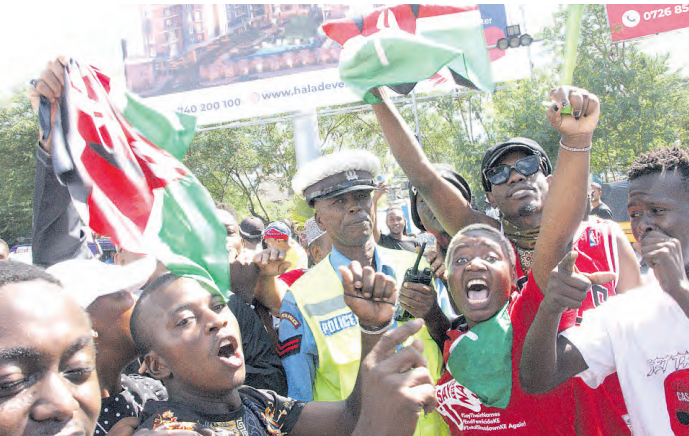
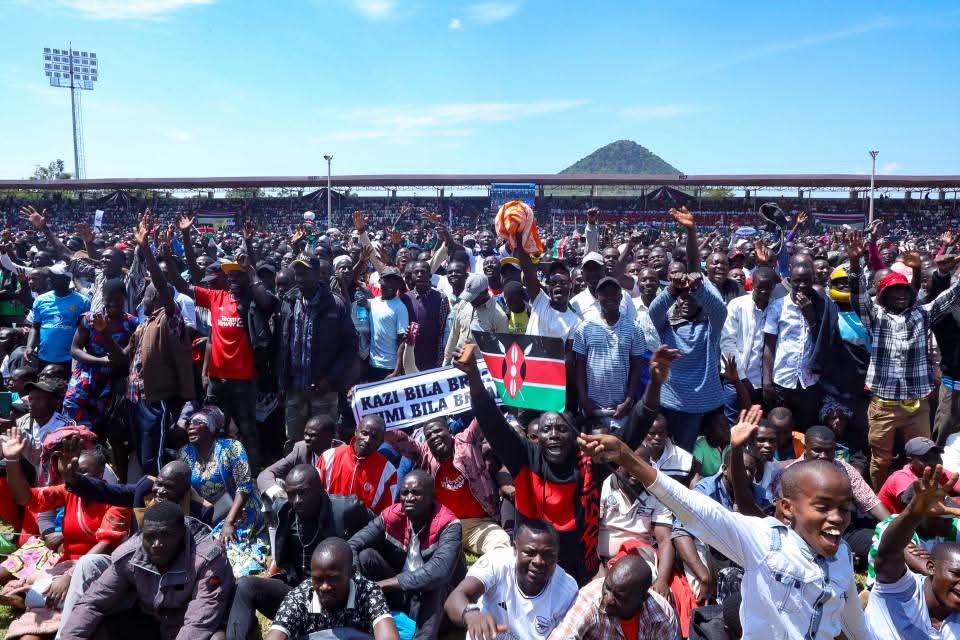
 Kenyans during the 62nd Madaraka Day celebrations at Raila Odinga stadium on June 1, 2025. Inflation, driven largely by food and transport costs, continues to erode household purchasing power /FAITH MATETE
The release of the Economic Survey 2026 should have been more than a statistical ritual. It is, in fact, a mirror - one that reflects not just the state of Kenya’s economy - but also the deeper contradictions between how our economy functions and how our politics is practised.
At first glance, the numbers appear reassuring. The economy grew by 4.6 per cent. Key sectors such as construction and mining posted recovery. Employment levels increased. Inflation, though present, remained within a manageable band. On paper, this is an economy that is stable, even resilient.
But beneath this surface lies a more troubling reality: Kenya is experiencing growth without meaningful transformation. And at the heart of this stagnation is a growing disconnect between economic realities and political choices.
The most striking feature of Kenya’s economy today is its dual nature. On one hand, there is a small, formal, high-income economy - structured, regulated and visible. On the other, there is a vast informal economy - comprising more than 18 million Kenyans - marked by vulnerability, low productivity and limited protections. This is where most livelihoods are found. It is also where most new jobs are being created.
Yet our politics does not reflect this duality. Policy frameworks, taxation regimes and regulatory systems are disproportionately designed around the formal sector, while political legitimacy is largely derived from the informal majority. The result is a system that extracts from the few who are visible while failing to protect the many who are not.
This is not merely an economic oversight - it is a political failure.
Consider the issue of job creation. Each year, Kenya celebrates the addition of hundreds of thousands of new jobs. But the Economic Survey makes it clear that the overwhelming majority of these jobs are informal. They lack stability, social protection and pathways for growth. What the economy requires is deliberate investment in productivity — through industrial policy, support to micro-, small and medium enterprises and value chain development, particularly in agriculture.
What politics offers instead are short-term, highly visible interventions: public works programmes, cash transfers and promises of employment that cannot be sustained fiscally. These may win votes, but they do not build economies.
Nowhere is this misalignment more evident than in the rising cost of living. Inflation, driven largely by food and transport costs, continues to erode household purchasing power. For ordinary Kenyans, the economy is not experienced through GDP growth figures — it is felt at the market, at the fuel pump and in the daily struggle to make ends meet.
Yet fiscal policy has moved in the opposite direction. Increased reliance on consumption taxes - particularly on fuel and basic goods - means that the burden of adjustment is being placed on the very households already under strain. In effect, the state is extracting more from citizens at the precise moment they can least afford it.
This raises a fundamental political economy question: whose interests are being prioritised?
Agriculture provides another telling example. It remains the backbone of livelihoods for a majority of Kenyans, yet its growth remains modest. While political discourse frequently invokes the plight of the farmer, policy attention has been episodic and often reactive - focused on subsidies and short-term relief rather than long-term structural transformation. Issues of market access, storage, value addition and climate resilience remain inadequately addressed.
The sector that sustains the majority does not shape the priorities of governance. That, too, is a disconnect.
Then there is the question of public debt. With the debt stock now exceeding Sh11 trillion, Kenya faces significant fiscal constraints. Debt servicing continues to consume a growing share of public resources, limiting the government’s ability to invest in critical sectors such as health, education and social protection.
But beyond the numbers lies a deeper democratic concern. Decisions around borrowing have largely been Executive-driven, with limited public participation or accountability. Citizens are now being asked to bear the cost of choices they had little role in shaping. This undermines not just economic sustainability, but democratic legitimacy itself.
Even in social sectors, the pattern persists. The strain in health financing systems points to a broader issue: social protection in Kenya remains fragmented, underfunded and often politicised. Rather than being built as a coherent social contract between the state and its citizens, welfare programmes are too often deployed as instruments of political messaging.
Taken together, these trends point to a single, overarching conclusion: Kenya’s economic structure has evolved, but its political logic has not kept pace.
The economy is complex, unequal and increasingly constrained by structural challenges. It requires leadership that is responsive, evidence-based and willing to make difficult, long-term decisions. It demands policies that prioritise productivity over optics, inclusion over expediency and sustainability over short-term gain.
What we have instead is a political system that remains largely personality-driven, electorally reactive and focused on immediate redistribution rather than structural transformation.
The Economic Survey 2026, therefore, should not just inform policy — it should provoke reflection. It should compel us to ask difficult questions about the kind of leadership we need, the nature of our political incentives and the future we are building.