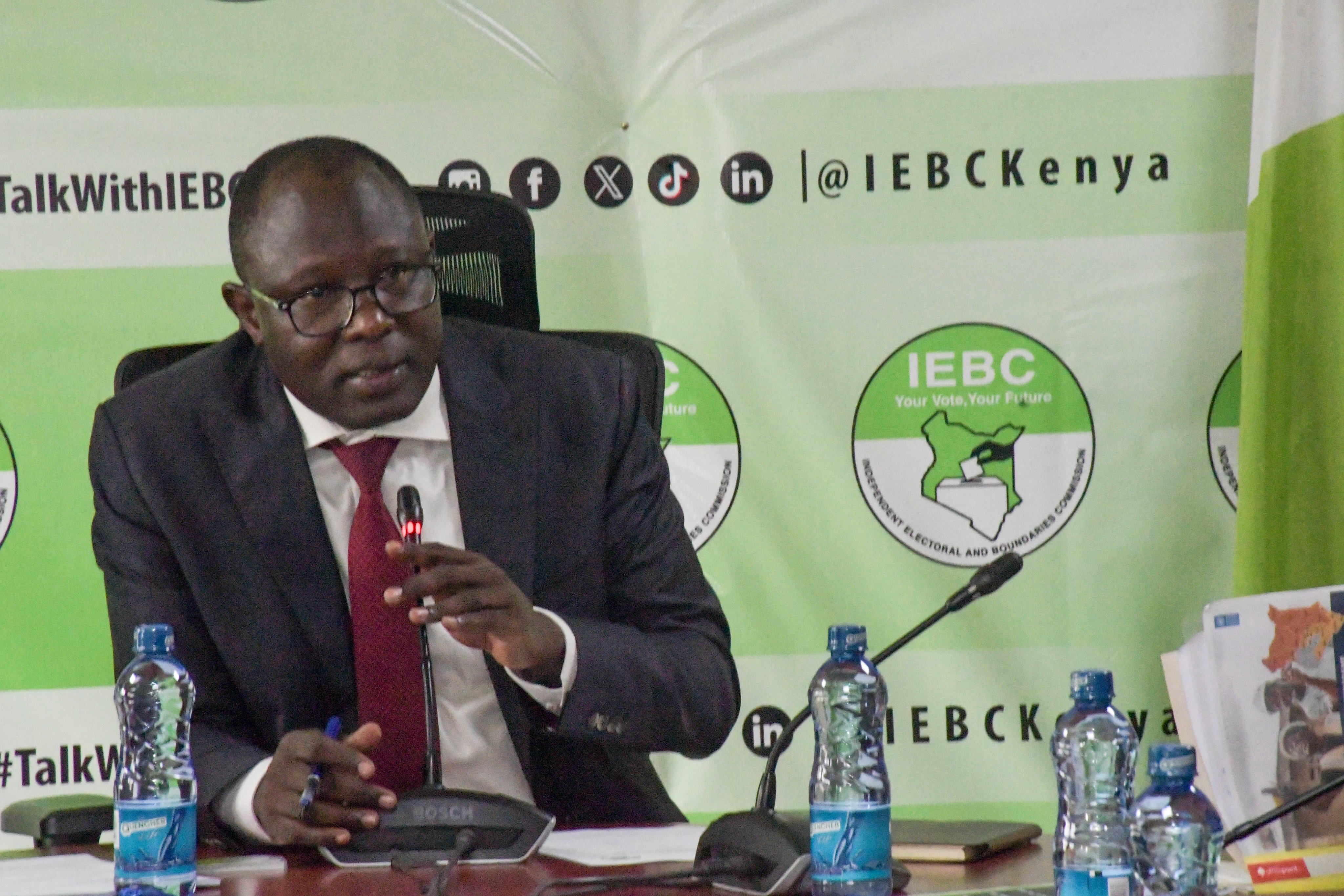
The Independent Electoral and Boundaries Commission has defended its decision to share voter-related data with state agencies and private contractors.
In a data privacy notice, the Erastus Ethekon-led commission said the arrangements are lawful, necessary for election management and protected under data protection laws.
The commission’s explanation comes amid heightened political pressure and allegations by opposition leaders that collaboration between the IEBC and government agencies could compromise the integrity of the 2027 General Election.
In the newly released privacy framework, the IEBC details the circumstances under which it shares personal data collected from voters, candidates, election officials, and other stakeholders.
The commission says data may be shared with government agencies such as the National Registration Bureau, Civil Registration Services and the Directorate of Immigration Services.
The primary aim, the IEBC says, is identity verification and the maintenance of an accurate voter register.
The commission adds that certain information may be disclosed to law enforcement agencies where required by law.
A case in point was in 2013 when the IEBC worked with agencies for a forensic analysis of Kethi Kilonzo's private documents, including her ID and passport.
Contracted service providers involved in election technology and logistics may also access the data under strict confidentiality agreements.
The IEBC insists that the arrangements are routine and grounded in the law.
“IEBC processes personal data lawfully under constitutional and statutory obligations,” the commission said, adding that all information is safeguarded.
In February, DP leader Justin Muturi accused the IEBC of entering into a ‘secret’ Memorandum of Understanding with the Office of the President, alleging that the arrangement could expose voter data to manipulation.
Muturi claimed the IEBC top officials’ meetings with the National Registration Bureau could be used to influence the election through manipulation of national identity records.
The Democratic Party leader demanded immediate disclosure of any data-sharing agreements between the IEBC and state agencies.
He also called for the electoral body to withdraw from any joint task forces that could undermine its independence.
At the time, the IEBC strongly denied the allegations, insisting that its engagement with agencies such as the National Registration Bureau was limited to legally mandated verification exercises.
It said the exercises were intended to clean up the voter register by identifying duplicate records and removing deceased persons.
The commission maintained that it retains exclusive custody and control of the voter register.
However, the issue has refused to fade from public debate, especially amid opposition leaders’ concerns.
The IEBC holds sensitive biometric data, including fingerprints, facial images and iris scans collected during voter registration.
For critics, while inter-agency cooperation may be legally permissible, there is a need for detailed public disclosure on how data is accessed, shared and protected.
By April, Muturi and his colleagues had intensified their push for reforms. They called for a forensic audit not only of the voter register but also of the population master register.
The IEBC, however, said data-sharing arrangements are standard administrative procedures.
It reiterated its commitment to conducting credible elections and complying with constitutional obligations.
Under the commission’s framework, contractors and service providers who access voter information are required to operate under strict confidentiality and non-disclosure agreements.
The electoral body also insists it does not sell, lease, or commercially exploit personal data under any circumstances.
The renewed scrutiny now places pressure on the IEBC to not only defend the legality of its data-sharing practices.