 Dennis
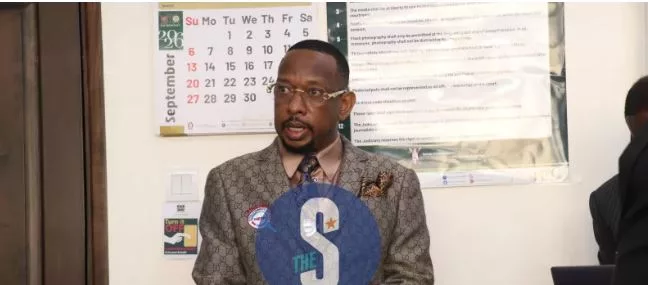
Beesigamukama from ICIPE talks about promotion of edible
insect technologies for food security, income generation, livelihood
enhancement and climate resilience./AGATHA NGOTHO.
Dennis
Beesigamukama from ICIPE talks about promotion of edible
insect technologies for food security, income generation, livelihood
enhancement and climate resilience./AGATHA NGOTHO. Dennis
Beesigamukama from ICIPE eats cookies made from locust flour./AGATHA NGOTHO.
Dennis
Beesigamukama from ICIPE eats cookies made from locust flour./AGATHA NGOTHO.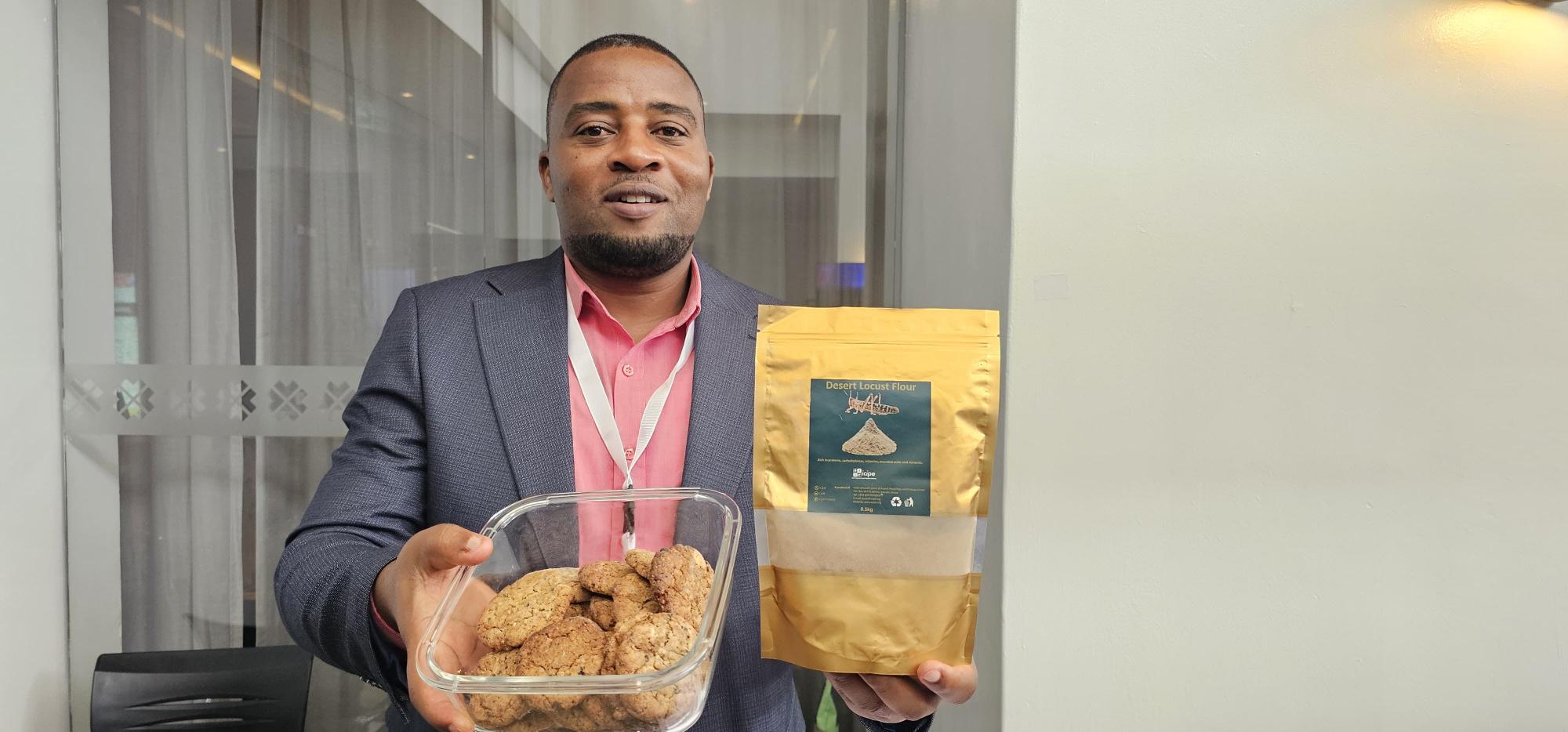 Dennis
Beesigamukama from ICIPE with locust flour and locust cookies./AGATHA NGOTHO.
Dennis
Beesigamukama from ICIPE with locust flour and locust cookies./AGATHA NGOTHO.
Did you know that the desert locusts that devastated Kenya in 2020 are now finding their way onto our tables as a nutrient-rich delicacy?
What was once feared as a destroyer of crops is now appearing on Kenyan tables, not as a swarm, but as cookies, flour and fortified foods.
At the heart of this transformation is research by scientists at the International Centre of Insect Physiology and Ecology (ICIPE), who are pioneering edible insect technologies as a solution to food insecurity, malnutrition and climate stress.
Dennis Beesigamukama, a postdoctoral fellow at ICIPE, said they are conducting research under the Insects for Food, Feed and Other Uses programme to promote edible insect technologies for food security, income generation, livelihood enhancement and climate resilience.
The focus of the programme may sound unusual, but it is grounded in science and culture. Across Africa, insects are already part of traditional diets. What differs is which insects are consumed and how they are prepared.
“We normally start by doing an inventory of insects consumed in different communities, then assess their nutritional value, safety and biology,” says Beesigamukama.
“After that, we develop simple technologies for mass production.”
One of the most surprising candidates is the desert locust, an insect historically associated with famine and destruction.
“Why the desert locust? Because it is very destructive, yes, but it is also rich in nutrients our bodies require. These include proteins, minerals, vitamins, and omega-3 and omega-6 fatty acids,” he explains.
According to the Food and Agriculture Organization, edible insects can contain up to 70 per cent protein by dry weight and are considered among the most environmentally sustainable sources of animal protein.
At ICIPE laboratories, locusts are no longer just fried whole. They are dried, milled into fine powder and blended into everyday foods.
“You can fortify bakery products such as bread, chapatti and cookies, or even porridge and dairy products. The aim is to improve nutritional quality without changing taste or appearance,” says Beesigamukama.
One of the most striking innovations is locust-fortified cookies. Adding just five per cent insect powder can raise protein levels from 7 to 20 per cent, while also boosting minerals and essential fatty acids.
“These nutrients are important in addressing lifestyle diseases and malnutrition,” he says, adding that the powder form also solves the challenge of acceptability.
“Some communities have a phobia of eating insects directly,” he says. “But when we convert them into powder and integrate them into familiar foods, acceptance increases significantly.”
Beyond locusts, researchers are working with crickets, black soldier flies and mealworms for both food and animal feed.
Kenya already has a long history of insect consumption, including termites and grasshoppers, but most harvesting has been seasonal and dependent on nature.
“This carries the challenge of seasonality. That is why we are shifting from wild harvesting to captive mass production to ensure year-round availability,” Beesigamukama said.
In north-eastern Kenya, in counties such as Isiolo, Turkana, Samburu and Laikipia, ICIPE is implementing projects such as “Eat the Locust”, aimed at turning past invasions into economic opportunity.
“We are developing environmentally friendly harvesting and production systems so that insects can be processed into powders for food and feed,” he says.
The innovation is also reaching vulnerable communities. In Kakuma refugee camp and in settlements in Uganda, farmers are being trained to rear insects as a source of both nutrition and income.
“We give farmers starter insects, train them and support them with rearing structures and technical guidance,” says Beesigamukama.
“The goal is to turn insect farming into a sustainable business while improving diets. Insects are a natural feed for animals as well, so they are useful for poultry and livestock production.”
He points out that one concern often raised is safety, especially the fear of escaped locusts becoming destructive again, but this, he says, is being carefully managed.
“We have designed controlled rearing systems that prevent escape and we work with regulatory agencies such as the Kenya Bureau of Standards to ensure safety,” he said.
On cultural acceptance, he notes that insect consumption is already part of African food heritage.
“What varies is which insects are eaten by which communities. Our role is to build on that tradition, not replace it. When people see locust cookies, they ask questions. But once they taste them, curiosity turns into acceptance,” he says.
He recalls a pilot session in Isiolo where pastoral women and girls consumed all the locust cookies and even asked to take more home.
“Demand is actually higher than supply in some areas,” he notes.
For researchers, the message is simple: edible insects are not a curiosity; they are a solution.
Beesigamukama says food systems are changing because of the challenges we face.
“We must adapt. Insects should not be seen as food for the poor, but as a sustainable source of nutrition for everyone. This is food for people who want to be food secure, healthy, and resilient,” he says.