 Selina Nkoline, a farmer from Narok, who doubles
up as Indigenous Maasai leader and founder of Nashipai Maasai Community
Projects during a side event at the launch of the
EAT–Lancet Commission 2.0 Report at the Africa Exchange Kenya forum. /AGATHA NGOTHO.
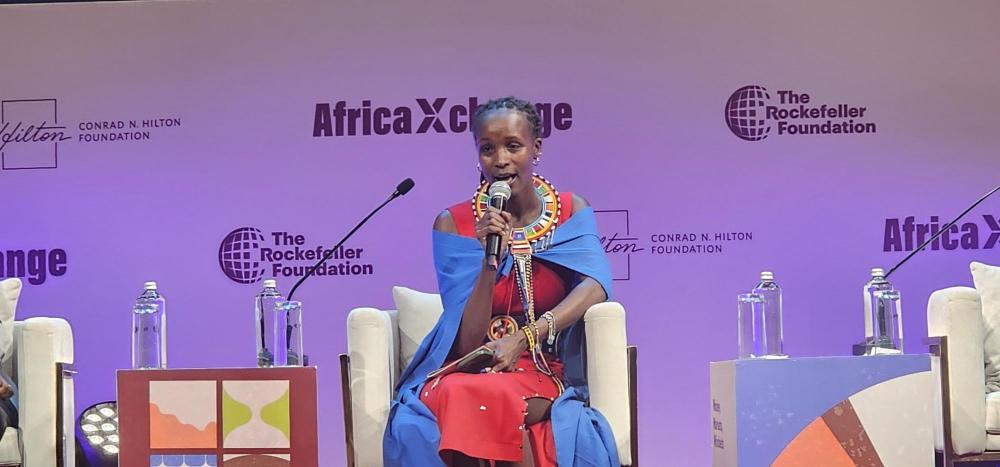
Selina Nkoline, a farmer from Narok, who doubles
up as Indigenous Maasai leader and founder of Nashipai Maasai Community
Projects during a side event at the launch of the
EAT–Lancet Commission 2.0 Report at the Africa Exchange Kenya forum. /AGATHA NGOTHO.
African countries must urgently address production gaps, poor nutrition, and the pressures of a rapidly growing population through coordinated action if they are to build sustainable food systems, experts have said.
Alliance of Bioversity International and CIAT Africa Managing Director Wanjiru Kamau-Rutenberg noted key challenges facing the continent, including persistent production gaps, malnutrition, and rapidly expanding populations.
Wanjiru said at the heart of The Alliance’s work are systems adapted to African contexts that are geared towards supporting both people and the planet.
This, she noted, generates practical, actionable science to navigate real-world trade-offs and ensure it informs policy, investment, and community impact through strong partnerships.
“What has emerged from the discussions here is clear, that no single institution can transform food systems alone; progress depends on collective action, and Africa is not waiting to be included but is actively shaping the global conversation," said Wanjiru.
She spoke during a side event at the launch of the EAT–Lancet Commission 2.0 Report at the Africa Exchange Kenya forum.
The event brought together policymakers, scientists, and development actors from across the globe to address growing pressures on food systems, including climate shocks and rising food prices to widening inequality.
“What the EAT-Lancet 2.0 brings is not just evidence. It brings a way to think differently. So, the pathways we design must reflect those realities. That means making decisions that are grounded in evidence but also in lived experience,” Wanjiru added.
Participants noted that sustainable food systems pillars including health, environment, justice, modelling, and transformation are global in scope, and that their implementation in Africa must be grounded in local realities, cultures, and ecosystems.
According to Selina Nkoline, a farmer from Narok, who doubles up as Indigenous Maasai Leader and Founder of Nashipai Maasai Community Projects, Indigenous African communities play a key role towards ensuring access to ample and healthy foods in Africa.
“As the Maasai community, we have enough resources especially land, but we need partnerships to educate the community on the most ideal and applicable farming technologies,” she said.
Nkoline explained how she was among the first girls from her village to access formal education, and that having been born in a typical pastoralist family, she had not experienced farming, at least until she learnt agriculture at school.
She has since established a food forest in the same school she studied, not just as a way of giving back to community, but also a way to prove that indeed farming is ideal and possible in the arid.
“We also have women and youth most of whose potential is underutilized yet can be trained on sustainable food production systems,” said Nkoline.
International Livestock Research Institute (ILRI) Director General and Representative to Ethiopia Dr. Namukolo Covic pointed out the need to make healthy food accessible, and sustainably produced to conserve the environment. This way, she noted, there would be enhancement of not just the health of the current population, but a better planet for the future generations.
“Even if we did everything else right like mitigated against use of fossil fuels and stopped using harmful chemicals but ignored intervention along food systems, we still would not have a sustainable planet,” said Namukolo, who is also an EAT-Lancent Commissioner.
The participants noted that food systems are both a major contributor to global challenges and a powerful entry point for solutions, hence transforming them offers an opportunity to simultaneously address climate change, improve health outcomes, and reduce inequality.