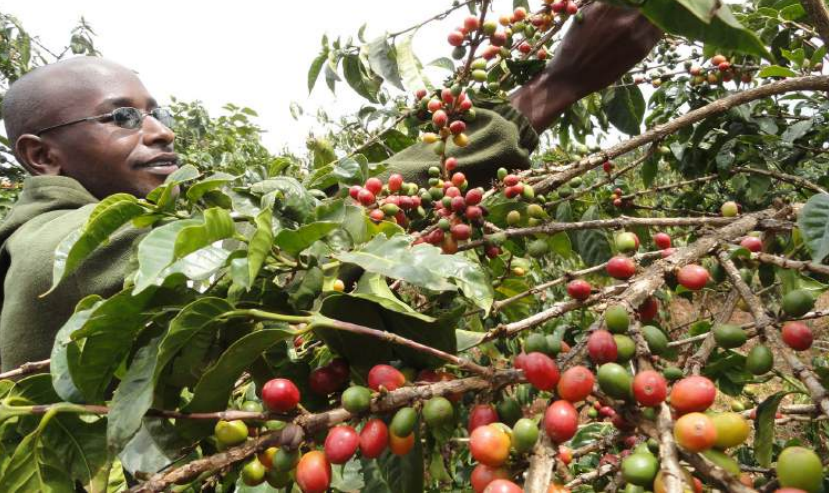
 A farmer
harvests
coffee at his
farm in Othaya,
Nyeri county
/FILE
A farmer
harvests
coffee at his
farm in Othaya,
Nyeri county
/FILE
Coffee production has continued to grow, lifting the incomes of thousands of farmers across the country, the Economic Survey 2026 shows.
Production rose to 51.4 thousand tonnes in the 2024-25 season, pointing to a gradual recovery in the sub-sector.
It is one of the few crops experiencing a boom in both production and prices across the country.
“Coffee production increased from 49.5 thousand tonnes during the 2023-24 cropping season to 51.4 thousand tonnes in the 2024-25 cropping season,” the report shows.
Coffee prices have risen sharply, from $35 per kilogram in 2024 to $60 in 2025 and now a record $120 in 2026, according to the African Coffee Trade Fair (ACT) 2026.
The Economic Survey, released in Nairobi on Wednesday, shows that farming slowed in 2025 due to changing weather patterns.
The sector grew by 2.8 per cent to Sh1.75 trillion in 2025, slower than the 4.3 per cent growth recorded in 2024.
“This slower growth is largely linked to uneven rainfall during the year, with some areas receiving too much rain and others too little, affecting overall farm production,” the survey stated.
According to the Kenya National Bureau of Statistics, the year was marked by above-average long rains and below-average short rains, resulting in mixed crop performance across the country.
Maize production recorded a modest increase of 2.4 per cent to 45.8 million bags, while potatoes and millet recorded notable growth of 13.6 per cent and 14.3 per cent respectively.
However, bean production declined sharply from 8.4 million to 7.4 million bags, reflecting the uneven weather impact on food crops.
Cash crops recorded mixed results during the year.
“Tea production declined by about eight per cent, while sugarcane output dropped sharply by 24.7 per cent to 7.05 million tonnes. Wheat production also fell by 18.2 per cent, reducing overall supply even as imports slightly eased,” the survey showed.
Horticulture stood out as one of the best-performing areas, with export volumes increasing by 13.8 per cent to 457.9 thousand tonnes, while earnings grew by 5.3 per cent to Sh143.8 billion.
“Cut flowers drove much of this growth, with export volumes jumping 27.4 per cent and earnings reaching Sh81.3 billion, reflecting strong demand in international markets,” it read.
However, earnings from vegetable exports fell by nine per cent to Sh21.3 billion, weighed down by compliance challenges, including Maximum Residue Level breaches that triggered export interceptions in key markets.
Export prices for major farm commodities moved in different directions during the year, according to the Economic Survey 2026.
“Coffee prices rose sharply by 35.9 per cent to Sh975 per kilogramme, while tea prices dropped by 5.2 per cent to Sh286 per kilogramme,” it read.
“Maize prices also increased by 23.2 per cent, showing recovery from the previous year. Wheat flour export prices jumped by 42.1 per cent, but fish prices fell significantly by 27.8 per cent.”
Rice production improved by 6.4 per cent to 303.7 thousand tonnes, supported by expanded irrigation acreage, highlighting the growing importance of irrigation in stabilising output.
In the livestock sector, milk production rose by 3.5 per cent to 5.5 billion litres, while marketed milk increased by over 11 per cent to just above one billion litres, reflecting stronger formal sector uptake.
The survey pointed to the growing vulnerability of Kenya’s agriculture to climate variability.
Food security experts have warned that, without greater investment in climate-smart farming and irrigation, production volatility could persist.
Overall, the survey showed gains in horticulture and select food crops, which provided some cushion, but noted slower sector growth due to mounting pressure from unpredictable weather.