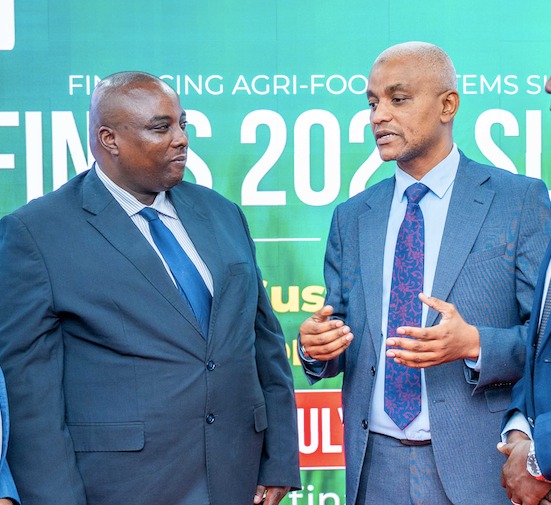
 Agricultural Finance Corporation (AFC) Managing Director George Kubai engages with Secretary of Administration in the State Department of Agriculture Rashid Khator during press briefing on the upcoming agri-food summit./HANDOUT
Thousands of stakeholders from across government finance, development, and the private sector are set to convene in Nairobi for a key summit seeking to unlock sustainable finance for Africa’s food systems.
Scheduled to take place from June 30 to July 2, 2026, Financing Agrifood Systems Sustainably (FINAS) 2026 Summit will be held under the them ‘Towards Sustainable Financial Architecture for Africa's Food Systems’ building on the outcome of previous editions.
FINAS 2026 will place a strong emphasis on implementation, investment mobilisation, and measurable outcomes across the Africa's agri-food systems financing landscape.
Africa's agri-food systems remain central to economic growth and livelihoods, contributing up to 20-30 percent of GDP in many countries and employing more than 60 percent of the workforce.
Yet the sector continues to face a financing gap estimated at over USD 100 billion annually, with agriculture receiving less than five percent of formal bank lending in most markets.
These gaps disproportionately affect smallholder farmers, women, youth, and agri-SMEs, even as they produce up to 70-80 percent of the continent's food supply.
At the same time, climate change, market volatility, and rising food import bills are increasing the urgency for resilient, inclusive, and scalable financing solutions.
Speaking during the official media launch of FINAS 2026 Summit, State Department of Agriculture PS Dr Paul Rono noted that the summit comes at a critical moment for the continent in strengthening the industry:
"The FINAS summit provides an opportunity to take stock of the funding in the sector and check IF our goals have been realised. Building on the strong track record of previous editions, the summit will unlock key opportunities for Africa,” Rono said.
Rono who was represented by Secretary of Administration in the State Department of Agriculture Rashid Khator said financing must be result oriented, delivering measurable outcomes to enhance agri-food sustainability.
“Let's move forward to improve efficiency, ensuring that every shilling invested delivers.”
The PS also highlighted progress the government is making in financing agriculture and the key achievements realised in 2025.
He said the government has significantly scaled up the fertilizer subsidy programme, which also this year includes the seed subsidy programme, a move that has lowered the cost of production and enabling more farmers to access critical inputs.
“This has contributed to improved productivity, particularly in staple food production,” he said.
Rono said access to affordable agriculture credit has also been expanded through partnerships with financial institutions and targeted financing programmes, enabling farmers, youth and agribusiness to invest across the country.
He said the agriculture sector has also received increased budget allocation under the bottom-up economic transformation agenda has strengthened support for priority value chains, extension services and market access initiatives.
Rono said investments in the dairy sector has also been enhanced including the installation and rehabilitation of milk coolers across key production areas.
“These interventions are reducing forced harvest losses, improving milk quality and enabling farmers to access better markets and prices,” he said.
In the fisheries sector, Rono said targeted support has been extended through investments in aquaculture, provision of inputs, capacity building and improvement of fish farming sites and culture infrastructure.
He said the efforts are enhancing productivity, supporting livelihoods and contributing to nutrition and food security.
Rono said the planned transformation of the Agricultural Information Resource Centre into the Kenya Agricultural Digital Information Centre is a critical step.
He said the initiative will enhance data capture, transparency and evidence-based decision-making, key enablers of effective financing and measurable sector performance.
Sophia Baumert, Project Manager, Sustainable Agricultural Systems and Policies (AgSys) said the summit is a crucial platform for advancing collaboration and partnership towards reliable, timely and secure agrifood systems.
The 2024 FINAS summit spotlighted urgent priorities such as de-risking investments, expanding credit access for smallholder farmers, and piloting innovative financing tools.
In 2025, the summit broadened this focus to resilient and inclusive financing structures, addressing Africa’s financing gap through enhanced coordination, digitalisation, and climate adaptation.
The upcoming summit will be seeking to build on the gains made so far by advancing a sustainable financial architecture that effectively links capital flows to policy, trade, and investment frameworks.
FINAS 2026 will be preceded by a series of high-level pre-summit d engagements focused on structuring an Agricultural Development Fund, unpacking the Kampala Declaration, advancing green finance as a lever for meaningful change and the unveiling a private-sector-led agri-food systems finance working group.