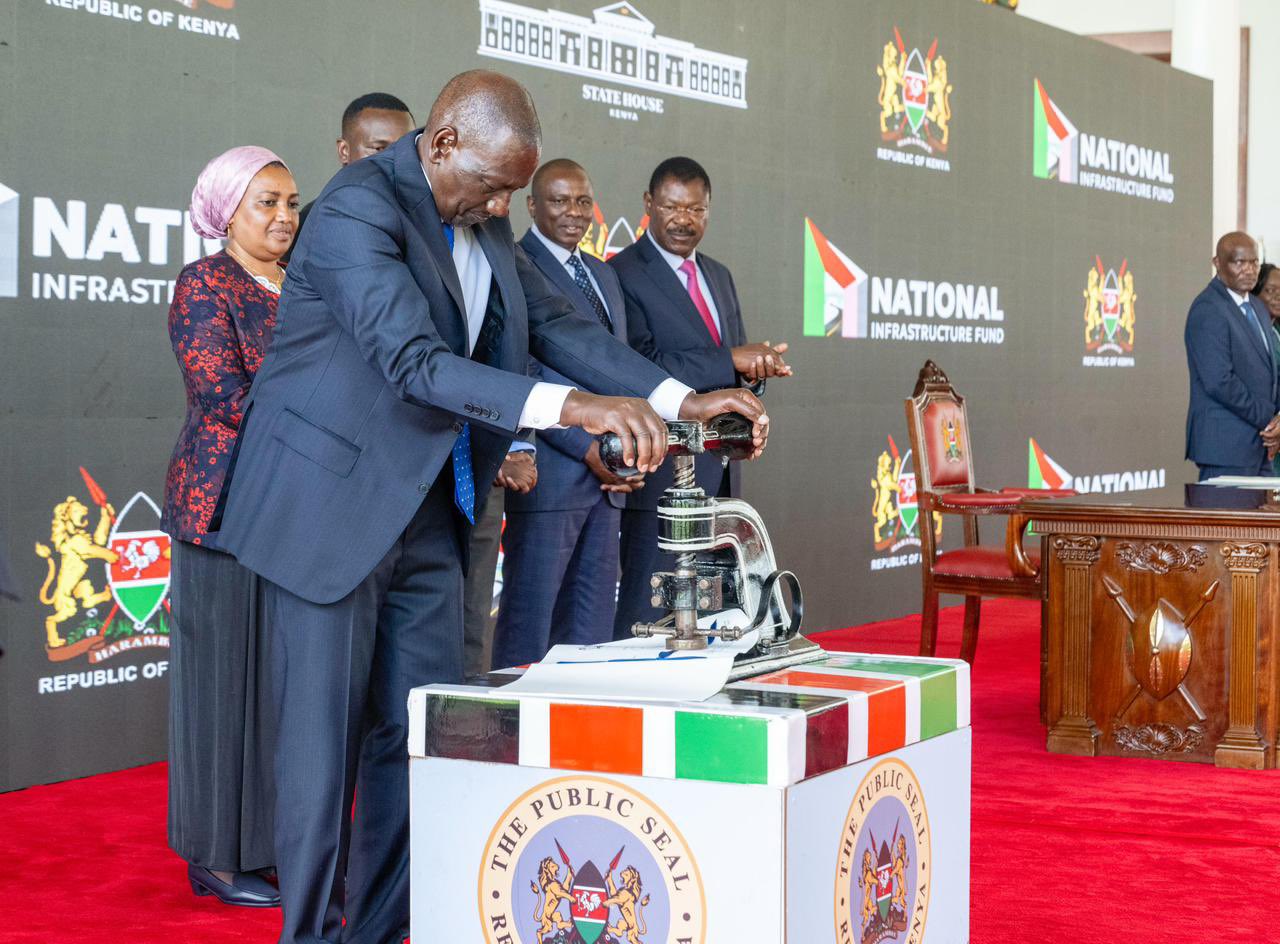
 President William Ruto assents to the National Infrastructure Fund Bill becoming law./PCS
A kind of frustration sets in when one gets stuck in a traffic jam, watching minutes’ slip past a meeting time, and one wonders why we cannot have functional roads.
Similarly, a feeling of vexation besets a traveler when the queue at the JKIA passport control desk moves slower than a sloth on a hot afternoon as registration clerks manually struggle to clear the gridlock.
For decades, the country has been faced with a brutal choice: whether to borrow more money and sink deeper into the hole of debts or put off the projects that citizens desperately aspire to.
The recent floods, which impacted every sector of the economy, ranging from power lines to highways and homesteads, made the situation even more dire, provoking an urgent itch for reliable infrastructure.
However, the National Infrastructure Fund (NIF) Act, 2026, comes in handy—deemed to change this form of desperation in its entirety.
With the signing of the National Infrastructure Fund Bill into law, President William Ruto set in motion a smart, modern way of building a country that Kenyans want without overtaxing them or drowning the nation in new loans.
“The Act establishes a Kshs.5 trillion kitty to finance major infrastructure projects across the country without overburdening the national budget or overtaxing citizens,” says the government spokesperson Dr. Isaac Mwaura.
The focus is on commercially viable infrastructural projects that generate returns and ultimately pay for themselves, Dr. Mwaura adds.
The Fund operates as a financial bridge, acting as public seed capital on one side and private investment on the other.
The National Treasury and Economic Planning Cabinet Secretary John Mbadi puts it plainly, "The government has seen it fit to set up a fund, which would help in taking out of our budget the commercially viable infrastructural projects and invest resources into a commercially viable infrastructure fund by blending with the private sector fund, bringing private capital into public infrastructure projects."
On his part, the president is categorical that the establishment of the fund is not an experiment but a model that has been adopted successfully around the world.
President Ruto gives Nigeria's Infrastructure Fund, established in 2011; Ghana's Infrastructure Investment Fund in 2014; India's National Investment and Infrastructure Fund in 2015, the Canada Infrastructure Bank in 2017; the United Kingdom's National Wealth Fund and South Africa's Infrastructure Fund as examples for Kenya to emulate.
“Kenya is simply stepping into the big leagues of global finance,” the Head of State clarifies.
The Fund will blend public resources with private sector financing from pension funds, insurance companies, and international institutional investors to mobilise Sh1.2 trillion for transformative projects.
The first to be financed initiative will be the expansion of Jomo Kenyatta International Airport, marking the inaugural investment under the new financial framework.
With such significant sums involved, the question of "who will manage the fund" becomes paramount.
President William Ruto has appointed a Governing Council to oversee the appropriation of the fund, naming Treasury Cabinet Secretary John Mbadi as chair of the panel tasked with steering the country toward investment-led infrastructure financing.
In a presidential notification issued on Wednesday, April 1, 2026, the Executive Office said the council had been constituted following the enactment of the National Infrastructure Fund Act, 2026, designed to mobilise private capital and reduce Kenya’s reliance on debts for major development projects.
The statutory members of the council comprise the Central Bank Governor Dr. Kamau Thugge and Attorney-General Dorcas Agik Oduor with independent members appointed by the president, including the former president of the African Export-Import Bank, Benedict Oramah; Kenya Pipeline Company Chairperson Faith Boinett; KCB Group CEO Paul Russo; and the financial services executive Richard Etemesi.
Crucially, the independent members were competitively recruited with proven experience from development banking.
“By moving these projects out of the daily budget, we reduce the need to take more credit or overtax Kenyans.
This innovative funding model is in essence aimed at easing pressure on the national budget, reducing taxes, and cutting sovereign debt. This is how we will transform Kenya in our lifetime. "President Ruto observes.
OGS: Ashley Nadia works at the Office of Government Spokesperson.