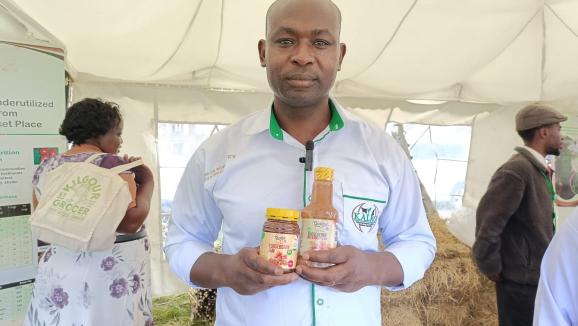
Owen Mwami, from food crop research centre at Kalro Muguga talks on value addition for the gooseberry fruit /AGATHA NGOTHO.
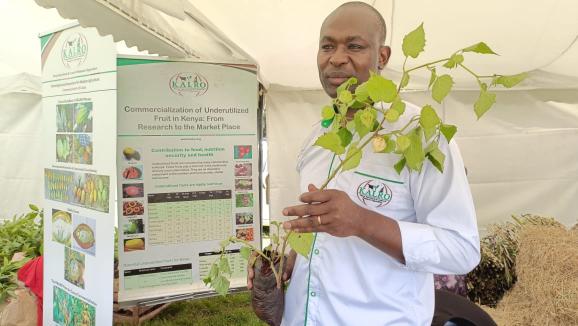
Many Kenyans who grew up in rural areas will recall picking and eating wild fruits straight from the bush.
One such fruit, the gooseberry, has long thrived naturally across different parts of the country with little attention.
Today, however, the once-overlooked fruit is quietly emerging as a new source of income for farmers, following research-led efforts to unlock its commercial potential through value addition.
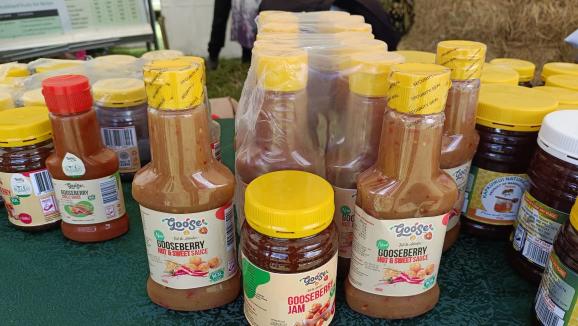
At a recent open day at the Kenya Agricultural and Livestock Research Organisation (Kalro) Muguga centre, jars of gooseberry jam and bottles of hot and sweet gooseberry sauce attracted the attention of participants, offering a glimpse into the fruit’s growing market potential.
Owen Mwami, a researcher at the Food Crops Research Centre at Kalro, explains that the products are derived from the Cape gooseberry, locally known as nathi in Kikuyu and chinsoboso in Kisii.
Scientists, working closely with farmers, are now pushing to transform the fruit into a viable agribusiness as part of a broader initiative to commercialise underutilised crops, which are widely available but have yet to realise their full economic value.
“Kenya has many fruits that grow naturally, but their commercial value has not been harnessed. Gooseberry is one of them,” Mwami explains.
Through the programme, Kalro is training farmers on how to process the fruit into higher-value products such as jam, juice, sauces and even baked goods.
“Value addition is key. For instance, we have developed a gooseberry ‘hot and sweet’ sauce, which is a mix of the fruit and chilli. This can be eaten with nyama choma or snacks like bhajias,” he says.
A 500-gramme jar of gooseberry jam currently retails at about Sh300, offering significantly higher returns compared to selling raw fruit.
For farmers like Jane Wanjiku from Gikambura in Kikuyu, Kiambu county, gooseberries were once just a plant that grew wild.
“We used to ignore it or let children eat it straight from the farm. We didn’t know it could bring income,” she said.
Today, Wanjiku grows gooseberries on a quarter-acre plot and supplies a local processor.
“I sell a kilo at between Sh150 and Sh200 depending on demand. It is not labour-intensive and it does well even with little care,” she added.
Wanjiku believes more farmers will adopt gooseberry farming as awareness grows.
“If there is a market and training, farmers will come in. We just need support to expand,” she said.
The crop’s resilience makes it particularly attractive to smallholder farmers facing climate uncertainty.
According to Kalro, gooseberry is a hardy crop that can thrive in diverse agro-ecological zones and requires relatively low inputs compared to conventional fruits.
Beyond income, gooseberries also pack nutritional value. They are rich in vitamin C and antioxidants, which are important for boosting immunity.
Data from the Food and Agriculture Organization (FAO) shows that increased consumption of fruits rich in micronutrients can significantly reduce malnutrition, particularly in developing countries.
Gooseberries fall into a category of “underutilised crops”—species that are locally abundant but neglected in mainstream markets.
A 2023 report by the World Bank estimates that Africa loses billions in potential agricultural revenue annually due to failure to commercialise indigenous and underutilised crops.
Kalro’s initiative is already showing results. Mwami points to a processor in Eldoret who has built a business around gooseberry products.
“One entrepreneur became very interested and set up a processing factory. She supplies farmers with seedlings, buys back the produce and processes it into finished products,” he says.
The model is creating a structured value chain, linking smallholder farmers to reliable markets.
“This is what we want, farmers not just growing crops, but earning from them,” Mwami adds.
Despite the promise, the sector remains small. There is limited awareness and many farmers still lack access to quality seedlings and markets.
According to the Kenya National Bureau of Statistics (KNBS) Economic Survey 2024, horticulture contributes 30 per cent of agricultural GDP in Kenya, yet underutilised fruits account for only a tiny fraction of this output.
Experts say scaling up will require investment in processing, market linkages and consumer awareness.
The initiative also targets other neglected fruits such as guava, pomegranate and jackfruit.
Mwami notes that guava, for instance, has exceptionally high vitamin C levels—up to five times more than oranges, according to nutritional studies.
“Yet farmers are not benefiting as they should. That is why we are promoting value addition across these crops,” he says.