
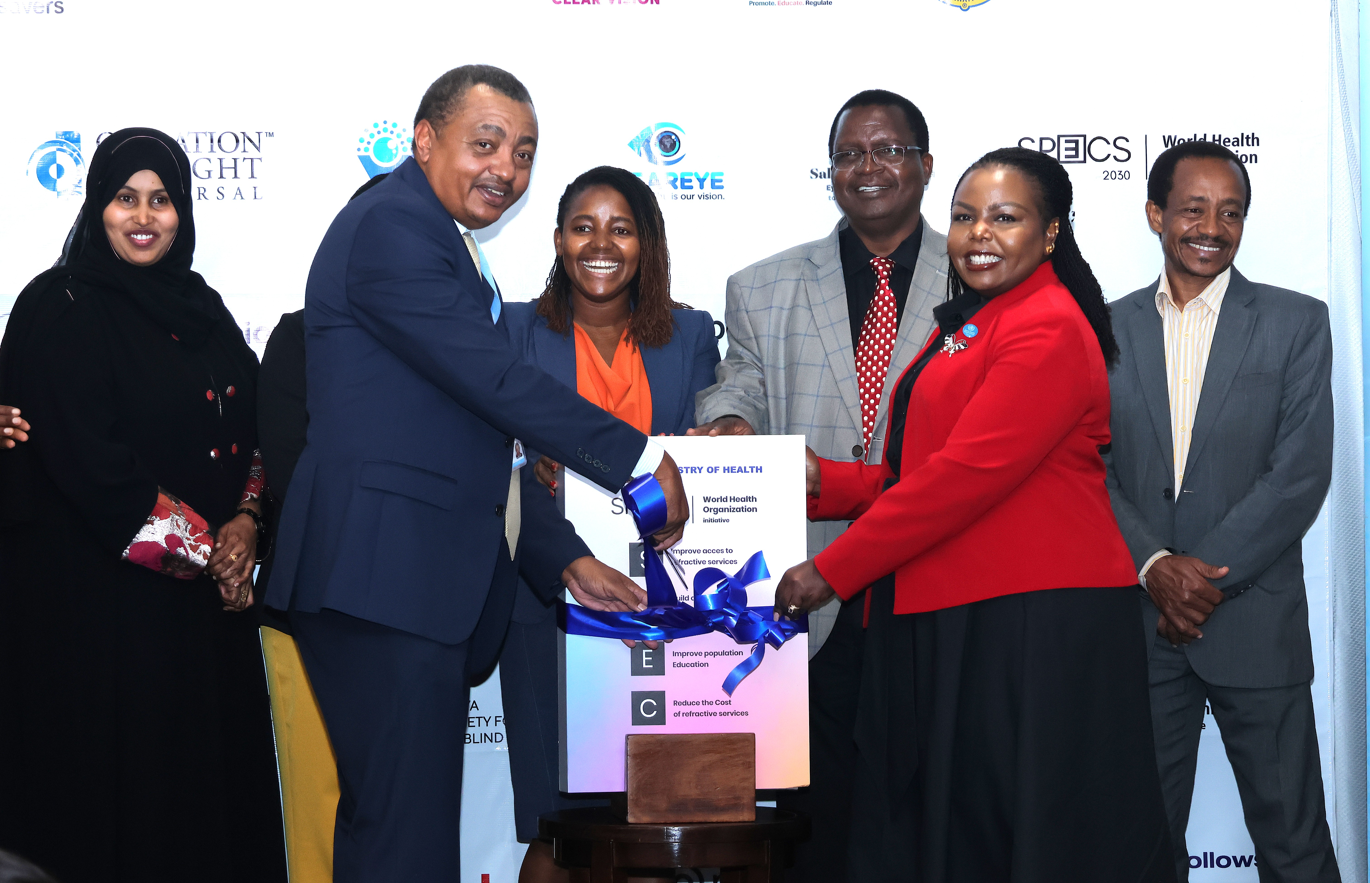
 The Director of Curative and Nursing Services Directorate, MoH, Dr Andrew Toro, launching the SPECS 2030 on April 2./HANDOUT
The government has launched a national plan to tackle poor vision in Kenya after revealing that only 6.7 per cent of people who need eyesight correction can access care.
The initiative, known as SPECS 2030, was officially unveiled in Nairobi by the Ministry of Health in collaboration with the World Health Organization and more than 20 eye health partners, marking what officials described as a critical step towards addressing a silent but widespread public health challenge.
Speaking during the event on behalf of Director General for Health, Dr Patrick Amoth, Dr Andrew Toro said the low access to eye care services reflects a major gap in the country’s health system that requires urgent and coordinated intervention.
“Our current effective refractive error coverage stands at approximately 6.7 per cent. This means that millions of Kenyans who need simple vision correction, something as basic as a pair of spectacles, do not have access to it,” read the statement delivered on behalf of the Director General.
The statistic underscores the scale of the problem, with health experts warning that uncorrected refractive error is one of the leading causes of visual impairment in Kenya.
Despite being easily treatable, the condition continues to limit opportunities for millions across the country.
Dr Toro emphasised that the impact of poor vision extends beyond health, affecting education, economic productivity, and public safety.
“Behind this statistic is a child falling behind in school simply because they cannot see clearly, a worker whose productivity is limited not by lack of skill but by poor vision, and even road traffic accidents that could have been prevented,” he noted.
The SPECS 2030 Initiative is part of a global framework aimed at ensuring universal access to affordable, quality, and people-centred refractive error services by 2030.
It aligns with commitments made by countries during the 74th World Health Assembly, where member states agreed to increase effective refractive error coverage by 40 percentage points as part of broader Universal Health Coverage goals.
For Kenya, this means increasing coverage from the current 6.7 per cent to at least 46.7 per cent within the next five years, a target that officials acknowledge will require significant investment and systemic reforms.
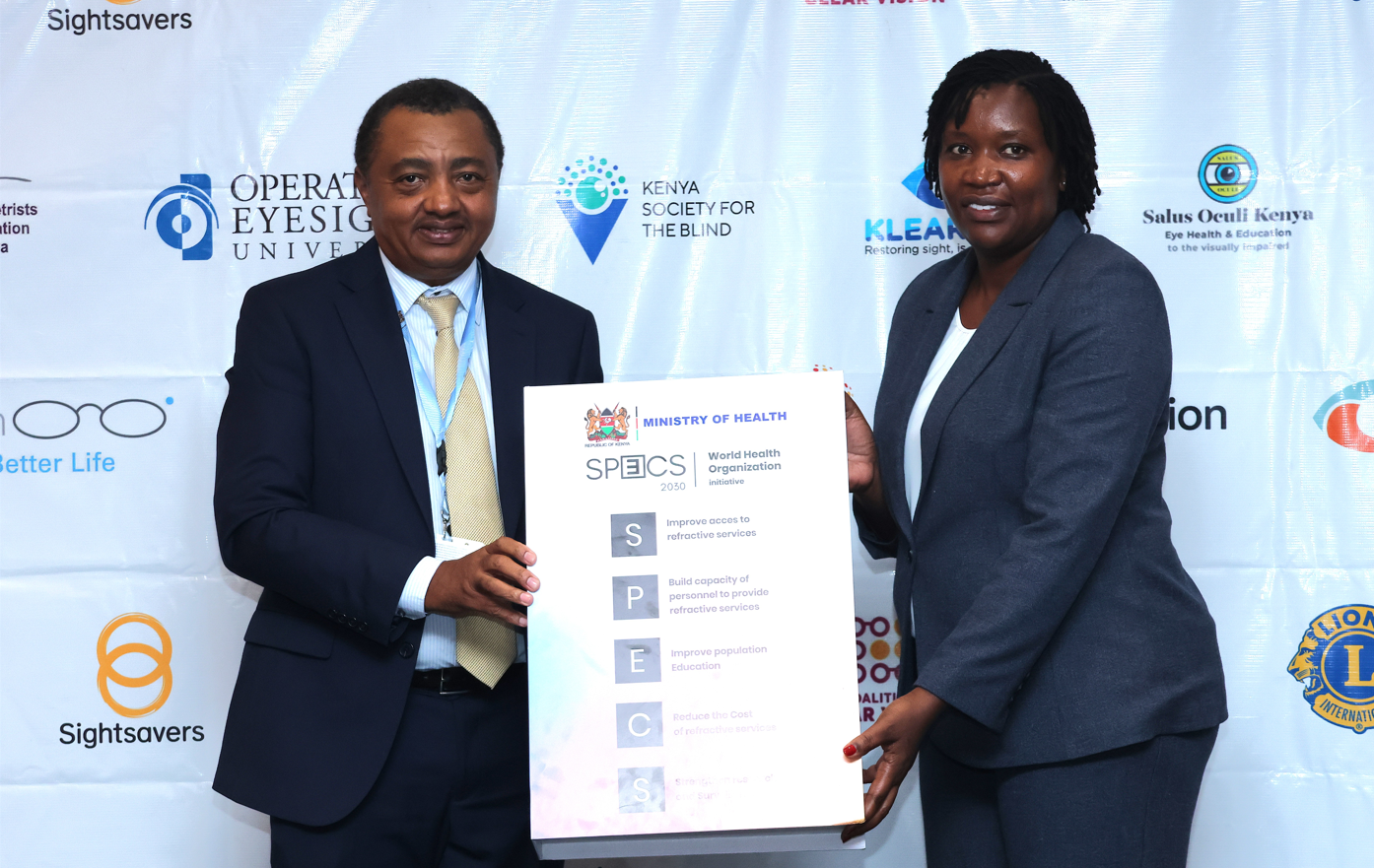 The Director of Curative and Nursing Services Directorate, MoH, Dr Andrew Toro, with Dr Monicah Bitok during the launch of SPECS 2030 on April 2./HANDOUT
The Ministry of Health says it has already begun laying the groundwork to achieve this target. Key interventions include integrating eye care into primary healthcare systems to bring services closer to communities, particularly in underserved and rural areas.
Additionally, the government is undertaking a nationwide situation analysis to identify gaps in infrastructure, workforce capacity, and service delivery.
This assessment is expected to inform targeted interventions and resource allocation.
“We are strengthening systems that improve the everyday lives of our people, and today’s launch speaks directly to that commitment,” the statement read.
Another major focus area is the review and update of national guidelines for refractive error services to ensure quality and standardisation across the country. At the same time, efforts are underway to strengthen data collection systems to improve monitoring and evaluation of eye care services.
Acting Head of the Eye Health Section at the Ministry of Health, Dr Monicah Bitok, highlighted the urgency of scaling up access, noting that the current gap has far-reaching consequences.
She said the SPECS 2030 framework provides a structured, evidence-based approach to expanding access while ensuring that services remain affordable and accessible to those who need them most.
“This initiative gives us a clear pathway to strengthen systems and ensure that no Kenyan is left behind due to poor vision,” she said.
The initiative will focus on expanding access to refractive services, increasing the number of trained eye health professionals, enhancing public awareness of the importance of eye care, and reducing the cost of spectacles and related services.
Affordability remains a key barrier for many Kenyans, particularly in low-income communities, where even basic eye care services may be out of reach. By addressing cost challenges, the government hopes to significantly increase uptake of vision correction services.
Dr Amoth, through the speech, also called for stronger collaboration among stakeholders, emphasising that achieving the SPECS 2030 targets will require a multi-sectoral approach involving national and county governments, development partners, private sector players, and training institutions.
“Health systems are only as strong as the partnerships that support them,” he said, urging stakeholders to align their efforts with national priorities under the SPECS framework.
County governments were challenged to prioritise eye care within primary healthcare systems, while training institutions were encouraged to expand programmes that produce skilled eye health professionals.
Health workers across the country were also urged to champion accessible and quality eye care services, especially at the community level, where the need is greatest.
Experts have described poor vision in Kenya as a “silent public health crisis,” noting that its effects are often overlooked despite their significant impact on individuals and the economy.
Children with uncorrected vision problems are more likely to struggle in school, affecting their academic performance and long-term opportunities. For adults, poor vision can limit productivity and reduce earning potential, particularly in sectors that require precision and visual acuity.
In addition, poor eyesight has been linked to increased risk of accidents, including on the roads, posing a broader public safety concern.
Despite these challenges, stakeholders expressed optimism that the SPECS 2030 Initiative could transform eye care in Kenya if effectively implemented.
The involvement of multiple partners, including international organisations and local stakeholders, is expected to strengthen implementation and ensure that interventions are sustainable.
The government has reiterated its commitment to ensuring that access to clear vision becomes a basic service rather than a privilege.
“We envision a Kenya where no child is left behind in school because they cannot see clearly, where access to a simple pair of spectacles is not a privilege but a right, and where better vision translates into safer roads and improved quality of life,” Dr Amoth said.






