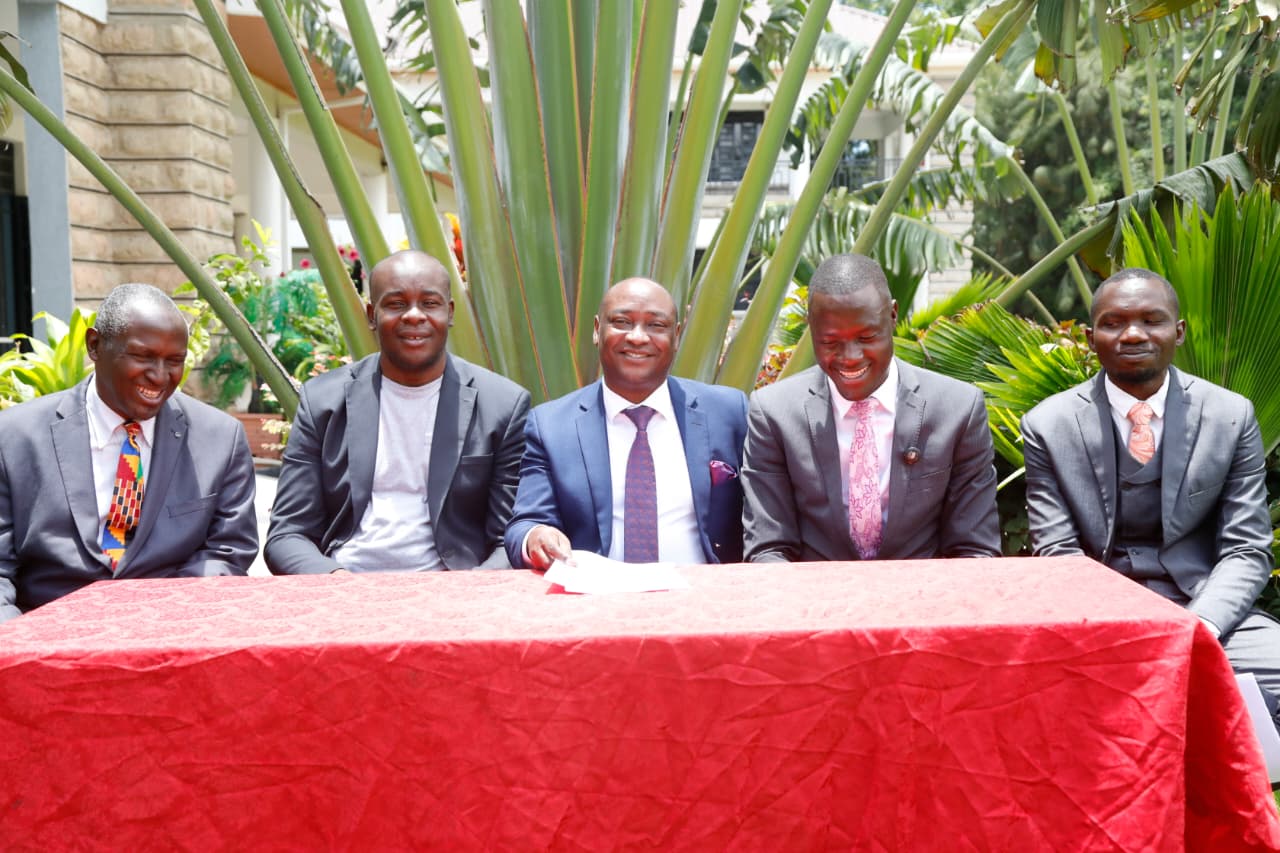
 National Liberal Party leader Dr Augustus Muli (centre) with other officials at a press briefing/HANDOUT
A storm is brewing within the Azimio la Umoja coalition as founding members openly push back against a plan to determine the 2027 presidential flagbearer through a closed-door process.
The dispute comes as Kalonzo Musyoka, leader of the Wiper Party and convener of the coalition, prepares to host a three-day retreat at the Coast bringing together leaders under the banner of the United Opposition.
The meeting is expected to set the criteria for selecting a candidate to challenge President William Ruto in the next general election.
However, the planned retreat has triggered sharp divisions within the coalition, with some affiliate parties warning that a lack of transparency could fracture the alliance at a critical time.
Dissenting voices argue that any attempt to settle on a flagbearer through a select group of leaders risks producing what they describe as a “boardroom candidate,” imposed without broader consultation.
Omondi K’Oyoo, Secretary General of the National Liberal Party (NLP), cautioned against what he termed exclusionary tactics.
“A boardroom candidate remains a closed-circle candidate,” he said. “We must resist any process that locks out key stakeholders and grassroots voices. The coalition should instead convene an inclusive forum that allows all parties to participate meaningfully.”
NLP party leader Dr Augustus Kyalo Muli, who urged Kalonzo to reconsider the approach, echoed K’Oyoo’s sentiments.
“We request that you shelve that plan as indeed it exists and give room to all parties and participants in this critical process,” Muli said. “We require a participatory process that births an all-inclusive candidate for the coalition.”
Another party official, Saulo Busolo, warned that the coalition’s credibility is at stake, noting that secrecy could alienate supporters and weaken its prospects ahead of the 2027 polls.
“Azimio’s strength has always been in its diversity and inclusivity. A secretive retreat risks undermining that foundation and eroding public trust,” he said.
The disagreement underscores deeper tensions within the opposition coalition over both the method and the individual who should carry its presidential flag.
The process of identifying a candidate to face Ruto has remained contentious, with leaders divided on whether to adopt consensus, zoning, or a competitive selection mechanism.
Eugene Wamalwa, leader of the Democratic Action Party of Kenya (DAP-K), confirmed that the retreat will proceed as planned and will focus on establishing the framework for selecting the coalition’s candidate.
The upcoming meeting follows a previous attempt held on February 12–13 that failed to reach consensus on both the selection criteria and the coalition’s branding, highlighting the complexity of uniting multiple parties under a single political strategy.
Despite the growing dissent, Kalonzo has defended the consultations, insisting that the coalition’s primary objective is not individual ambition but building a strong and functional system capable of delivering for Kenyans.