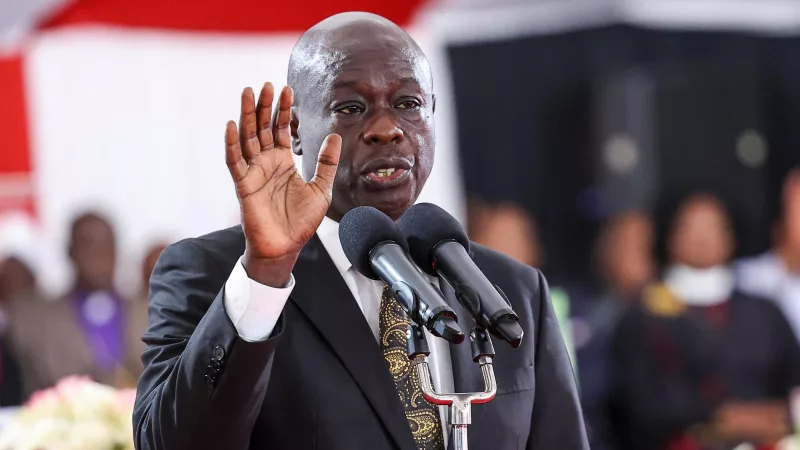
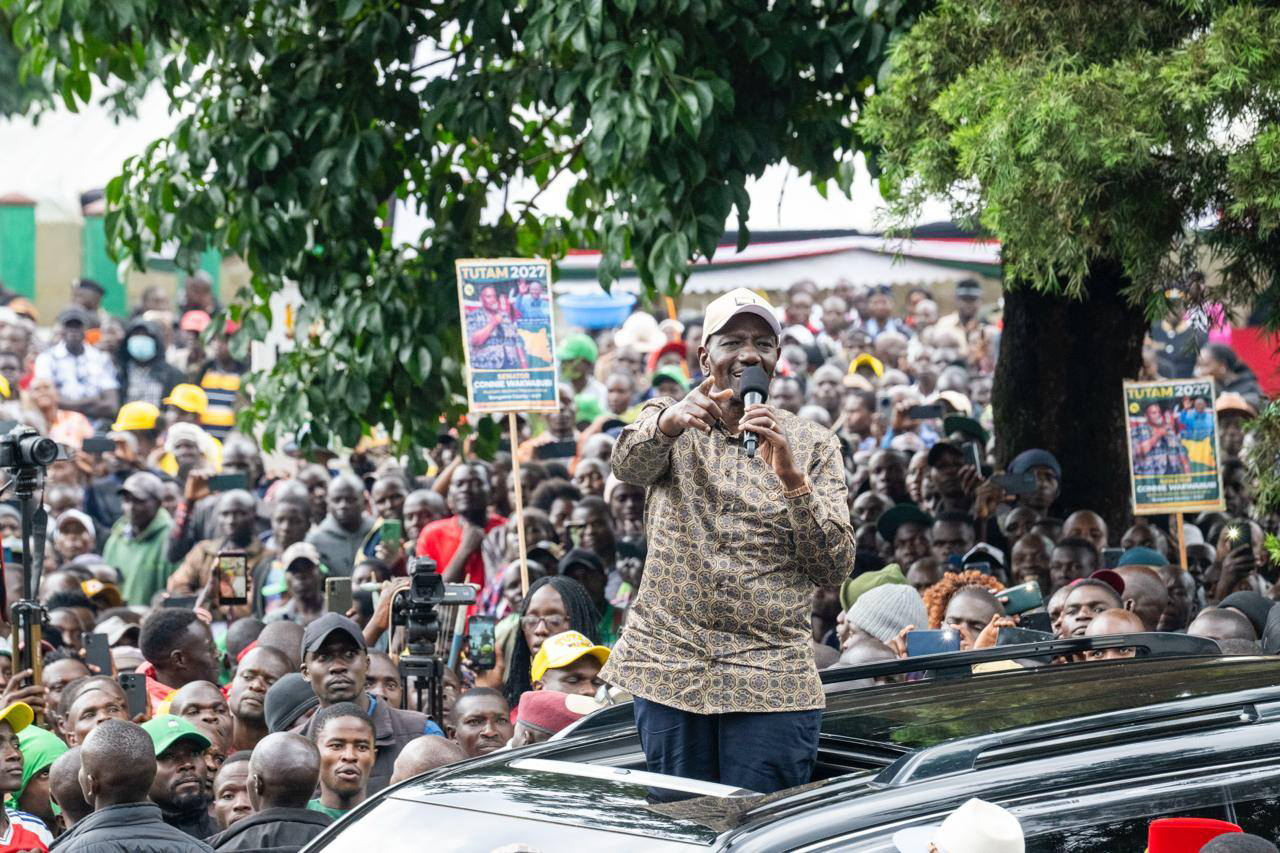
 President William Ruto at Ebutani Junction in Khwisero constituency, Kakamega county after he launched the construction of the Serem and Khwisero modern markets in Kakamega and Vihiga counties /PCS
Both are practitioners of a bizarre brand of rhetoric-fuelled vindictive politics, often delivered on SUV sunroofs, and usually thin on fact but high on innuendo.
This week, they both outdid themselves when they went hammer and tongs at each other, in a charged slur-fest that made adults switch off their TVs and hide the remote controls from the children.
Ruto and Gachagua evidently have a very low opinion of each other. But in my view, they firmly belong to each other. I am reminded of that meeting in Karen in 2022, ahead of the appointment of the running mate for the UDA presidential candidate, William Ruto.
In a room full of party luminaries and top actors, nearly everyone is said to have opposed the idea of Gachagua being made running mate, pointing out that the former Mathira MP was divisive, arrogant and contemptuous of everyone. Ruto overruled them and picked Gachagua.
The deputy president is a position just one disaster away from the office of the President. That Ruto found Gachagua good enough to be a heartbeat away from the highest office in the land is quite telling. But this statement presupposes that Ruto himself was fit for high office.
On this week’s evidence, if Gachagua wasn’t, I doubt that Ruto was. If anything, by falling into the bait set by his impeached former DP, the President confirmed the uncanny resemblance that I alluded to earlier.
Outside the Mt Kenya region, the former DP is claimed to be the worst things to have ever happened to Kenyan politics. But in any spat with him, Ruto should and must understand that he is the President while Gachagua is not.
The presidency is a symbol of national unity. The nation expects a calm head from the holder. At any rate, he is the Commander in Chief of the security forces, making him the custodian of the nation’s instruments of state security.
If he therefore goes ahead to call his former deputy a “cold blooded murderer”, he has to follow it up by having the DCI arraign Gachagua for murder, rather than making this a political statement.
If there is someone Gachagua is alleged to have murdered, regardless of the veracity of such claims, what does it do to the family of such deceased to hear the President himself “confirming” without follow-up action? What about the family of Gachagua’s brother, whom the President has accused the former Mathira MP of disinheriting?
There is a political philosophy many of us hold close, even though it doesn’t exist in written form. It is that as the years roll by, the calibre and quality of leadership should improve organically.
Our independence generation of leaders had grown up in closed villages, beholden to tribal customs and cultures that confined their view of the world. The world itself was still largely a closed place, and most of these leaders were practically the only ones from their regions to ever make it to the national stage and become part of the struggle for freedom.
Six decades later, you can’t blame us for expecting a new breed of leadership in the country, beneficiaries of globalisation and formal education, and raised in a world that has become a melting pot for diverse cultures and ethnicities. We therefore take it for granted that those who lead us today must be better than those who did before.
Yet, listening to Ruto and Gachagua this week, I wondered if Jomo Kenyatta, Daniel arap Moi, Mwai Kibaki and Uhuru Kenyatta would have sunk as low as the President did this week.
There is an interesting perspective to it, too. If indeed the President thinks his former deputy committed fraud by disinheriting his late brother’s family, or arranged the murders of certain girls, it seems to me that he is referring to events or incidents that go back way before the 2022 elections. So, at what point did he get to know these things he spoke about, and how did they not affect his choice of Gachagua as deputy?
That sexuality, body weight and gutter press rumours have made it to presidential conversations is a wake-up call to the entire country. There is an urgent need for change, a new generation of leadership that doesn’t keep mud on each other for politics.
The exchange between Ruto and Gachagua would perfectly fit in as a children’s playground banter, the variety Kenyans call “mchongoano” if it wasn’t about such serious matters.
But when both sides accuse each other of the exact same things, then it is time to seek leadership that doesn’t have skeletons or doesn’t keep a record of where the bodies are buried, for future political references.
It is my considered opinion that the lack of focus that has sent the President and the opposition to discuss weight loss, weight gain and the sexuality or sexual escapades of each other, has desecrated the positions they hold, and the younger generation of Kenyans have a duty to send all of them home next year.
Interestingly, this ugly verbal spat, which may still be continuing by the time you get to read this piece, happened in the same week that a local media station ran a scoop detailing the background events around the disputed election of 2007.
In the documentary, many of those who played a role in disenfranchising Kenyans were captured confessing, some with triumphant smiles, obviously oblivious to the fact that the 2007 election is the source of most problems the country has faced since.
Illegitimate elections have the long-term effect of spurring citizen revolts, especially in increasingly divided societies like the current Kenyan situation.
Indeed, during the perennial verbal slurs between Ruto and Gachagua, one of the things the latter has stated is that their UDA formation stole Raila’s votes in 2022. It seems that everyone who “confirms” electoral theft in this country simply gets away with it.
However, I worry that continuing to ignore electoral reforms in this country is to play with fire. There is an emerging, and large, force of new young voters that is not beholden to such historical matters as post-election reconciliations following disputed elections.
Besides, the divisive nature of every successive regime and their failures to bridge the ethnic and political divisions after elections mean that the feeling that the quest for justice is yet to be fulfilled grows stronger every day.
This is why Ruto and Gachagua must be called to order. In the last three years, no two people in the country have poisoned Kenya’s politics like the pair. And yet the country is preparing for perhaps its most consequential elections ever.
It has been a turbulent term, one in which the fall-out between Ruto and Gachagua, the Gen Z protests of 2024 and 2025, and the campaigns that seemed to start immediately Ruto was sworn in in 2022, have all combined to create a disturbing atmosphere of tension and instability.
Part of the problem, perhaps even the bigger portion of it, is the trust deficit in the country. With regard to the reconstituted Independent Electoral and Boundaries Commission, not many believe that the new team has the courage or the grit to run a credible general election without bending to the whims of powerful people. Indeed, not many Kenyans I have spoken to feel that the electoral systems offer any hope that things have changed from the past elections.
It is acknowledged that the last credible election ever held in this country was the 2002 one won massively by Mwai Kibaki. All the others have been mere stopgap measures to fulfil the requirements of the electoral cycle.
But the key reason the country is in perennial campaign mode is the feeling within a large part of the country has never yet got the opportunity to elect a president in whom they will find universal legitimacy.
To be honest, the last two regimes, the Uhuru-Ruto rule of 2013-2022 and the short-lived Ruto-Gachagua union after 2022, having been formed on the platform of “healing the Kikuyu-Kalenjin divide following the 2008 PEV”, succeeded in alienating large parts of the country.
After the pair’s election in 2022, Gachagua in fact went preaching the “shares” gospel, which Ruto didn’t seem to have a problem with. But in a major way, those two last regimes did much damage to the fabric of the nation, widening ethnic fault lines and planting the seeds of division we see now.
The eventual fall-out between Ruto and Gachagua just made it much worse. With it, the President lost his mountain support and went scrambling for the Luo bloc.
Meanwhile, his former DP set on a mission to remove the President from power, declaring that the mountain region would rather have no presidential candidate in 2027 but support someone else as long as Ruto is voted out.
The angry reaction of the President to Gachagua’s incessant accusations seems to suggest that the pressure is getting to him.
Be that as it may, it behoves the two gentlemen to understand that cursing at each other like sailors, while spewing insults, only helps to divide their two populous regions and keeps the environment too poisoned for an election next year that everyone agrees will be very tense.
The two must be called to order, but especially the President, whose office represents a much higher calling. If they don’t see the need to tone down, our message is simple; the children are watching, please act like adults!