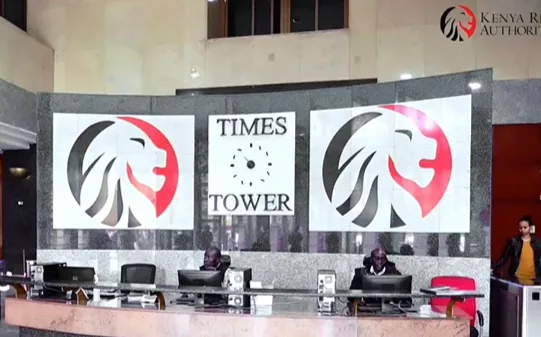
 The Kenya Revenue Authority (KRA) offices at Times Towers in Nairobi/FILE
The Kenya Revenue Authority (KRA), in collaboration with the National Treasury, has announced the successful integration of the Electronic Tax Invoice Management System (eTIMS) with the Integrated Financial Management Information System (IFMIS).
The move is expected to strengthen tax compliance and transparency in government transactions.
KRA said the integration marks a significant milestone in the government's digital transformation agenda and will streamline the processing of payments to suppliers doing business with government entities.
According to the authority, the integration will promote greater transparency and accountability in government transactions while supporting more efficient and seamless financial processes across government institutions.
It will also enable automated validation of tax invoices, allowing government payment processes to be linked more closely with tax compliance requirements.
“The integration marks a significant milestone in the government's digital transformation agenda,” KRA said in a statement.
The authority said the system would enhance accountability by ensuring that invoices submitted for payment through IFMIS are valid and correspond with records generated through eTIMS.
Under the new requirements, all suppliers doing business with government entities will be required to generate valid eTIMS invoices for all supplies before submitting them for payment processing through IFMIS.
KRA warned suppliers that invoice details submitted to government entities must precisely match the invoices generated and recorded in eTIMS.
“Suppliers must generate valid eTIMS invoices for all supplies before submission for payment processing through IFMIS,” the authority said.
KRA further directed suppliers to ensure consistency between invoices submitted to government agencies and those recorded in the electronic tax invoicing system.
“The details of invoices submitted to government entities must correspond precisely with the invoices generated and recorded in eTIMS,” KRA said.
The development is expected to make it more difficult for suppliers to submit invoices that do not correspond with their tax records, while giving government agencies an automated mechanism to verify invoices before payments are processed.
KRA also urged suppliers to take greater responsibility for maintaining their tax compliance status and ensuring that their tax information remains accurate.
“Suppliers are encouraged to regularly verify their tax compliance status and ensure that their tax records and information are accurate and up to date,” the authority said.
The integration comes as the government continues to expand the use of digital systems in revenue collection, public financial management, and service delivery.
By connecting eTIMS with IFMIS, the government is seeking to create a more seamless link between the supply of goods and services to government entities, invoice generation, and the subsequent payment process.
KRA said suppliers who experience difficulties with eTIMS onboarding, invoice generation, or other related issues will continue to receive assistance through its support channels.