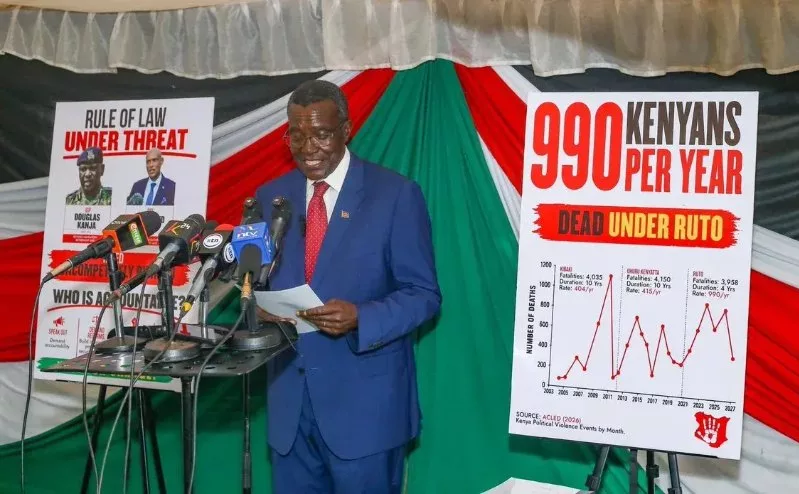
 Former Chief Justice David Maraga/HANDOUT
A far-reaching set of reforms proposed by a taskforce chaired by former Chief Justice David Maraga could fundamentally change the leadership, recruitment, remuneration, welfare and accountability systems in Kenya’s security and national service institutions.
The Report of the National Taskforce on Improvement of the Terms and Conditions of Service and Other Reforms for members of the National Police Service (NPS), Kenya Prisons Service (KPS) and National Youth Service (NYS) was presented to President William Ruto in November 2023.
The taskforce was established to identify legal, policy, administrative, institutional and operational constraints affecting effective service delivery by the three Services, while reviewing the welfare and terms and conditions of service of their members.
Its findings painted a troubled picture of institutions facing a combination of structural and management problems.
The taskforce identified underfunding, endemic corruption, leadership challenges, poor human capital management and development, as well as other structural constraints, as among the major problems affecting the three Services.
For the police, the recommendations went beyond salaries and welfare to target the leadership of the National Police Service, the role of the National Police Service Commission, corruption and the organisation of specialised units.
One of the most significant proposals for the National Police Service is a fresh vetting exercise targeting senior officers.
The taskforce recommended that all officers holding the rank of Senior Superintendent of Police (SSP) and above undergo a fresh vetting process.
“The exercise should be conducted by an independent panel appointed by the President,” the taskforce proposed.
The recommendation was intended to address concerns around leadership and accountability within the police service and ensure that senior officers meet the standards expected of those entrusted with command responsibilities.
The taskforce also proposed stronger measures against corruption within the NPS.
It recommended that the Service review its anti-corruption and prevention of bribery procedures and policies to ensure they are effective in stemming the vice.
“The NPS should also seek assistance from the Ethics and Anti-Corruption Commission (EACC) to establish mechanisms for fully implementing anti-corruption legislation and measures.”
Among the proposed measures are procedures for preventing bribery and corruption, annual corruption risk assessments and management, performance contracting and customer satisfaction surveys.
The taskforce further called for reporting mechanisms that conform to the National Values and Principles of Governance.
The taskforce also raised concerns over the way performance is managed within the police service.
Although it established that a performance management system exists within the NPS, it found that the system was not being effectively used to measure progress, productivity and accountability.
The Inspector General was therefore tasked with monitoring and ensuring implementation and compliance with the performance management system.
The report also delivered a strong assessment of the National Police Service Commission.
The taskforce took the view that the current NPSC leadership had failed to effectively oversee the pursuit of its mandate, with consequences for the wider police reform process.
It recommended that the government consider initiating a negotiated or any other legally recognised mechanism to exit the current chairperson and commissioners of the NPSC.
According to the taskforce, such a move would pave the way for “fresh and revitalised leadership” at the Commission committed to reforms within the police service.
The proposal could prove particularly consequential because the NPSC has a constitutional role in matters including recruitment, appointment, promotion and discipline of members of the NPS.
The taskforce also recommended an overhaul of specialised police units.
The Joint Service Board of the NPS should review existing specialised units with the aim of rightsising and streamlining them.
Units with overlapping functions, expertise, resources or operations should be merged and placed as sections under one existing specialised unit.
The objective would be to eliminate duplication and improve efficiency in the deployment of police resources.
Another major recommendation concerned the Police Air Wing.
The taskforce recommended that the Police Air Wing be restored to the “exclusive control” of the National Police Service forthwith.
The recommendation was aimed at clarifying command and operational control of the aviation component of the police service.
For the Kenya Prisons Service, the taskforce proposed extensive reforms covering the Prisons Council, corruption, recruitment, human resources, salaries and housing.
It recommended restructuring the Prisons Council to include a chairperson with qualifications equivalent to those of a Supreme Court judge.
The Council would also comprise the Principal Secretary for Finance or a representative, a representative of the Public Service Commission, the Principal Secretary for Correctional Services and the Commissioner General of Prisons.
The Commissioner General of Prisons would serve as the secretary to the Council.
The taskforce argued that given the importance of the Prisons Service to the justice system, the chairperson and members of the Council should receive competitive retainers and sitting allowances.
These payments would be determined by the Cabinet Secretary in consultation with the Salaries and Remuneration Commission.
Corruption was also identified as an issue requiring urgent intervention in the Prisons Service.
The KPS was advised to review its anti-corruption and prevention of bribery procedures and policies to ensure they effectively prevent corruption.
It should also seek assistance from EACC in establishing mechanisms to implement anti-corruption measures and policies.
The taskforce proposed significant changes to recruitment into the Prisons Service.
An HR audit should be conducted within six months of publication of the report to establish the extent of challenges associated with nepotism and develop policies and guidelines to address the problem.
The minimum academic qualification for entry into the Service should be set at a Kenya Certificate of Secondary Education grade of C-.
However, exceptions should be allowed for candidates from marginalised areas.
The minimum recruitment age should also be increased from 18 to 21 years.
The taskforce proposed a hybrid recruitment system.
Applicants would initially apply online, allowing officials to filter candidates according to the requirements contained in recruitment advertisements.
Shortlisted applicants would then attend physical interviews at county and sub-county levels.
For graduates, internal recruitment should account for a quarter of the total advertised vacancies.
The remaining positions would be filled externally from the labour market.
Perhaps one of the most significant welfare recommendations was a proposed new remuneration structure for uniformed prison officers.
The taskforce recommended a basic salary increase of 40 per cent for officers at the lowest rank or Pay Grade 1, with the increase progressively reducing to 3 per cent for the highest rank, Pay Grade 14.
The proposed remuneration structure was to be implemented in three phases beginning July 1, 2024.
The recommendations also addressed the longstanding housing challenges facing prison officers.
The Commissioner General of Prisons was asked to urgently develop a housing policy to guide the construction, allocation and management of KPS housing units.
The taskforce further recommended prioritising the development of a masterplan for KPS facilities, including officers’ housing.
For the National Youth Service, the taskforce proposed changes to governance, recruitment, training and inclusion.
It recommended amendments to the NYS Act to provide for the chairperson and members of the NYS Council to be recruited through a competitive process.
The selection would be undertaken by a panel constituted by the President for that purpose.
The taskforce also proposed raising the minimum educational qualification for NYS recruits.
With the government pursuing a 100 per cent transition policy from primary to secondary education, the report recommended that NYS recruits should have at least a secondary school leaving certificate.
The Service should also restructure and develop courses for different grades and qualifications.
This would include basic skills courses for applicants whose KCSE grades do not qualify them for higher-level courses.
The taskforce singled out recruitment, particularly the recruitment of privates, as an area vulnerable to corruption.
To address the problem, it recommended that NYS publicise recruitment opportunities widely through all forms of media.
These should include community radio stations, religious institutions, social media and National Government Administration Officers.
The report also recommended reducing human interaction in the recruitment process.
Technology would play a central role in the proposed system, with applicants submitting applications online.
NYS would then publish shortlisted candidates, conduct physical interviews at sub-county level and subsequently publish the names of successful recruits.
The taskforce also called for affirmative action policies to ensure equitable recruitment of servicemen and women from marginalised areas, communities and groups.
The recommendations contained in the Maraga-led report therefore sought to address not only pay and welfare, but the deeper institutional problems affecting Kenya’s police, prisons and youth service.
At their core was an attempt to strengthen accountability, professionalise recruitment and leadership, improve working conditions and make the three institutions more efficient and responsive.
The report placed particular emphasis on technology, transparent recruitment, stronger oversight and better human resource management as tools for addressing longstanding weaknesses.
Its recommendations also reflected the taskforce’s view that improving the performance of the three Services would require reforms extending from the highest levels of leadership to the day-to-day welfare and recruitment of individual officers.