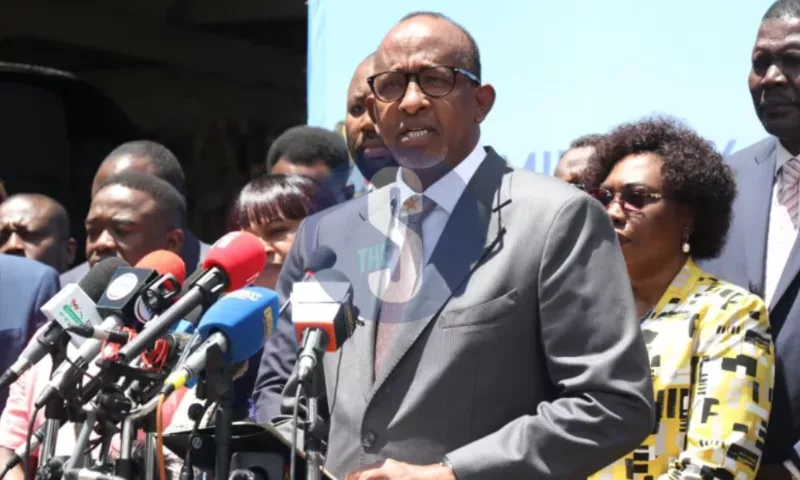
Ministry of Health has been advised to stop issuing Ebola statements at night and instead hold regular press conferences where journalists and independent health experts can seek clarity about Kenya’s rising infections.
Pathologist Dr Ahmed Kalebi, who said he was not criticising the ministry, noted the ministry held a press conference when announcing Kenya’s first case but had since relied on written statements, leaving important questions about the spread of the virus unanswered.
“These are legitimate public-health questions for MoH, not criticism for its own sake. Greater openness and clarity on the transmission chain will strengthen public confidence in the outbreak response,” he said.
Kenya has confirmed nine cases of Ebola Bundibugyo virus disease, including the first patient who died on October 5.
The eight other infections have been linked to the first patient, but questions remain about whether they all resulted from direct contact with him or whether the virus spread through other infected people.
The eight cases were announced through statements at dusk and once casually by the director general for health during a TV show.
The approach marks a departure from the more open communication seen during the Covid-19 outbreak, when health officials regularly briefed the public and responded to questions from journalists.
“MoH should also provide opportunities for the public via independent health professionals and journalists to seek clarification through regular interactive briefings rather than relying on late-evening press statements,” Kalebi said.
In its latest update, the ministry said the ninth patient, a 24-year-old close family member of the first patient, tested positive on October 19 while already in quarantine. He was isolated at the first sign of illness and started treatment after his positive result was confirmed.
The ministry has said all nine cases belong to one known cluster, with no evidence of transmission beyond the group. It also reported that the eight surviving patients were improving and that 134 of 135 identified contacts had been traced and quarantined.
Dr Kalebi welcomed the progress in tracing contacts and identifying infections among people already in quarantine.
However, he said the ministry needed to provide more information to help the public understand how the infections occurred.
He questioned whether the eight local infections resulted directly from contact with the first patient or whether some patients caught the virus from other infected people. The fact that all cases belong to one cluster does not, by itself, establish who infected whom.
“One epidemiological cluster can contain multiple generations of transmission. The ninth patient’s diagnosis on 19 October remains compatible with exposure to the index case before his death on 5 October, given Ebola’s 2–21-day incubation period,” Kalebi said.
He said the ministry should clarify when the ninth patient entered quarantine, when he was last exposed to an infected person and when his symptoms began. Such information would help establish whether he was infected directly by the first patient or through another contact.
Kalebi also called for clarity on how contacts were accommodated during quarantine and what evidence supported the ministry’s statement that no infections had occurred within quarantine facilities.
He said: “The progress in contact tracing, early detection and patient care deserves recognition. But understanding who likely infected whom is equally important for assessing the effectiveness of quarantine and infection prevention measures.”
The ministry has said the first group of contacts who entered quarantine on October 6 and remain well would complete their 21-day monitoring period and begin returning home from October 25.