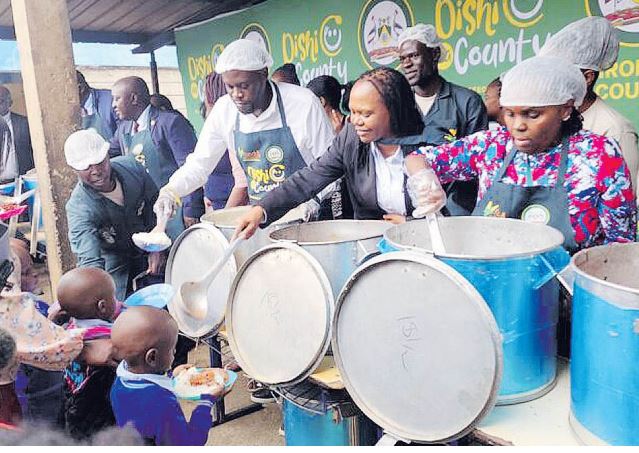
At exactly 12.40 pm, the lunch bell rings at Roysambu Primary School in Nairobi and hundreds of pupils quickly form orderly lines outside the serving area.
Each child stretches out a wrist fitted with a small orange-yellow digital band, taps it against a reader and moments later walks away with a plate of steaming food.
For many of the more than 4,000 learners at the crowded public school in Zimmerman estate, this daily ritual guarantees something many children cannot always count on at home — a hot meal.
The food costs as little as Sh5 to Sh20, a fraction of what a plate would cost almost anywhere in the city.
Yet for thousands of schoolchildren across Nairobi, Kiambu and Murang'a counties, the programme is ensuring they can learn on a full stomach.
The initiative is part of Dishi na County, a school feeding programme run by the Nairobi county using the Tap-to-Eat digital payment system developed by the nonprofit, Food4Education.
The system allows parents to pay for subsidised meals through mobile money, while vulnerable learners can access food at no cost.
At Roysambu Primary, the programme has changed far more than what is served on the plate.
According to headteacher Nelius Njoroge, enrolment has surged since the feeding programme was introduced four years ago.
“Before Covid, we had about 1,950 learners. By 2023 we had 3,250. Now we have over 4,400 learners?” she told the Star.
Today the school enrols about 2,600 learners in primary, 1,800 in junior secondary and about 220 in early childhood classes — far beyond the infrastructure designed for 1,500 learners.
Njoroge said the feeding programme a major reason parents are transferring their children to the school.
“Many families lost jobs during Covid-19,” she said. “When parents know their children will get a hot meal at school, they feel relieved, bringing them here.”
Before the programme, lunchtime often came with challenges.
Some learners carried food packed the previous night. By midday in Nairobi’s heat, the meals were often spoilt.
“When they opened those lunchboxes, sometimes the smell filled the classroom,” Njoroge said. “The next day we would have children absent or complaining of stomach aches.”
Others simply went hungry.
“Some learners used to fast the whole day. You could see them struggling to concentrate during afternoon lessons,” she said.
Today, most learners simply tap their wristbands and receive a hot lunch that typically includes rice, beans and vegetables. Occasionally, they get fruit.
“For some of our learners, this is the only balanced meal they get,” Njoroge said.
Amina Mohamed, Nairobi chief officer for nutrition, wellness and school feeding, said the Dishi na County programme was introduced to tackle hunger among children in public schools. Thus, it improved attendance and academic performance.
“The primary goal was to ensure that children from vulnerable households are able to remain in school, concentrate in class and perform better academically,” she said.
Since its launch, the programme has had a visible impact in many schools across the city.
Mohamed says several schools have reported increased enrolment as parents gain confidence that their children will receive at least one nutritious meal during the school day.
Teachers have also observed better attentiveness and participation in class.
Under the programme, parents in Nairobi pay Sh5 per meal for their children.
This is significantly lower than what parents pay in neighbouring counties such as Kiambu and Murang'a, where meals cost Sh15 to Sh20.
The county government heavily subsidises the programme to keep meals affordable, particularly for families in informal settlements.
“It costs about Sh45 to prepare and deliver a meal,” she said. “Parents pay Sh5, the county subsidises Sh20 and other partners contribute the remaining Sh15.”
Each learner in public primary and early childhood schools receives about 550 grammes of food every school day.
“The meals are carefully designed to provide a balanced combination of carbohydrates, proteins and essential micronutrients to support learners’ growth, concentration and overall well-being,” Mohamed said.
The meals are prepared in centralised kitchens under strict hygiene standards before being transported to schools across the city.
Running a programme that feeds thousands of children every day, however, comes with challenges.
Fluctuating food prices remain one of the biggest hurdles. Changes in the cost of staples often affect procurement planning and budgeting.
Weather disruptions affecting agricultural supply chains can also delay deliveries of cereals and other food supplies.
“Inconsistent quality of cereals from some suppliers can also create operational difficulties,” Mohamed said.
Poor road access to some schools can slow last-mile delivery of meals, while rising transportation and fuel costs increase the cost of operations.
Despite these challenges, the centralised kitchen model has proved to be the most efficient approach for a dense urban environment like Nairobi.
“It enables quality control, cost efficiency and reliable daily distribution of meals to thousands of learners,” Mohamed said.
Beyond feeding children, the programme is also supporting farmers and suppliers across the country by sourcing food locally.
Vegetables come from Kiambu and Nyandarua counties, beans from Narok and green grams from Meru, Embu, Tharaka Nithi and Makueni.
Mangoes are sourced from Murang'a, bananas from Kisii county and ndengu from Busia.
The programme also supports the city’s informal manufacturing sector.
“The Jua Kali sector in Nairobi provides non-food items and kitchen equipment used in the programme,” Mohamed says.
Technology has also been integrated to improve transparency and accountability.
Linda Rono of Food4Education, the Tap-to-Eat system addresses long-standing accountability challenges common in school feeding programmes across Africa.
Traditional programmes often relied on manual reporting and cash handling, making it difficult to verify whether meals were actually reaching children.
Each student receives an Near Field Communication wristband (a short-range wireless technology that ensures devices such as wristbands exchange data).
“When they receive a meal, they tap the device that confirms their identity, logs the meal, records the time and location and reconciles payments or subsidies,” Rono says.
The information feeds into real-time dashboards used by programme managers and government partners to monitor operations and respond quickly to any problems.
“In essence, Tap-to-Eat transforms school feeding from trust-based delivery to evidence-based governance,” Rono says.
Food4Education reports that more than 150 million meals have been served to learners since the programme began four years ago.
Today, more than 600,000 meals are served daily across 13 counties, supported by 31 centralised high-tech kitchens — including Nairobi’s Giga Kitchen — and more than 90 decentralised kitchens supplying schools across the country.
INSTANT ANALYSIS
The Dishi na County feeding programme is improving attendance, concentration and academic performance in Nairobi’s public schools in informal settlements., It tackles one of the most basic barriers to learning: hunger. It does not help nonpublic, community schools. It uses technology in digital wristbands worn by learning to tap and eat highly subsidised food from central kitchens. It shows how targeted social programmes can ease pressure on struggling households while supporting local farmers and suppliers. Long-term success will depend on sustainable funding, stable food supply chains and efficient logistics. It could become a blueprint for addressing classroom hunger across Kenya.