Kenya is once again grappling with the devastating aftermath of deadly floods that have claimed dozens of lives, displaced thousands of families and triggered a familiar debate over accountability, and planning failures.
As rescue teams continue assessments in affected regions, authorities say the scale of destruction caused by the recent heavy rains is significant.
According to the National Police Service, the death toll has risen to 49 people, while thousands have been forced from their homes and vital infrastructure has been damaged across multiple counties.
The disaster has struck at a time when the Kenya Meteorological Department is warning that the rains are far from over.
The agency has cautioned that persistent rainfall is expected to Sunday, March 16, affecting six major regions including western Kenya, the Central Highlands, the Lake Victoria Basin, the Rift Valley, the South-eastern Lowlands and the South Coast.
For many Kenyans still reeling from the recent tragedy, the warnings have heightened fears that the worst may not yet be over.
The capital Nairobi has borne the brunt of the flooding, with authorities confirming at least 26 deaths in the city alone.
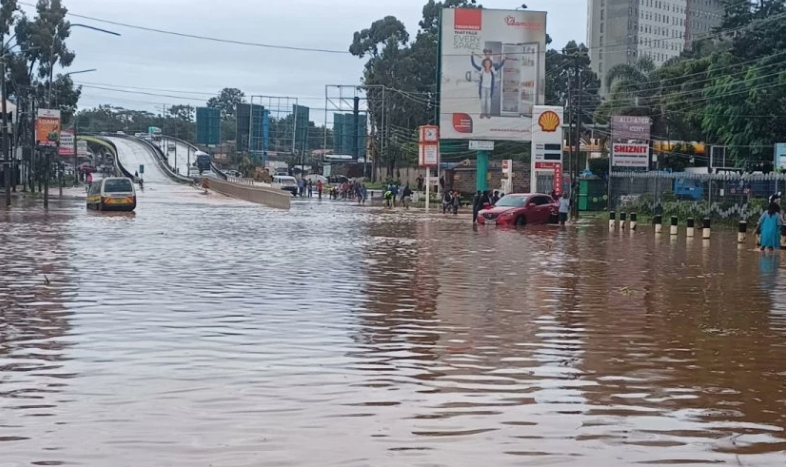
Several low-lying neighbourhoods including Mukuru, Mathare and parts of the city centre were inundated after heavy rain caused rivers and drainage channels to overflow.
Major roads were submerged, cutting off key transport routes and leaving commuters stranded for hours.
In some informal settlements, residents watched helplessly as floodwaters swept through homes and businesses, destroying property and washing away livelihoods built over years.
Emergency responders have been working around the clock to assist affected families, while humanitarian agencies are assessing the damage.
The Kenya Red Cross Society says the impact stretches well beyond the capital.
According to the organisation, families across 16 counties are counting losses worth millions of shillings after floodwaters destroyed homes, businesses and road networks.
The humanitarian agency estimates that 4,845 people have been displaced, forcing families to abandon their homes and seek refuge on higher ground. This figure is significantly higher than the 2,624 families displaced reported by police earlier, highlighting the evolving nature of the crisis.
“The situation continues to unfold and we are still conducting assessments to establish the full scale of displacement and humanitarian needs,” the Red Cross said in a statement.
As often happens after disasters of huge magnitude, the floods have reignited debate about what went wrong.
Political leaders have traded blame while residents have also been accused of contributing to the worsening crisis through poor waste management and illegal construction.
But experts say the disaster is not simply the result of heavy rainfall.
Rather, they argue it reflects years of planning failures, governance challenges and rapid urban growth that has outpaced the city’s infrastructure.
Architect and urban development expert Alfred Omenya says flooding in Nairobi has steadily worsened over the years and is now affecting both informal settlements and affluent neighbourhoods that historically experienced fewer drainage challenges.
“Every year it gets worse and the reason is that our drainage infrastructure is the same while the runoff has been increased several times because of housing developments,” he said.
According to Omenya, Nairobi’s drainage system was not designed to handle the massive increase in stormwater runoff caused by rapid urban expansion.
Large housing developments and commercial buildings have replaced open spaces that previously absorbed rainwater, leaving drainage systems overwhelmed during heavy storms.
He argues that the problem begins during the planning and approval stages of new developments.
“We cannot approve structures and increase runoff and we do not know where that water will go,” Omenya said.
Urban planning authorities, he said, must require developers to conduct detailed calculations showing how new construction projects will affect water flow and the capacity of existing drainage systems.
Omenya also pointed to deeper structural challenges related to settlement patterns in Nairobi’s informal neighbourhoods.
“The reason informal settlements are usually hit again is due to planning failure,” he said.
“Those areas are not meant to be settled in the first place, but when people have nowhere to go, they move into them. They end up occupying waterways, rivers, open spaces, parks and so forth.”
Officials involved in the restoration of Nairobi’s river systems say encroachment on riparian land has made the flooding crisis worse.
Joseph Muracia, the chief executive officer of the Nairobi Rivers Commission, said floodplains along major rivers were historically designated as green spaces meant to absorb excess water.
But rapid population growth and rural-to-urban migration have led to widespread settlement in these areas.
“The truth is always painful and we know where the problem is,” Muracia said.
“The riparian land in the 1930s and 1940s was always designated as floodplains and green areas. But because of overpopulation and rural-urban migration, people have occupied these areas.”
As settlements expand along riverbanks, channels become narrower, reducing the rivers’ ability to carry water during heavy rains.
“When they occupy, they narrow the river channel and when that happens, when some little rain comes, there is overflow of water,” Muracia said.
He added that authorities have taken flood control seriously within the Nairobi River recovery strategy, but difficult decisions may be required.
“People will have to move out of riparian land if we have to fix this problem.”
Muracia acknowledged that relocating communities from these areas will not be easy.
“Engineers have spoken very well about doing small dams but where do we build them when the areas have been occupied?
“So it has to be painful for us to tell our people to move. We have spoken to people and they have agreed that they need to move but they have asked for time.”
Urban planning expert Patrick Adolwa says that the flooding crisis ultimately points to a deeper governance problem.
He says Kenya has the technical expertise needed to prevent such disasters, but the challenge lies in leadership and implementation.
“Nairobi is not lacking in technical skills at all,” Adolwa said.“I think what we seem to have is a perennial leadership problem. Nairobi’s problem has always been its governance.”
According to Adolwa, the destruction witnessed during the recent floods is not simply a natural disaster but the result of years of weak urban management.
Poor enforcement of planning regulations, corruption and political interference have allowed construction in areas that should never have been developed.
Experts also say the tragedy could have been mitigated if warnings had been better communicated and acted upon.
Geographic Information System and remote sensing specialist Mohamed Omar said information about the likelihood of floods had been available ahead of time.
However, he said that authorities failed to clearly identify and warn residents living in high-risk flood zones.
“There was information warning that floods were likely to happen, but the missing piece was identifying the flood risk zones,” Omar said.
He believes many deaths could have been prevented if the warnings had reached those most vulnerable.
“That is why there were so many fatalities. If someone was keen with what the Kenya Meteorological Department and the Kenya Red Cross were saying, they knew this was going to happen,”
he said.Some officials have also blamed residents for worsening flooding in the city.
Former Nairobi environment chief officer Geoffrey Mosiria said poor waste disposal practices have contributed significantly to blocked drainage systems.
Mosiria, who now serves as chief officer for citizen engagement and customer service, said many residents dump garbage into drainage channels, preventing water from flowing freely during heavy rains.
“When we are constructing our houses, we ignore prioritising the drainage system and also how we manage our waste and disposal,” he said.
“Everyone just does not care about their waste; they throw the waste into the drainage system.”
While he acknowledged that the intensity of the rainfall played a role in the flooding, Mosiria argued that human activity amplified the impact.
City officials say efforts are underway to address the underlying causes of flooding through river restoration projects.
Bramwel Simiyu, Nairobi chief officer for disaster management, said rivers remain the backbone of the city’s natural drainage system.
He added that the Nairobi, Mathare and Ngong rivers carry the majority of stormwater.
“The rivers in the city — Nairobi River, Mathare River and the Ngong River — take 70 per cent of runoff water.”
For the system to function effectively, he said the rivers must be restored.
“We must restore and regenerate the rivers,” he said.
According to Simiyu, the ongoing Nairobi regeneration project includes deepening, widening and dredging the rivers to allow water to flow more freely during heavy rains.