Dear people of Kenya, Jambo!
I am Toshimitsu Motegi, Japan’s Minister for Foreign Affairs. As I visit Kenya for the first time in five years, I would like to share my thoughts on the development of friendly relations between Japan and Kenya, and indeed with Africa as a whole.
Japan and Kenya established diplomatic relations shortly after Kenya’s independence in 1963. To this day, the heartfelt exchanges between our two nations have borne wonderful fruit in various fields.
Prime examples include infectious disease research conducted by the Kenya Medical Research Institute (Kemri) and Nagasaki University, the cooperation between Jomo Kenyatta University of Agriculture and Technology (JKUAT), Kyoto University and Okayama University, which contributes to Kenya’s economy and local communities through educational and research activities in agriculture and industry.
Furthermore, the number of Japanese experts dispatched to Kenya to date stands at approximately 4,900, whilst the number of Kenyans who have received training in Japan exceeds 16,000.
In addition, when I consider that many of the fresh roses popular among Japanese florists are imported from Kenya, I feel both delighted and proud that the diligence of the Kenyan people, combined with Japan’s cooperation, has borne fruit and is blossoming magnificently across the globe.
Trade and economic relations between Japan and Kenya are also making significant progress. More than 120 Japanese companies have already established business bases in Kenya for African market. Now, even more Japanese companies are turning their attention to Kenya.
Furthermore, Mombasa is an important hub for trade. Japan intends to continue supporting the growth of the Kenyan economy through the development of the Mombasa region, including the construction of Mombasa port, the Dongo Kundu Special Economic Zone and the Mombasa Gate Bridge.
In the world of sport as well, exchanges between Japan and Kenya are progressing steadily. Last year, the World Athletics Championships were held in Tokyo, where Kenyan athletes performed brilliantly, thrilling the whole of Japan.
In February of this year, a Memorandum of Understanding (MoU) was signed between the Japanese Olympic Committee (JOC) and the National Olympic Committee of Kenya (Nock), laying the foundations for developing sporting exchanges by leveraging each other’s strengths.
Kenyan track and field athletes have long been active in Japan. Going forward, we have high hopes that sporting exchanges between our two countries will become increasingly vibrant, extending beyond athletics to include ball sports and martial arts.
Furthermore, the Osaka-Kansai Expo held in Japan last year attracted over 29 million visitors in total, not only from Japan, but from all over the world. Among these, the Kenya Pavilion proved extremely popular, providing an excellent opportunity to discover the diverse charms of Kenyan culture and products.
I also understand that Japanese media, such as music, manga and films, are particularly popular among young people in Kenya. I look forward to Japan and Kenya utilising various opportunities to connect on a personal level and deepen our friendly relations.
Looking at the wider world, the international situation is becoming increasingly severe, with the situation in Ukraine, instability in the Middle East, attempts to unilaterally alter the status quo through force or intimidation in the vicinity of Japan, North Korea’s nuclear and missile development, and military cooperation between Russia and North Korea.
In Africa, too, instability persists in regions such as the Horn of Africa, the Sahel and the Great Lakes region. In the face of these pressing challenges, our ‘friendly relations’ have taken on a greater significance than ever before.
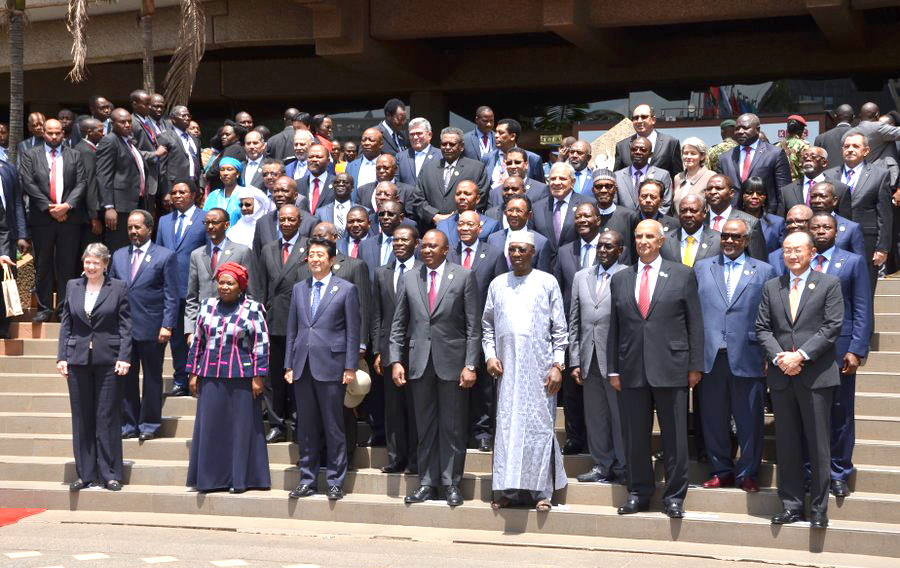
In such times, Japan and Africa need to join hands once again and move forward together with a strategic vision. The Free and Open Indo‑Pacific (FOIP) is exactly such a vision, which the former Prime Minister Shinzo Abe put forward in Nairobi in 2016, when the sixth Tokyo International Conference on African Development (TICAD VI) was held in Africa for the first time.
Prime Minister Abe stated: “We wish to work together with the people of Africa to ensure that the seas connecting our two continents are peaceful and governed by rules. That is Japan’s aspiration.” FOIP positions the ‘two continents’ of Asia and Africa, and the ‘two oceans’ of the Pacific and the Indian Ocean, as the key to the future peace and prosperity of the international community, and demonstrates Japan’s resolve to build a free and open international order in this region.
Ten years have passed since FOIP was proposed, and we now face the realities of a new era: intensifying geopolitical competition, the growing importance of economic security, and the rapid pace of technological innovation particularly in AI and digital technologies, along with the struggle for hegemony in these fields.
Whilst the importance of the core principles of FOIP, namely ‘freedom’, ‘openness’, ‘diversity’, ‘inclusivity’ and ‘the rule of law’ remains unshakeable, it is also necessary for each country to become autonomous and resilient in fields such as the economy, society and security in order to realise FOIP amidst these challenging international circumstances. Japan intends to make every effort to achieve this as a trustworthy and equal partner.
To date, Japan has worked towards realising FOIP through a variety of initiatives, such as the development of the Mombasa port. Based on this approach, Japan established the Official Security Assistance (OSA) in 2023.
OSA is already implementing cooperation with Djibouti in Africa, and we are currently making arrangements to expand this to Kenya as well. Japan will continue to ‘evolve’ the FOIP initiative and further strengthen its cooperation with African nations, starting with Kenya.
Furthermore, Japan recognises the vital role of international organisations in Nairobi. The United Nations Office at Nairobi (UNON), located here, serves as a key hub for the United Nations in the Global South, hosting numerous international organisations such as the United Nations Environment Programme (UNEP) and the United Nations Human Settlements Programme (UN-Habitat).
Through close cooperation with these international organisations via the Government Mission to International Organisations in Nairobi, established last year, Japan aims to enhance our capacity to address global challenges such as environmental conservation, urban development and peacebuilding, and to jointly promote forward-looking international cooperation.
TICAD, now marking its landmark 10th anniversary, is scheduled to be held in Africa once again. I hope that my visit will serve as an opportunity to further deepen our cooperation in the run-up to TICAD 10.
In order to realise a better future for Japan, Kenya and the world, I wish to further strengthen our cooperation not only within the bilateral relationship but also within the framework of TICAD and on the international stage as a whole.