
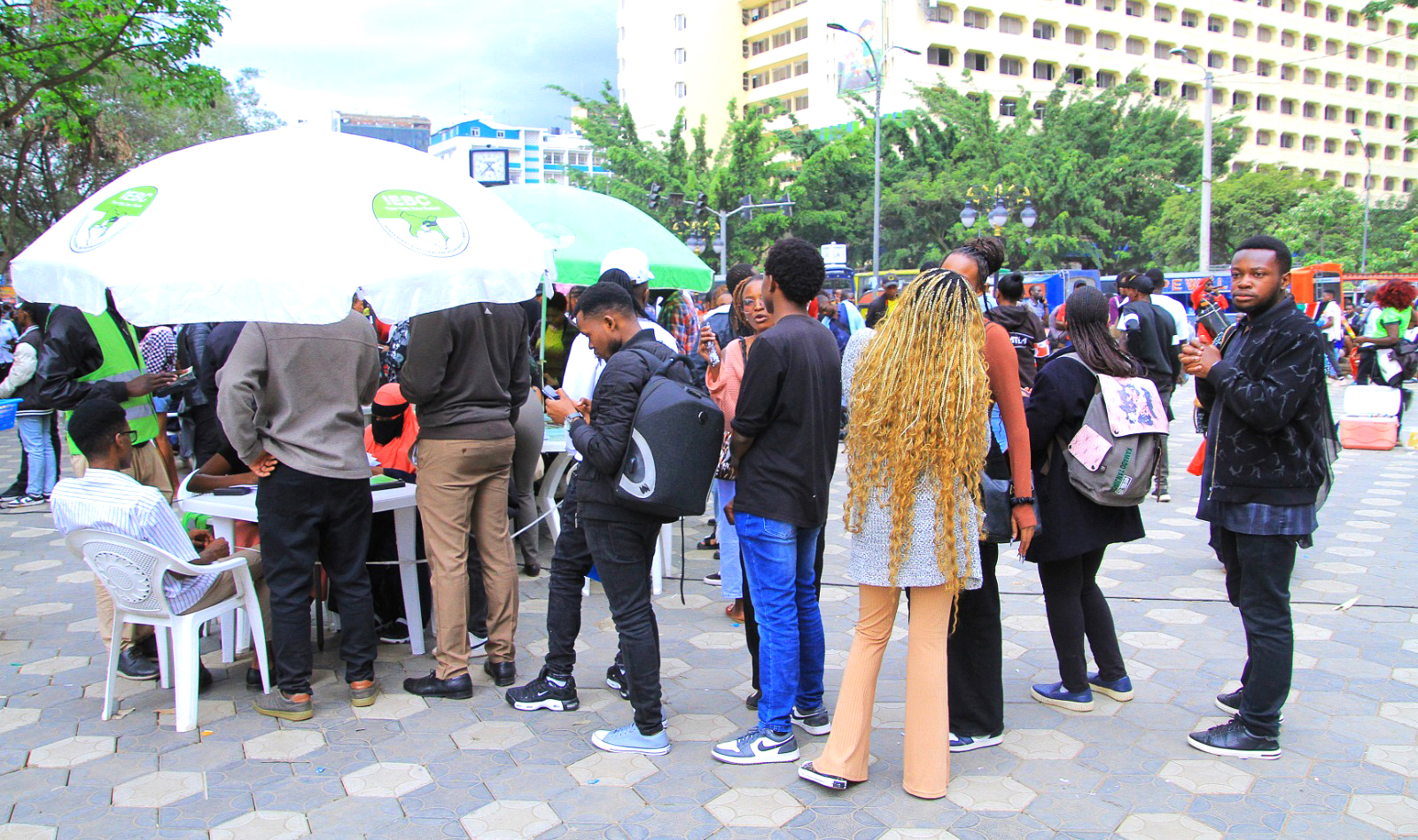
Kenyans went through a period of enhanced continuous voter registration that ended on Tuesday, April 28. Almost two million new voters were registered, with Nairobi and Kiambu leading the pack of the counties.
The enhanced continuous voter registration period has lapsed today, with more than 1.8 million new voters already listed by the electoral body, IEBC. The exercise, which began on March 30, had targeted at least 2.5 million new voters. It appears from a glance that the IEBC overestimated the number of citizens not yet registered as voters.
In the alternative, it is imperative to note that the publicity and mobilisation might not have been undertaken effectively. During these events that IEBC has conducted regularly, the political class has come out more loudly to sensitise Kenyans to register.
However, political leaders have partisan interests and therefore cannot be relied upon to support the process objectively. Recent events have shown that aspiring and sitting political leaders get actively involved in the exercise solely to woo supporters for their selfish interests. What the political leaders are engaged in, even though they support IEBC endeavours, is political education as opposed to civic education.
Civic education arises from the early concept and contemporary practice of citizenship. Citizenship is the legal status and relationship between an individual and a state, granting specific rights — such as voting, protection and residency — alongside responsibilities such as obeying laws, paying taxes and contributing to society. It defines a person as a member of a political community, often acquired by birth or through naturalisation.
It derives from the classical Greek city-states. In Aristotelian theory, every citizen would gather at the city square, deliberate and make decisions on the city’s affairs. Citizens usually enjoy full civil and political rights, including the right to live, work and vote in the country.
Citizenship involves responsibilities such as civic participation, obeying laws and sometimes national service. To undertake these responsibilities and discharge the duties effectively, every citizen requires a special set of skills and knowledge.
Good citizens exhibit virtues such as responsibility, integrity, compassion and respect, translating into actions such as obeying laws, voting, paying taxes, volunteering and respecting diversity. They prioritise community welfare over personal gain, fostering social harmony and building a resilient society. Key qualities include being informed, law-abiding and active in the community. Being morally upright, trustworthy and truthful is their default setting.
Based on a common philosophical framework, which is often attributed to a modern interpretation of Greek political thought, the three primary types of people in society are citizens, tribalists and idiots. Citizens are individuals who engage in public life, prioritise the common good, understand their rights and responsibilities, and work towards building inclusive, functional communities.
Tribalists or tribesmen comprise individuals whose loyalty and perspective are limited to their specific tribe, ethnicity, religion or group. They view the world through a "us versus them" lens and tend to trust only those within their own group.
In this context, idiots are considered private individuals who are entirely self-centred, focusing only on private pleasure or gain, and not caring about the wider community or its rules.
Civic education is the deliberate effort and process of developing quality citizens. This can only be done effectively by nonpartisan and professional players. Political leaders should offer supporting cast roles. Therefore, the IEBC and similar organisations should be tasked and facilitated to provide this noble service.
In life, a society must make conscious decisions on the type of leader citizens must have. The type of leaders a society has determines whether it progressively develops or regresses and remains backward.
Among the citizens exist thinkers and intellectuals who are philosophers focused on equality and humanity. Then there are professional traders who operate the machinery of society, sometimes acting as elites. Those with limited access to resources and rights constitute the oppressed. This duty of selecting good leaders can only be undertaken prudently by citizens.
As has been shown above, citizens must be nurtured and given the right mental tools to be productive. In Kenya, the selection and appointment of public officers to political offices have been compromised by tribalism and nepotism. The tribe has become the bastion of political mobilisation since the struggle for Independence.
Jaramogi Oginga Odinga mobilised the Luo community to join with Jomo Kenyatta’s Kikuyu community in Kanu. Daniel Moi organised his Kalenjin ethnic communities to combine forces with Ronald Ngala’s Giriama and Masinde Muliro’s Luhyia communities, respectively under Kadu.
Kenyatta and Oginga won the ensuing elections under the unitary manifesto against the Majimbo ideology of regionalism promoted by Moi and Ngala. What is crucial is that the tribes under Kadu were brought together by the fear of the erstwhile big tribes – Kikuyu and Luo. This dichotomy would come to haunt the national unity initiative when Oginga fell out with Kenyatta in 1966.
The events that followed the dissolution and assimilation of Kadu by Kanu led to the reconfiguration of the political architecture of the country. Kenya soon after became a one-party state in practice.
To contain the rebellion of the Luo community, the Kenyatta administration marginalised them by excluding them from government leadership and administration. Development projects were never taken to Nyanza, thereby making the region lag and remain backward. Eventually, under Moi as president, the country became a de jure one-party state in 1982.
The height of the official one-party system was the infamous mlolongo method of voting. The method significantly reduced the civil rights of citizens and their civic duties and responsibilities. When multiparty system was later reintroduced in 1992, the tribe once again became the focal point of political mobilisation. Voting was done along ethnic fault lines.
Tribalism soon degenerated into barbarism and every election witnessed violent reactions. In 2007, matters came to a head when the presidential election results were disputed and led to unprecedented post-election violence. It took the intervention of the international community to calm nerves through the formation of the grand coalition government in 2008.
When the dust settled, thousands of lives had been lost, hundreds of persons displaced and maimed. Millions of shillings worth of property had been destroyed and lost. It was the clearest demonstration of extremely low-quality citizenship close to savagery.
The challenges facing citizens that compromise their ability to make rational choices at the ballot can be largely attributed to lack of proper mentorship into citizenship. The reliance by national institutions on political leaders for civic education has curtailed the effectiveness of the process.
The citizens cannot elect quality leaders because they rely on the same for direction. This logically leads to inability to hold the leaders accountable for their mandates. This has made the political leadership generally mediocre and uninspiring.
While the citizens wish for a transformative leadership at the political front, they lack the virtues of good citizens to make such monumental decisions. Voting, which starts with registration and concludes at the ballot booth when a voter casts their vote, has been watered down. It is taken more to be a political responsibility than a civic duty.
Stakeholders should reassess the process with a view to making it more civic than political. This will rightly place the role of citizen development through civic education on institutions such as IEBC, instead of the political leadership.
The writer is a political and policy analyst





