If you live in Mukuru, you already know the price of being forgotten. You pay up to 150 per cent more for illegal electricity than your neighbour in Kilimani pays legally. You walk home in the dark because seven out of every 10 streetlights in this city do not work. When it rains, raw sewage backs up through infrastructure that was never designed for the density you live in.
This is Nairobi in 2026 — the capital city of a republic that hosts two United Nations headquarters and brands itself the innovation hub of East Africa.
On February 17, William Ruto signed a cooperation agreement between the national government and the Nairobi City County Government. In his speech, he outlined approximately Sh80 billion in capital investments: Sh9 billion for trunk sewers, Sh6 billion for a new wastewater treatment plant, Sh3.7 billion for street lighting, Sh8.7 billion for roads, and more.
He promised a dedicated metropolitan police unit within 60 days. He spoke of a capital city that must work, must function, must meet the highest standards. It was a speech designed to make you believe that change is finally coming.
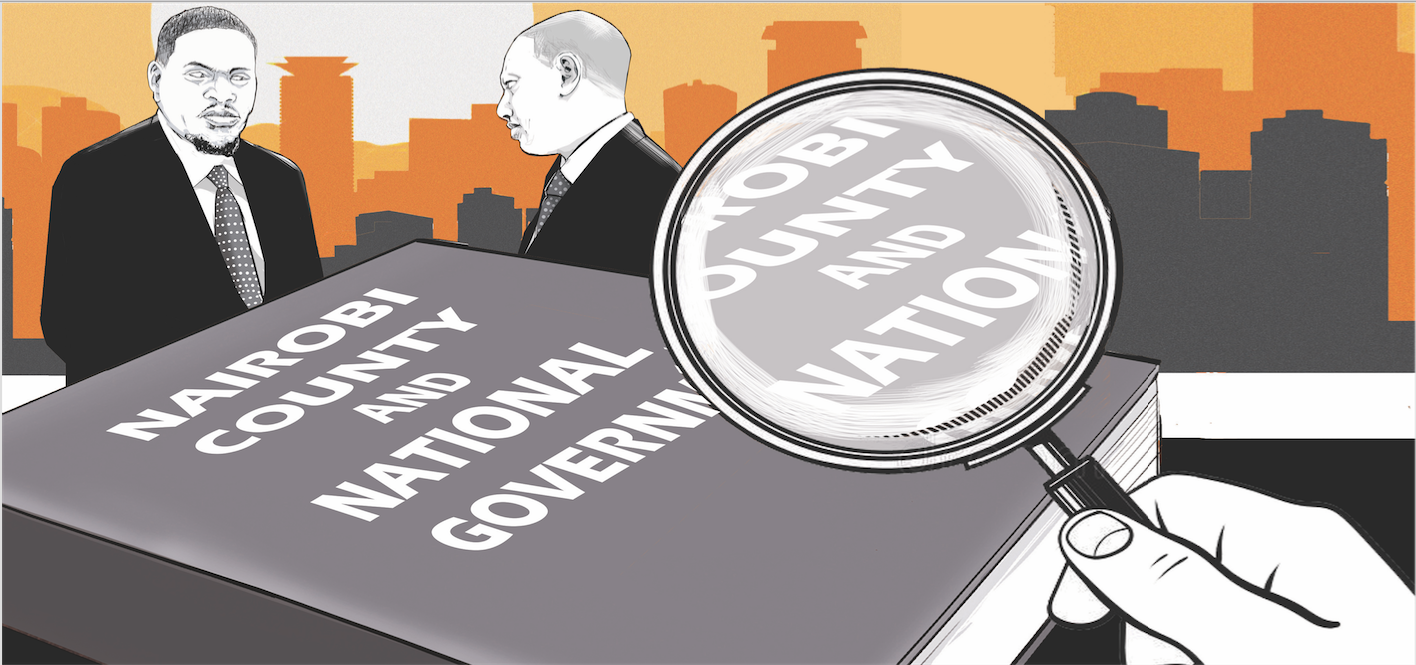
I have read the actual agreement. You should know what it says — and what it does not.
The 13-page document is a framework for cooperation, grounded in the Urban Areas and Cities Act and Article 189(2) of the Constitution. Its legal basis is solid. It explicitly states that no functions are being transferred from the county. It creates a governance structure and lays the groundwork for joint projects.
But here is what the agreement does not contain: a single one of the figures the President quoted. The Sh80 billion? Not in the document. The Sh9 billion for sewers? Absent. The street lighting budget? Nowhere. Every number in that speech was a political aspiration, not a contractual commitment.
Clause 7.1 says the parties will “jointly agree on the modalities for financing.” Clause 7.3 requires all projects to go through normal budgetary processes at both national and county levels. In plain language, every shilling of the Sh80 billion must still survive the annual budget cycle, compete with debt servicing that now exceeds Sh1.4 trillion, and clear procurement hurdles across multiple ministries. The agreement commits no one to any specific expenditure.
Nairobians have been here before. In 2020, the Nairobi Metropolitan Services was launched under Major General Mohammed Badi with the same energy and the same ambition. Hospitals were announced. Roads were dug up. Sewer lines were contracted. Then the Auditor General reported that taxpayers may have lost Sh2.6 billion in advance payments to contractors for works that stalled.
Governor Johnson Sakaja inherited a Sh16 billion pending bills burden and sought a parliamentary inquiry into Sh45 billion in NMS spending.
The NMS operated on a 24-month tenure. This new agreement? Also, 24 months, with either party able to walk away on six months’ notice.
The pattern is not unique to Nairobi. The Institute of Economic Affairs recently described stalled public projects as a structural weakness in Kenya’s public investment framework. Road projects historically achieve about 60 per cent budget execution, with cost overruns of up to 80 per cent and timelines that routinely double.
The Office of the Controller of Budget has flagged this year after year. Nothing changes. The supplementary budget process, designed for emergencies, is routinely abused to redirect development funds toward recurrent spending such as travel and allowances.
What would make this agreement different? The things it does not include: independent project monitoring with public dashboards so every Nairobi resident can see what was promised, what was spent, and what was delivered; ring-fenced escrow accounts so capital allocations cannot be raided mid-year; milestone-based disbursement so contractors are paid for completed work, not promises; competitive procurement with public disclosure.
None of these appears in the agreement. The only reporting mechanism is an annual report to the National Cabinet and the County Executive Committee. For Sh80 billion in proposed spending in the capital city, that is not accountability. That is a formality.
To be fair, there are things this agreement gets right. The legal grounding in the Urban Areas and Cities Act is far stronger than the NMS arrangement. The acknowledgement that Nairobi’s fiscal formula was never designed for a capital of this scale is 14 years overdue. The Nairobi River Regeneration Programme, already employing 45,000 young people, shows that delivery is possible where political attention is sustained. And unlike the NMS, the county government retains its mandate. Governor Sakaja chairs the Implementation Committee. The power dynamics are more balanced.
But balance does not guarantee results. The real test lies in the supplementary arrangements contemplated under Clause 11 of the agreement, where project-specific budgets, timelines, and accountabilities would need to be nailed down.
If those arrangements begin to emerge in the next 90 days with genuine specificity and safeguards, there is reason for cautious optimism. If the agreement sits on a shelf while ministries negotiate budget lines and procurement timelines stretch past the next election cycle, Nairobi will have gained a well-drafted legal document — and nothing more.
The woman in Mukuru will still be paying 150 per cent more for her electricity. The streetlights will still be dark. The sewage will still back up when it rains.
Read the fine print. Always read the fine print.