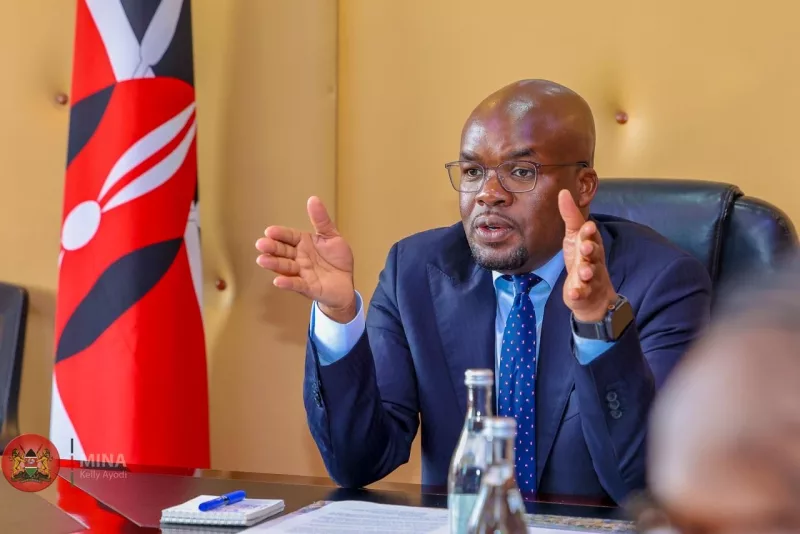
 Hon. Mustafa Abdirashid Ahmed is MCA Iftin and current Deputy Speaker of Garissa County Assembly./COURTESY
Kenya’s political arena is once again in a state of fluid reconfiguration, shaped by a rupture few anticipated in both its speed and its consequences: the fallout between President William Ruto and his former deputy, Rigathi Gachagua. The impeachment of Gachagua in late 2024 did not merely signal the end of a political partnership; it triggered a recalibration of power, loyalty, and electoral strategy that now defines the road to 2027.
What appeared, at first glance, to be a decisive assertion of presidential authority has evolved into a complex political gamble. In removing a deputy who had become increasingly combative and unpredictable, the presidency achieved short-term internal discipline. The executive arm grew more coherent, messaging became synchronised, and policy direction sharpened. Yet beneath that surface stability lies a deeper, more consequential question: at what cost was that order achieved?
Central to this unfolding drama is the Mt Kenya region, the country’s most influential voting bloc and often the ultimate kingmaker in presidential contests. In 2022, Gachagua was not just a running mate; he was the political bridge that delivered the Mountain to Ruto. His grassroots mobilisation, his unapologetic ethnic messaging, and his ability to translate national narratives into local idioms proved decisive. His removal, therefore, was not just institutional; it was symbolic. To many within the region, it signalled a rupture in trust.
Gachagua has been quick to weaponise that perception. Recasting himself from insider to aggrieved outsider, he has embraced a narrative of betrayal, framing his impeachment as a calculated political purge rather than a constitutional process. His rhetoric, raw, emotive, and steeped in populist undertones, has found fertile ground among sections of the electorate that feel sidelined. By invoking identity and grievance, he is not merely defending his legacy; he is reconstructing his political relevance.
Meanwhile, the administration has responded with a dual strategy: consolidation at the centre and diversification at the periphery. The elevation of Prof Kithure Kindiki represents a deliberate shift toward a more technocratic and less confrontational style of leadership. Prof Kindiki’s approach, measured, policy-orientated, and institutionally grounded, stands in stark contrast to his predecessor’s combative populism. The hope within government circles is that competence, stability, and delivery will gradually outweigh the emotional turbulence stirred by Gachagua’s exit.
At the same time, President Ruto has pursued an ambitious broad-based government strategy, incorporating elements of the opposition, notably figures aligned with the late Raila Odinga. This recalibration aims to construct a wider national coalition that cushions the administration against regional volatility. In the short term, it has delivered legislative ease and reduced political friction. In the long term, however, it raises uncomfortable questions about ideological coherence and the erosion of the Hustler identity that powered the 2022 victory.
Indeed, one of the unintended consequences of this realignment is the dilution of the very narrative that once distinguished Kenya Kwanza. The populist, bottom-up ethos has increasingly given way to a pragmatic, elite-driven consensus. For critics, this is not evolution but abandonment, a retreat from principle in favour of survival. And it is within this perceived ideological vacuum that Gachagua is attempting to reinsert himself as the authentic voice of the disenfranchised.
His strategy is methodical. Through relentless grassroots engagements and carefully choreographed public appearances, he is rebuilding a political base anchored in regional solidarity. Should he succeed in consolidating Mt Kenya as a unified voting bloc outside the government’s orbit, he would fundamentally alter the electoral map. For the first time in decades, the mountain could transform from a predictable stronghold into a contested swing region, dramatically complicating the incumbent’s path to re-election.
Yet the equation is far from settled. The legal shadow hanging over Gachagua’s political future introduces an element of uncertainty that could either constrain or amplify his influence. Court battles and constitutional interpretations will determine whether he remains a central actor or becomes a symbolic figurehead. Either way, his continued presence in the political discourse ensures that the government cannot fully escape the narrative of his removal.
For the administration, the counterweight lies in performance. Economic recovery, cost-of-living stabilisation, and tangible development outcomes remain the most potent tools for regaining public confidence. Should these indicators improve significantly by 2026, the emotional resonance of Gachagua’s ouster may diminish, overtaken by a pragmatic electorate prioritising continuity over conflict.
But Kenyan politics rarely unfolds along purely rational lines. It is a theatre of emotion, identity, memory, and reaction. Elections are not just audits of performance; they are verdicts on belonging and perception. In this context, Gachagua’s greatest strength lies not in institutional power but in his ability to speak the language of the ordinary voter and to convert personal grievance into collective sentiment.
As 2027 approaches, the contest is crystallising into a clash of contrasting political philosophies. On one side stands Ruto’s model of broad-based inclusivity, anchored in coalition-building and governance pragmatism. On the other is Gachagua’s doctrine of regional consolidation, rooted in identity, loyalty, and perceived injustice.
Ultimately, the enduring impact of the Gachagua factor is that it has forced the government onto unfamiliar terrain, defensive within its own traditional stronghold. While the numerical strength of the administration remains intact, the psychological cohesion of its base has been disrupted. The mountain, once firmly anchored, now appears restless, its political direction uncertain.
The months ahead will be decisive. They will test whether development can outweigh discontent, whether new leadership can inspire renewed trust, and whether a fractured coalition can reinvent itself as a durable national movement. What is certain, however, is that the shadow of the former deputy president will stretch long and wide, shaping narratives, influencing alliances, and hovering over every calculation leading to 2027.
In Kenya’s high-stakes political chessboard, no move exists in isolation, and the aftershocks of this one are still unfolding.
The author is the MCA for Iftin Ward and Deputy Speaker Garissa County Assembly. A columnist and a playwright.