 Hon.Salah Maalim Alio, Horn of Afrika, Governance , Peace and Security Management Specialist and CEO of Sambul Consulting.
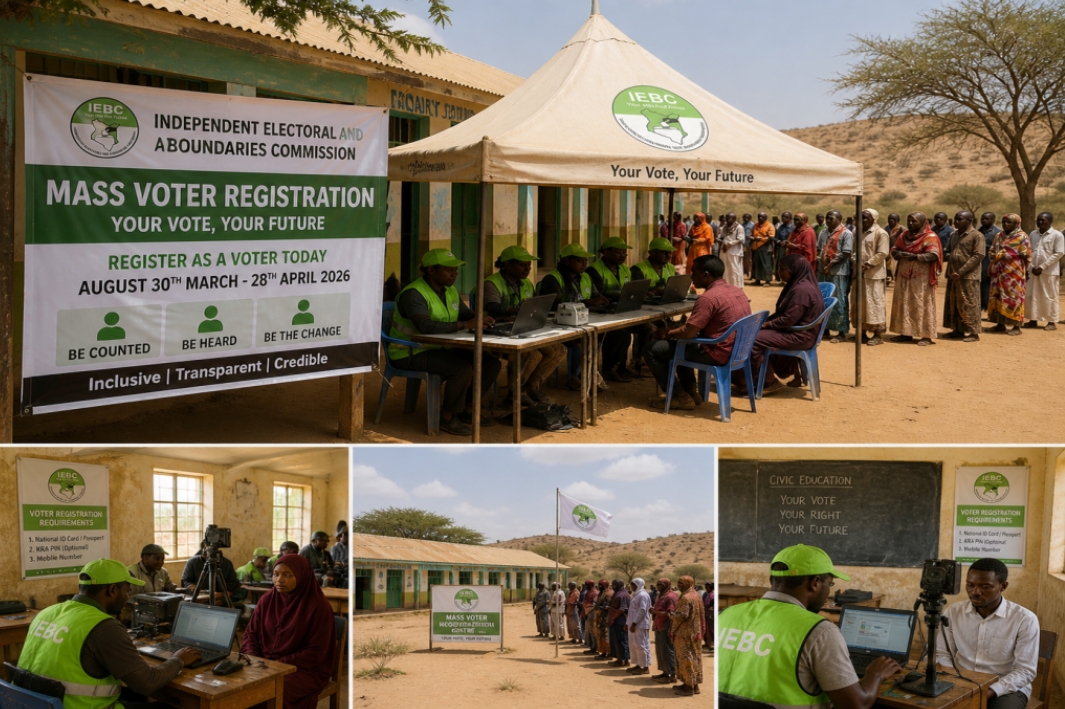
The recently concluded Phase I of the mass voter registration exercise by the Independent Electoral and Boundaries Commission (IEBC), conducted between March 30 and April 28, 2026, offers both encouraging signals, disturbing realities and sobering lessons.
The rollout covered 290 constituencies, 1,450 wards, 57 Huduma Centres, and institutions of higher learning across the country, the outcomes reveal a persistent structural imbalance—particularly in Kenya’s arid and semi-arid lands (ASALs).
The data speaks clearly. Counties in ASAL regions, including Lamu,Tana River,Isiolo, Mandera, Wajir,Garissa and Marsabit, recorded comparatively lower registration numbers relative to their population and target potential. This is not a reflection of civic disinterest alone, but rather a manifestation of layered operational, environmental, and socio-economic constraints that must be understood in context.
First, security considerations continue to shape electoral operations in northern Kenya. Certain localities require escorted movement, which limits flexibility and reduces the number of operational hours available for registration. This inevitably affects outreach, especially in border towns and remote zones where security protocols are non-negotiable.
Second, logistics remain a central bottleneck. Vast distances, poor internet,road infrastructure, and sparse settlement patterns significantly increase the cost and complexity of deploying registration kits and personnel. In regions like Mandera East, mobility is not just a convenience—it is a prerequisite. When deployment schedules are disrupted by terrain or fuel constraints, entire communities are effectively locked out of the process.
Third, the proliferation of misinformation and disinformation significantly undermined public confidence. In some areas, false narratives around voter registration requirements and intentions discouraged participation. This challenge is compounded by limited access to verified information channels, making communities more vulnerable to manipulation.
Forth environmental factors cannot be overstated.The ASAL regions experienced both flooding and prolonged drought conditions during the registration window. Flooded access routes and displaced populations disrupted planned deployment, while drought conditions forced pastoralist communities into migratory patterns, placing them far from fixed registration centers. Electoral planning that does not integrate climate variability is, by design is incomplete.
Fifth, voter education remains insufficient. Civic awareness campaigns have not adequately penetrated remote regions, leaving many eligible voters unclear about the importance, process, and timelines of registration. This feeds into a broader issue of voter apathy, particularly among populations that feel historically marginalized from governance processes. However, within these challenges lies a powerful counter-narrative—one driven by Kenya’s youth.
Across the country, and notably even within ASAL regions, Gen Z voters turned out in significant numbers where access was possible. Their participation signals a generational shift: a growing recognition that governance begins with registration.
One, IEBC must adopt context-specific deployment models for ASAL regions. This includes mobile registration units tailored to pastoralist mobility patterns and flexible scheduling aligned with local calendars.
Two, climate-responsive planning must be institutionalized. Electoral timelines and logistics should integrate meteorological data and contingency frameworks to mitigate environmental disruptions.
Three, sustained and localized voter education campaigns are essential. These must leverage community structures, local leadership, and youth networks to counter misinformation and build trust.
The integrity of our democracy depends not just on the right to vote, but on equitable access to registration.
If Kenya is to realise truly inclusive electoral participation, the ASAL regions must no longer be treated as peripheral—they must be planned for with precision, investment, and intent. The lessons from Phase I are clear. The question is whether we are prepared to act on them before the next cycle.
The writer is a Governance, Peace and Conflict Resolution Specialist aand CEO Sambul Consulting.