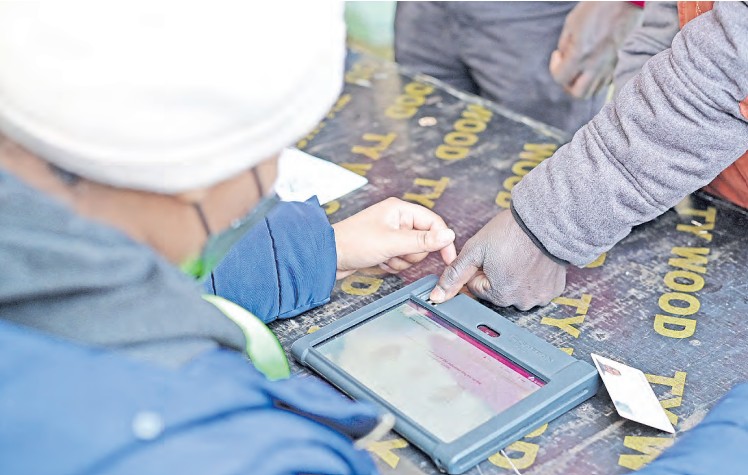
The electoral agency has rolled out plans to introduce a
system to secure Kiems kits and tighten control over sensitive election equipment.
The Independent Electoral and Boundaries Commission
(IEBC) seeks to use a Radio Frequency Identification (RFID) system to track the
poll devices from the point of dispatch to their destinations.
Under a newly issued tender, the electoral agency wants to deploy the RFID-based inventory management system at its main elections technology centre.
Its implementation would mark a shift towards automated tracking of voting devices and real-time visibility of their movement.
The project targets Kiems tablets first, but the scope is designed to expand to other electronic equipment, including laptops, desktops, printers, power banks and satellite devices.
IEBC says the system will provide “end-to-end visibility and control” over devices during storage and maintenance cycles, ensuring what it terms an “unbreakable chain of custody” from receipt to dispatch.
HOW IT WORKS
According to the technical specifications, each Kiems kit will be fitted with a passive high-frequency tag carrying a unique identity.
The tags will be scanned by handheld and fixed radio frequency identification readers installed at storage rooms and entry or exit points.
Once tagged, every device will be registered into a centralised database, linking the radio frequency code to the tablet’s serial number, model, user and physical location.
Movement in and out of stores will be captured automatically, allowing bulk scanning without line-of-sight and replacing manual counting procedures.
The system is designed to support automated check-in and check-out, track issuance and returns and generate detailed reports on asset location, movement history and inventory status.
IEBC also wants real-time alerts for unauthorised movement or missing items, alongside audit trails showing who handled each device and when.
A web-based dashboard and Android mobile application will give authorised staff access to live inventory data.
The integration with existing commission systems is planned through application programming interfaces.
IEBC has not used RFID before, hence this tender marks the first attempt to apply the technology to secure Kiems tablets and related election equipment.
The location of Kiems kits has been a bone of contention in past presidential polls.
In 2022, the legal team for Azimio, then led by Raila Odinga [deceased], alleged in the Supreme Court case that the kits were manipulated and allowed unauthorised access.
They claimed the kits were changed to transmit results from unauthorised or unspecified locations rather than from the designated polling stations.
The legal team argued some Kiems kits were transmitting data from unknown locations for many hours after the close of the election.
Claims were made that the gadgets’ GPRS and geofencing features, designed to lock the kits to specific locations, were deactivated.
There have been audit concerns about missing or untracked kits. An audit for the period to June 30, 2024, revealed 200 kits were missing.
The machines were not returned to the IEBC’s central warehouse after the 2017 and 2022 general elections. The IEBC said it was unable to trace the kits.
Kiems kits are used to identify voters, are loaded with results transmission software and are able to access registered voters’ data.
IEBC seeks to change the scenario through the new bid, with the tender setting performance targets to include a system with 99 per cent accuracy.
They say it should assure accurate tracing under normal indoor conditions, database response times of under two seconds, and system availability of 99 per cent.
Security requirements include encrypted connections, role-based access controls and multi-factor authentication, aligned to the latest information security standards.
55,000 KITS
The bill of quantities attached to the tender indicates IEBC plans to procure RFID tags for about 55,000 tablets, including a 10 per cent spare margin.
They will be sourced alongside handheld readers, fixed readers and antennas, a centralised server and inventory management software.
The initial rollout will be based at the main warehouse in Nairobi’s Industrial Area, before it is scaled to county and constituency warehouses in future.
The commission seeks to track equipment nationwide. IEBC has not disclosed the projected cost of the rollout.
It has instead invited bidders to quote prices for tagging about 55,000 tablets, readers, software, servers and support services.
Beyond hardware, the winning bidder will be required to provide installation, configuration, staff training and at least two years of technical support.
Already, IEBC is under scrutiny over the procurement of election technology. Election seasons are usually rife with complaints of delayed deployment and data integrity.
IEBC says by shifting to RFID-based tracking, it aims to automate audits, reduce manual workload and improve accountability across its logistics chain.
The system is intended to capture “event-based data” every time a device is issued, returned or relocated, creating a digital footprint that can be reviewed in real time.
While the tender focuses on inventory management rather than vote transmission, officials see a first step in safeguarding election infrastructure ahead of 2027.