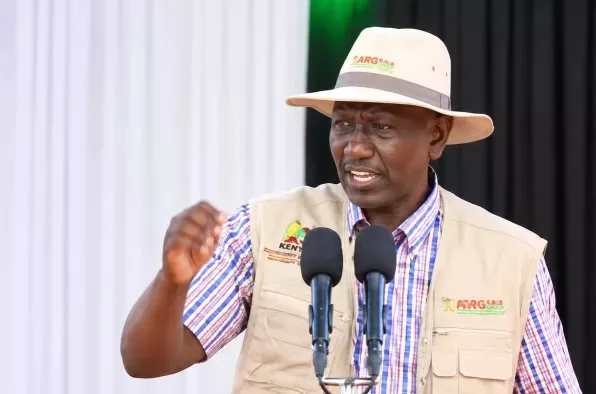
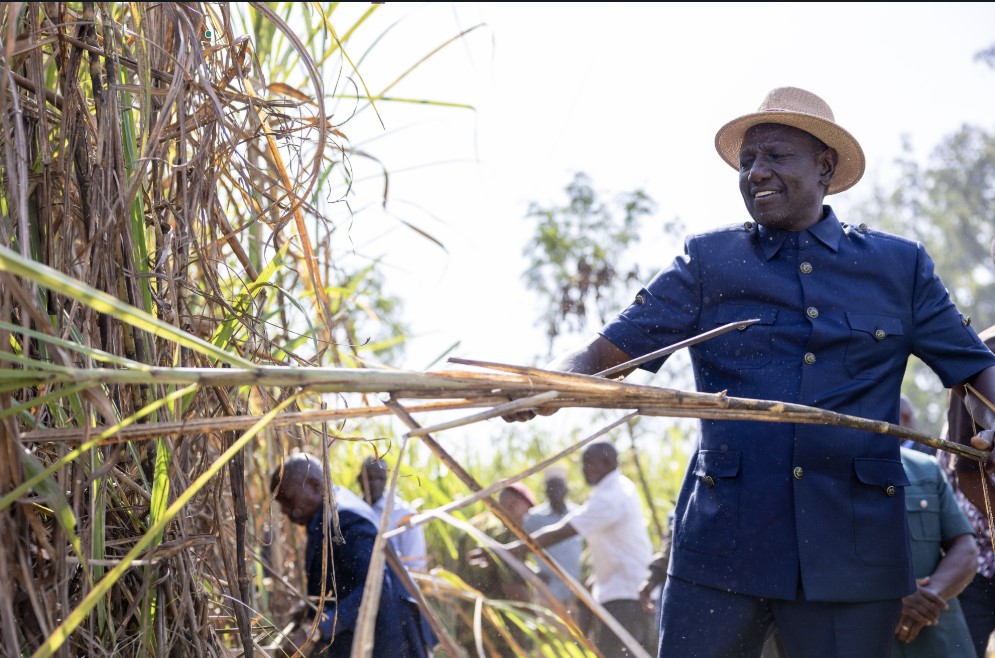
 President William Ruto cuts sugar cane in Mumias, Kakamega county, on January 20, 2025. For decades, Mumias stood as a symbol of industrial promise in western Kenya /FILE
Mumias is not poor by accident. It is not marginal by destiny. It has not declined because it lacks resources, people, or history. Mumias has declined because of systemic leadership failure sustained by weak citizenship - a toxic bargain that has reproduced underdevelopment election after election.
This is the uncomfortable truth Mumias must now confront as Kenya inches toward 2027.
For decades, Mumias stood as a symbol of industrial promise in western Kenya. Anchored by Mumias Sugar Company, it was a growth pole—linking farmers to industry, labour to wages and the town and proud community to national imagination.
That promise collapsed not in one moment, but through years of elite capture, political cowardice and citizen disengagement. When it collapsed, Mumias lost jobs, incomes and dignity. More damningly, it exposed how politically defenceless the region had become.
From independence, the political culture of Mumias – and later Mumias East, Mumias West and Matungu – was shaped by a narrow understanding of leadership. MPs, save for may be Elon Willis Wameyo, were largely appendages of the central state.
Their politics focused on loyalty, not leverage; access, not accountability. Development was transactional – a road and a dispensary here, a school and a bridge there – never structural, never strategic. No institutions were built to protect local economic power.
The return of multiparty politics did not fundamentally cure this structural pathology. It entrenched it. Mumias entered an era of competitive populism without developmental clarity.
MPs campaigned as clan champions, personal benefactors, or party foot soldiers – but rarely as strategic legislators, representatives of the people of Mumias, capable of defending Mumias’ long-term socioeconomic interests.
The collapse of Mumias Sugar Company should have been the political reckoning moment. The opportunity was squandered. Instead of sustained legislative pressure, forensic oversight, or coordinated regional advocacy, Mumias witnessed: Silence when looting occurred; noise without strategy when collapse became obvious; blame-shifting when consequences hit households.
At no point did leaders successfully build a multi-level coalition – linking Parliament, county government, farmers, unions, professionals/technocrats and private capital – to defend or restructure the sugar economy.
Indeed, what failed was not just a factory, but political imagination. The slow suffocation of the company was the ultimate test – and leadership failed it, dismally.
There was no sustained parliamentary interrogation of ministries responsible for agriculture and industry. No relentless oversight of receivership, asset stripping, land grabbing or policy sabotage. Instead, leaders attended taskforces, traded blame publicly, issued declarations – and quietly moved on. They danced, cat-walked and tik-toked on the misery of the people.
The result has been catastrophic but predictable. Cane farmers have been impoverished. Workers discarded. Small businesses have collapsed. Mumias town hollowed out. A once-productive economy and proud people have been reduced to dependency without a serious political fight.
Even the celebrated expansion of CDF spending has only succeeded in masking this failure rather than correcting it. Classrooms have multiplied. Bursaries have flowed. Yet unemployment has deepened.
Poverty widened. Why? Because projects are not development. Development is power: the power to negotiate investment, influence industrial policy, protect value chains and discipline state agencies that undermine local economies. Mumias MPs largely ducked this harder work.
Today, the crisis persists across all three constituencies, dressed up as a new political moment. Youth unemployment remains chronic. Informal traders struggle. Public institutions are thin and mistrusted.
Politics is louder than ever – and thinner than ever. Leaders are hyper-visible but strategically absent. Visibility is mistaken for relevance; noise for influence. Mumias suffers from irrelevance where decisions are made. But leadership failure alone is not the full story.
Citizens across Mumias East, Mumias West and Matungu must also confront their role. Voters have repeatedly rewarded behaviour that undermines their own interests: generosity over governance, insults over ideas, ethnic signalling over economic strategy.
Budget literacy is low. Legislative records are rarely interrogated. Elections are treated as emotional rituals, not instruments of leverage.
This low-demand citizenship has consequences. Politicians quickly learn that theatrics are safer than competence, and that short-term excitement beats long-term delivery. When citizens demand little, leaders deliver less.
As 2027 approaches, Mumias faces a stark choice.
It can continue recycling disappointment and idiocy – or it can renegotiate the relationship between leaders and citizens. What Mumias needs is not a new face, but a different kind of MP: policy-literate, economically grounded, legislatively active and ethically credible.
A people’s representative whose primary task is not distributing projects, but defending Mumias’ interests in national decision-making spaces – on agriculture, industry, jobs and regional development.
Equally important, Mumias needs a new civic posture. Citizens must organise around issues, demand plans rather than promises, interrogate budgets and track delivery. Voting must become strategic, not habitual.
Political renewal is never gifted. It is forced – by citizens who insist on seriousness. Mumias still has the human capital, land and history to recover. What it lacks is not potential, but discipline: disciplined leadership and awake citizenship.
That work cannot wait for 2027. It must begin now.