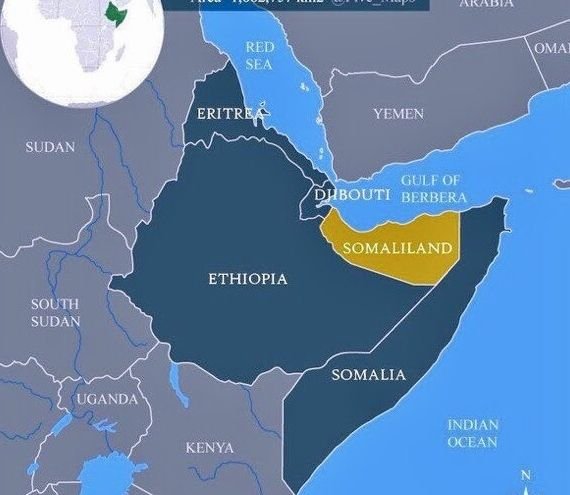
 The Horn stands not only as a maritime crossroads but also as a geopolitical frontier where strategic opportunity and insecurity coexist /HANDOUT
Few regions in the world sit at the heart of so many global interests as the Horn of Africa.
Perched along the Red Sea and the Gulf of Aden, this narrow corridor of water connects the Indian Ocean to the Mediterranean through the Suez Canal, a route through which nearly one-third of global trade, including vital oil and gas supplies, passes every year. What happens along these waters matters not just to the Horn, but to the entire world.
Its proximity to the Middle East further elevates its geopolitical significance, positioning it as a pivotal bridge between Africa, the Arabian Peninsula and the wider Indo-Pacific. It’s is also an important gateway to other parts of the continent of Africa.
The Horn stands not only as a maritime crossroads but also as a geopolitical frontier where strategic opportunity and insecurity coexist. It is a region marked by fragile states with cases of piracy, terrorism and recurrent conflict, yet simultaneously rich in maritime, economic and strategic potential that continues to draw the engagement of global powers.
For decades, the United States and other Western powers have viewed the Horn as both a security and economic frontier, a place where they can protect global shipping routes, combat terrorism and project influence across Africa and the Middle East.
Yet, the story of the Horn’s maritime importance is no longer a Western one alone. Over the past two decades, a new wave of external powers, including China, Russia, Turkey, Iran and the Gulf States have entered the waters, each pursuing their own interests.
China’s first overseas military base is in Djibouti, just a few miles from the long-established US base, while Gulf countries have built or leased ports in places like Berbera and Assab. This growing competition has transformed the Horn into a crowded and contested maritime theatre.
The influx of foreign military bases and maritime agreements in the Horn of Africa has raised fundamental questions about the extent to which regional states retain effective control over their maritime domains.
While agreements granting external powers exclusive or preferential access to ports, air bases and logistics corridors can generate short-term revenue and security guarantees, they often constrain long-term sovereignty and weaken domestic maritime governance capacity.
Such arrangements may limit a state’s ability to regulate access to its waters, manage port infrastructure in the national interest, or coordinate maritime security independently of external actors.
The ongoing tensions between Somalia and the United Arab Emirates illustrate how external maritime engagement can exacerbate internal political fragmentation and regional instability.
The UAE’s direct engagement with Somalia’s federal member states, particularly Somaliland and Puntland, through port investments and security arrangements, has increasingly bypassed the federal government in Mogadishu.
From the perspective of the Somali state, these arrangements undermine federal authority over maritime assets and foreign policy, effectively decentralising control of ports and coastal infrastructure without national consensus.
For the UAE, such subnational engagements serve strategic maritime and commercial interests along the Red Sea-Gulf of Aden corridor, but they also entangle foreign objectives with Somalia’s unresolved state-building process.
These dynamics have turned maritime infrastructure and access into arenas of political contestation, pitting federal authorities against regional administrations and deepening internal divisions. Rather than strengthening Somalia’s collective maritime governance, external competition has contributed to fragmented authority over ports, security forces and revenue streams.
In this context, maritime engagement becomes a vector through which external rivalries are localised, transforming domestic governance disputes into proxy battlegrounds that prolong political instability and complicate conflict resolution.
Instead of viewing the ocean merely as a space for foreign leases or security operations, the horn of Africa governments must see it as an engine for development, through fisheries, renewable energy, trade and the emerging blue economy.
The Horn’s maritime future should be built on partnerships that strengthen governance and skills, not just on rent from foreign bases or transit fees from ports.
Equally important is the need for accountability and transparency. Maritime wealth, whether from ports, fisheries, or undersea resources, must be managed for public benefit, not captured by domestic and foreign elites.
Strong institutions and clear rules for foreign investment will ensure that the maritime domain becomes a source of shared prosperity rather than conflict.
Dr Rugutt-Chebon, PhD, is a lecturer in Diplomacy and International Relations. She is programme lead, Africa Centre for Study of the US, Institute of Diplomacy and International Studies, University of Nairobi