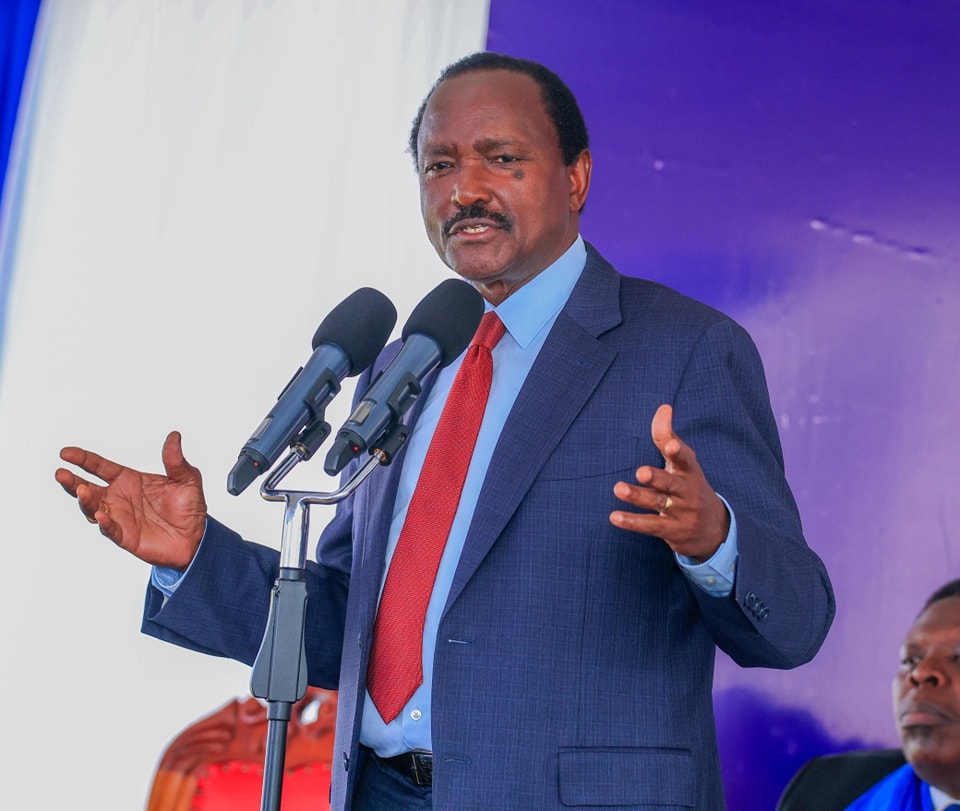
The appointment of Wiper boss Kalonzo Musyoka as Azimioparty leader has stirred fresh speculation about the future of United Opposition politics.
The appointment sees the former vice president step into the role previously held by Raila Odinga until his death in October last year.
The announcement was made on Mondayduring a joint session of the Azimio Council and the national executive committee, chaired by former President Uhuru Kenyatta.
The meeting also saw key leadership changes within the coalition, including the removal of Junet Mohamed as secretary-general, replaced by Suba South MP Caroli Omondi, and the appointment of former Nairobi Town Clerk Philip Kisia as executive director.
In accepting the appointment, Kalonzo described the position as a collective responsibility aimed at national renewal.
“I graciously accept my appointment as party leader of Azimio la Umoja One Kenya coalition. I thank our chairman, (former) President Uhuru Kenyatta, and all constituent parties for this trust,” he said, pledging to guide the coalition’s political direction while fostering unity among its diverse membership.
Kalonzo’s appointment comes amid ongoing realignments within Azimio, prompting speculation that he may be positioned as the joint opposition’s presidential flagbearer in the 2027 election.
Political analyst Fred Sasia said that within the United Opposition, there is little need for protracted lobbying or manufactured debates about seniority.
He explained that the coalition, whether by design or by political gravity, is already coalescing around Kalonzo’s experience.
“Others bring energy, numbers, or regional appeal, but none bring the depth of political capital required to confront an incumbent president on equal footing,” Sasia said.
“To borrow from a familiar analogy, when rats debate who among them can bell the cat, only one rat is realistically capable of doing so and surviving. In this case, that rat is Kalonzo Musyoka. The political ‘cat’ cannot afford to eliminate him.”
Sasia added that without Kalonzo, the opposition lacks the political gravitas, networks and strategic depth needed to seriously unsettle President William Ruto.
“For this reason, the debate on who should be the opposition’s flagbearer is, frankly, misplaced. On the government side, there is no confusion, President Ruto is the candidate. The opposition should exhibit similar clarity and maturity.”
Sasia said that the real conversation should not be whether Kalonzo should lead, but how the coalition should be structured around him, who deputises him, what political vehicle carries the ticket and how the alliance presents a credible governing alternative.
He said the narrative that the Wiper chief is being “prepared” or “groomed” to be opposition flagbearer misses the point entirely.
“He is not an apprentice waiting for his turn. He has already positioned himself in the upper echelon of Kenyan politics through decades of service, sacrifice and strategic engagement.”
The recent restructuring within Azimio reflects broader shifts in Kenya’s political landscape.
Suba MP Caroli, a former aide to Raila, brings to the secretary-general role both legislative experience and a history of engagement with the Kenya Kwanza administration, which he has argued is essential for development in his constituency.
Meanwhile, Kisia, who served as Nairobi’s Town Clerk from 2009 to 2012, is expected to focus on operational management, policy execution and institutional strengthening within the coalition.
The coalition described the appointments as necessary adjustments driven by “evolving political circumstances” to strengthen internal coordination and effectiveness, part of a deliberate effort to reposition and revitalise the party.
These developments come as speculation grows over potential alliances within the United Opposition.
Kalonzo, along with other former Azimio stalwarts such as Martha Karua of People’sLiberation Party, former Interior Cabinet Secretary Fred Matiang’i and DAP–Kenya’s Eugene Wamalwa, are seen as key figures in the political outfit’s strategy to present a united front against Ruto.
Interestingly, the coalition also features impeached Deputy President Rigathi Gachagua, who, while not an Azimio member, has emerged as a leader in the United Opposition, reflecting its cross-party composition and efforts to consolidate anti-Ruto forces.
Political observers say that the inclusion of leaders with both historical and regional influence is aimed at maximising voter appeal across the country’s diverse electoral landscape.
Political commentator, Daniel Orogo, said Kalonzo is clearly being positioned as the de facto opposition presidential candidate.
“As the most senior and seasoned leader within the opposition ranks, he is best placed to marshal and lead the anti-government brigade,” he said.
Orogo added that the former VP’s stature as a unifying national figure, combined with vast political experience, makes him a formidable challenge to the President.
“Having served in two elections as Raila Odinga’s running mate and later as a co-principal in the Azimio coalition, Kalonzo brings unmatched experience, legitimacy and cohesion to the Opposition, qualities that pose a serious threat to the Kenya Kwanza establishment,” he said.
Political analyst Kariuki Ngunjiri is of a different opinion.
He said the elevation to Azimio leader was bound to happen much because Matiang’i is a newcomer and Gachagua has an active case in court.
“But Azimio has no political life, it will not survive the prevailing political climate in Kenya. As a candidate Kalonzo has no national constituency that poses a threat to President Ruto’s re-election,” he said.
Ngunjiri explaind that the Wiper leader has not demonstrated any known manifesto to sell to Kenyans, as he has only been seen saying he wants to be president but without any real plan to govern Kenya.
He added that Kalonzo is also demonstrating a lot of weakness in his politics, as he is seen to be operating as a shadow of Uhuru.
He further said the former VP has not shown any capability to pull a serious national engagement. “He seems to take too much time to get ready. Time is moving. 2027 is nearing.”
A particularly intriguing dimension of the ongoing realignments is the question of Kalonzo’s running mate should he emerge as the joint opposition candidate.
Some analysts speculate that Matiangi, a key figure within Jubilee and Azimio, could play a role in bridging historic divides between the opposition and pro-Ruto supporters who have realigned politically.
The reshuffling of leadership within Azimio has not been without controversy.
Several parties allied to the Azimio have rejected the leadership changes, describing them as null and void.
The parties, including the National Liberal Party and the United Democratic Party, opposed the changes in a letter to the Office of the Registrar of Political Parties, saying they will not recognise the adjustments and plan to challenge them through legal channels.
“We reject in totality the resolutions submitted to your office and caution you from further processing the illegal, null and void resolutions, failure to which we shall seek legal redress in a competent court of law,” the letter read in part.
Further, Junet has in recent months been critical of internal party manoeuvres, alleging that Uhuru was seeking to inject more than Sh1 billion into the Orange Democratic Movement to politically re-energise the party ahead of the 2027 polls.
Junet, who also serves as Suna East MP, claimed that he received instructions from a senior party figure in Kisumu to abandon cooperation with the Ruto administration, reflecting tensions within ODM as the party seeks to navigate its future post-Raila.
Azimio la Umoja, formally the Azimio la Umoja One Kenya Coalition Party, remains one of Kenya’s broadest political coalitions.
Anchored by ODM under Raila’s legacy, the coalition brings together Jubilee, Wiper, Kanu, PLP, DAP–Kenya, NLP, United Progressive Alliance (UPA), among other smaller regional parties.
The coalition’s diversity provides both strength and complexity, with each party bringing distinct regional support, historical influence and voter bases. Wiper, under Kalonzo, commands a significant following in the Eastern region, while PLP and DAP–Kenya extend the coalition’s reach in Central and Western Kenya, respectively.
By accepting the party leadership, the Wiper boss has positioned himself not only as a custodian of Azimio’s political vision but also as a potential presidential flagbearer for a United Opposition.
The political outfit has publicly reiterated its commitment to remain cohesive, signalling that all constituent leaders, including Kalonzo, Karua, Eugene, Matiang’i and Gachagua, are aligned in the pursuit of a single candidate.
This unity, they argue, is essential to consolidating votes and overcoming fragmentation that has historically undermined opposition coalitions in Kenya.