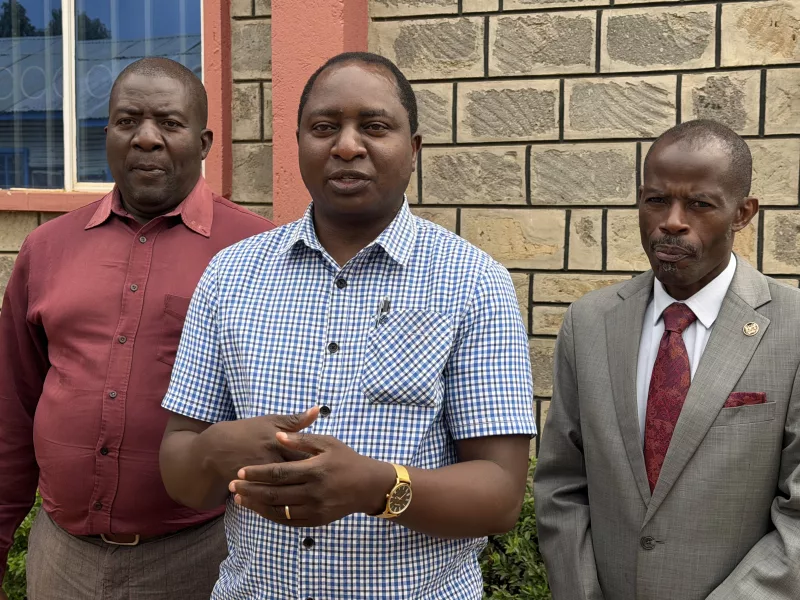
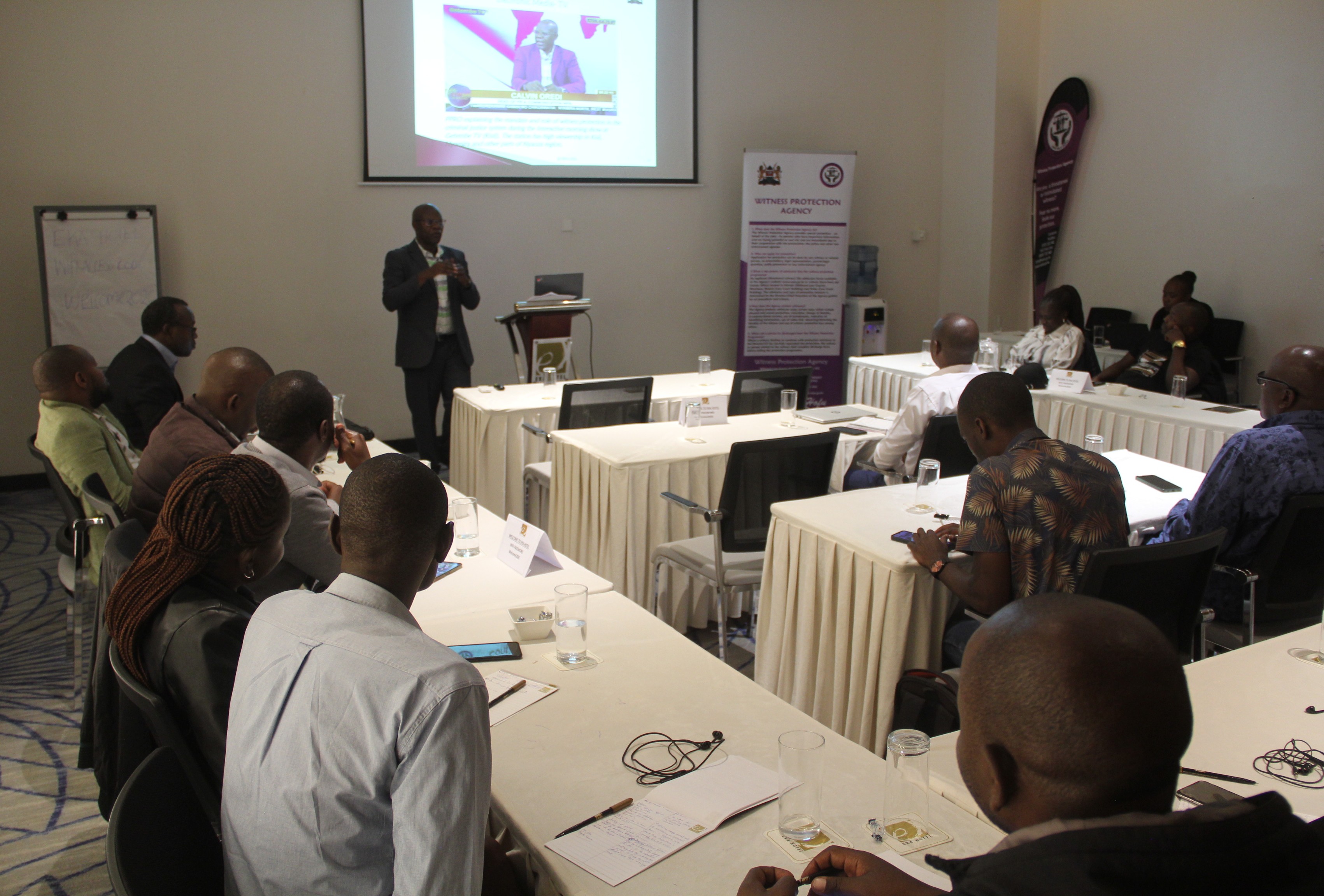
 Uasin Gishu journalists during the WPA's training on the media's role in witness protection in Eldoret./KNA
Journalists in Uasin Gishu county have been sensitised on witness protection to safeguard the welfare of witnesses in criminal cases.
The journalists were equipped with skills to ensure the identities of witnesses are not disclosed when covering stories involving individuals who feel intimidated or threatened due to the sensitivity of cases before the justice system.
The sensitization forum on the media’s role in witness protection was conducted by the Witness Protection Agency, an agency formed under the Witness Protection Act, 2006, to provide protection, safety and welfare for witnesses in criminal cases and other proceedings who face risk or intimidation.
The Act, updated through the 2010 and 2016 amendments, authorises the agency to manage protection programmes, including relocation, identity changes and psychosocial support.
The training, held in Eldoret, Uasin Gishu county, on Wednesday, underscored the key role of the Fourth Estate in protecting witness identities by not revealing names, faces, locations or personal details.
The Head of Public Relations and Communication at the WPA Calvin Oredi underscored the importance of responsible reporting by journalists to ensure media coverage does not compromise witness safety.
The engagement shed more light on Section 30 of the Act (Chapter 79), which prohibits the unauthorised disclosure of information regarding the identity or location of a protected witness or participant.
The media were urged to be vigilant, as violating this provision by disclosing information that compromises a participant’s safety without lawful excuse constitutes a criminal offence punishable by imprisonment of up to seven years.
Additionally, Section 117 of the Kenya Penal Code (Chapter 63) addresses “conspiracy to defeat justice and interference with witnesses”, making it a criminal offence to hinder legal proceedings. It penalises acts such as falsely accusing someone of a crime, preventing witnesses from testifying or obstructing legal processes, punishable by up to five years’ imprisonment.
Oredi implored the scribes to uphold ethical reporting and restraint by balancing the public’s right to know with individuals’ right to life and security, warning against sensationalism that could undermine witness protection programmes and obstruct justice.
He acknowledged the media as key agents in raising awareness without exposure by highlighting the importance of witness protection laws and programmes without identifying specific witnesses, thereby strengthening public trust in the justice system.
Oredi indicated that the press plays a watchdog role by scrutinising whether governments properly implement and fund witness protection schemes, exposing failures or abuses without endangering witnesses, hence holding authorities accountable.
He mentioned that journalists help restore confidence in the legal process by supporting the rule of law through accurate reporting on trials and investigations, thereby encouraging witnesses to come forward knowing their safety would be guaranteed.
By exercising their advocacy role, particularly for legal reforms, media coverage could influence policy by exposing gaps in witness protection laws and advocating reforms that improve safety, anonymity and long-term support for witnesses.
“Threats cause witnesses to run hostile to the course of the justice system. Media must ensure the rights of witnesses are acknowledged and protected. In the era of witness protection, the Fourth Estate must act with responsibility, ethics and restraint. Its power lies not just in exposing wrongdoing, but in ensuring that justice is served without putting lives at risk,” Oredi noted.
The event comes at a crucial moment as the agency endeavours to enhance communication with its partners and stakeholders, including the media, to build awareness of its activities and services.
The agency devises appropriate communication strategies that safeguard its covertness while positioning it to stakeholders, as well as enhancing and strengthening its corporate identity and image.
Oredi said there may be witnesses in the region, particularly Uasin Gishu, who fear testifying due to threats encountered. He called on the media to help reach the public by disseminating information about witness protection to help people understand the agency’s mandate and services.
“So we are here to inform them that in case of any such threats, there is a major intervention from the Witness Protection Agency to ensure that they get the necessary protection so that when cases are in court and they involve witnesses, they go to full conviction and we are able to bring the justice system into the best way possible to deal with the Kenyans who need that service in the country,” Oredi added.
The impact of WPA interventions is strongly felt in transnational and organised crimes such as terrorism, drugs, human trafficking, murder, robbery with violence, sexual and gender-based violence cases, corruption, land-related cases and others.
They revealed that the annual average cost of maintaining a protected person in the programme, with about three dependants, is approximately Sh5.7 million per annum.
In order to strengthen its role, WPA works hand in hand with over 30 State organisations, including the Office of the Director of Public Prosecutions, National Police Service, Kenya Prisons Service, Court User Committees and others.
Since its inception in 2011, the agency has received over 2,000 applications from people seeking protection, out of which 900 were approved. Over 600 witnesses out of the 900 admissions into the witness protection programme have testified in court.
Media Council of Kenya Regional Coordinator Joseph Mecha lauded the insightful engagement with the WPA, noting that it helped to upskill journalists’ knowledge on matters of witness safety.
“If there is a person who has a difficult life or who is in a case where he can lose his life, how can he protect himself in the case? How can he get his rights and get his safety? So, we have been able to learn a lot from the Witness Protection Agency,” Mecha noted.
He said the interaction with the facilitators helped media practitioners understand the need for structured collaboration between institutions that deal with witness safety and how they could work closely to ensure the safety of journalists covering highly sensitive stories.
The regional coordinator said the platform created an opportunity to exchange ideas, where journalists also shared the challenges they face while covering sensitive stories and how best to handle them.
“We look forward to continued engagements around this to ensure that we also ensure our safety, because journalists also handle very sensitive information. They might also be the target. So, it is personal safety and also the safety of others who may be dealing with these cases,” Mecha added.