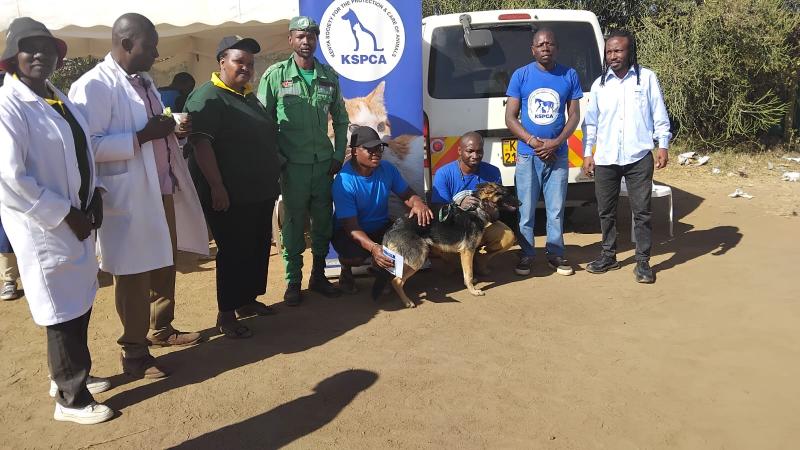
 Animal health officers vaccinate a pet dog, Luna, as her owner, Erick Okoth, looks on during a rabies vaccination exercise at Muhuru Muchiri Stadium in Ruai, Nairobi County. /AGATHA NGOTHO.
More than 2,000 donkeys, dogs, and cats have so far been vaccinated against rabies in Nairobi County’s ongoing campaign.
The initiative, described by officials as the largest mass sensitisation and vaccination exercise in the city’s history, has already reached 2,418 animals.
Governor Johnson Sakaja, who led the campaign that began at the end of January, said the county aims to vaccinate more than 10,000 dogs, cats, and donkeys. The campaign is part of a major public health effort to control and eventually eliminate rabies across the capital.
In addition to vaccinations, county veterinary teams have treated several severely ill dogs on site, providing urgent medical care to improve animal welfare and reduce the risk of disease.
According to the World Health Organization (WHO), rabies is a serious public health problem in over 150 countries and territories, killing up to 60,000 people a year—95 percent of them in Africa and Asia. It is a neglected zoonotic disease, causing tens of thousands of deaths annually, with 40 percent of victims being children under 15.
The Strategic Plan for the Elimination of Human Rabies in Kenya 2014–2030, developed by the Ministry of Health and the Ministry of Agriculture and Livestock Development, estimates up to 2,000 human deaths from rabies in Kenya each year.
Approximately 77,000 to over 100,000 dog-bite incidents occur annually, driven by large unvaccinated dog populations and underreported cases. Recent data show significant regional disparities, with high burdens in counties such as Lamu, Marsabit, Embu, and Taita Taveta.
Maureen Njeri, Nairobi County’s Green executive, said the free rabies vaccination campaign entered its third day in Ruai, with 2,418 animals vaccinated so far. She described the exercise as the largest mass sensitisation and vaccination effort in the city’s history.
“The exercise began at Athi Market before moving to Muhuru Muchiri Stadium on the third day, recording steadily rising numbers of vaccinated animals,” she said.
Over the first three days, vaccination numbers increased across different sites. On day one, January 31, 2026, at Athi Market, 830 animals were vaccinated, comprising 606 dogs, 197 cats, and 27 donkeys. On day two, February 1, 2026, 552 animals received vaccines, including 378 dogs, 164 cats and 10 donkeys.
Momentum peaked on day three, February 2, 2026, at Muhuru Muchiri Stadium, where veterinary teams vaccinated 1,036 animals: 823 dogs, 116 cats, and 97 donkeys.
Cumulatively, the three-day drive vaccinated 2,418 animals—1,807 dogs, 477 cats and 134 donkeys. Njeri noted this reflects strong public turnout and the scale of Nairobi county’s rabies prevention efforts.
“The progress demonstrates strong community response and growing awareness of the dangers of rabies. Rabies is 100 per cent preventable, yet it continues to claim lives. This campaign is about protecting our people by stopping the disease at its source,” she said.
She described the programme as the most comprehensive rabies intervention Nairobi has ever undertaken, combining public sensitisation with mass vaccination across multiple sub-counties.
The countywide initiative, conducted in partnership with the Kenya Society for the Protection and Care of Animals (KSPCA), runs from January 31 to February 15, 2026. Vaccinations are offered free of charge at designated centres.
The exercise will continue in Ruai, Kasarani, on 6, 7 and 8 February before expanding to other parts of the city.
Food and Agriculture chief officer Gladwell Cheruiyot advised pet owners that annual rabies vaccination is a legal requirement and urged residents to comply for the safety of their families and communities.
“Responsible pet ownership is not optional. Vaccinating your dog or cat is a legal duty and a civic responsibility that protects everyone,” she said.
Residents are encouraged to promptly report any suspected rabies cases to county veterinary offices, licensed veterinarians, the county customer service hotline, or KSPCA for a swift response.
The exercise will continue in Ruai, Kasarani Sub-County, on 6th, 7th, and 8th February 2026.
INSTANT ANALYSIS
According to WHO, rabies has an incubation period of 2–3 months but may vary from one week to one year, depending on the location of virus entry and viral load. Symptoms include fever, pain and unusual or unexplained tingling, pricking, or burning at the wound site. As the virus reaches the central nervous system, it causes progressive and fatal inflammation of the brain and spinal cord. Clinical rabies in humans can be managed but is rarely cured, and treatment often results in severe neurological deficits.