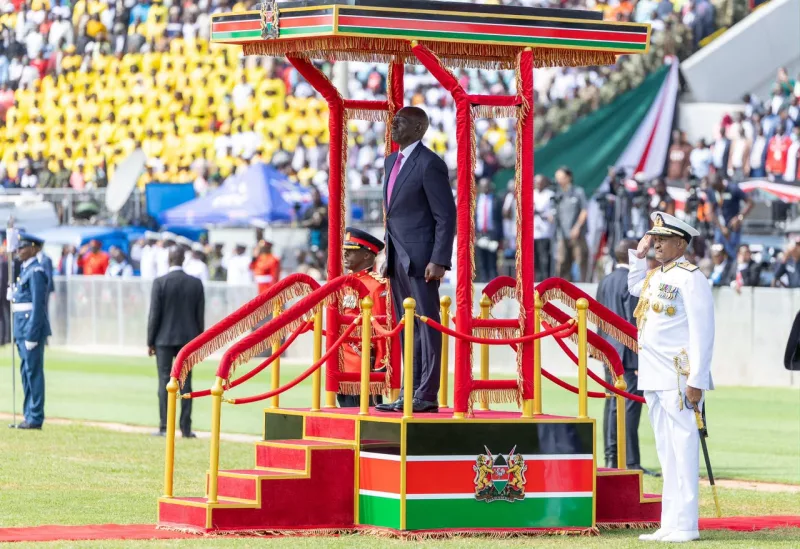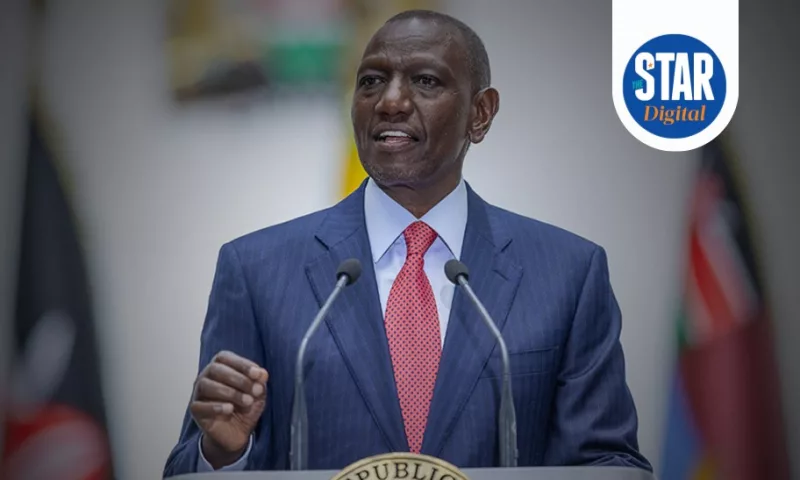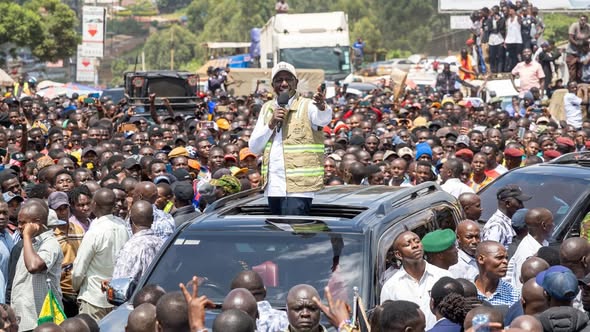
He is leveraging the power of incumbency, embarking on extensive tours to inaugurate projects, consolidate his base and explore new ones.
Meanwhile, opposition heavyweights, recognising that division is their greatest weakness, are making very public vows to rally behind a single presidential candidate.
On Wednesday, they declared the ‘welfare of the country is bigger than any individual ambition’.
Ruto has adopted a whirlwind style, crisscrossing the nation to launch development projects and connect directly with the voters, leveraging cash empowerment programmes.
The President was in Kisii on Thursday for the launch of the Nyota Fund disbursement, where he rallied residents to back his reelection bid.
While there, he revealed plans to upgrade Kisii Stadium and renovate the region’s airport.
He pledged to return next month to launch the two projects and lead a development tour of the Gusii region.
In the tour, he dismissed the opposition as having no agenda apart from ‘Must Go’, ‘Kasongo’, and ‘One Term’.
“Will you vote because of looks, tribe, height or because of the work they do? Do our friends in the opposition have anything to point at? Some have been around for 40 years, and they cannot make any difference now," he asked.
His deputy, Kithure Kindiki, who has been accompanying him to some of the trips, also took a swipe at the opposition.
"If they want to talk to Kenyans, let them build roads, connect homes to electricity, not come here to spread the gospel of tribalism," the DP said.
Ruto is expected in Kisumu on February 2 for the Nyota disbursement to Kisumu, Siaya and Homa Bay residents.
He will later head to Kilifi for a Nyota event to benefit small-scale traders from Kilifi, Lamu and Tana River counties.
After Kilifi, the President is expected to lead the disbursement of the capital boosts to traders from Mombasa, Kwale and Taita Taveta counties, with dates yet to be set for Northeastern.
Dates for Mandera, Marsabit, Garissa and Wajir are expected to be unveiled after the Mombasa tour.
Each stop serves a dual purpose, which is showcasing government delivery and shoring up political support in strategic regions.
Kenya Kwanza honchos say it will take the opposition a lot of work to catch up with the President’s pace.
Majority leader Kimani Ichung’wah (Kikuyu MP) said, “They will never match our pace ‘hata wafanye nini’ (despite what they do), they haven’t even settled on an agenda for Kenyans.”
Baringo North MP Joseph Makilap said, “The President is always ahead of time. We can see the opposition is being micromanaged around Mt Kenya and Ukambani.”
“The opposition can barely move, they have no agenda, and I doubt they will manage to pace up with our team,” Makilap told the Star on Thursday.
In January alone, the head of state has toured 11 counties—minus Nairobi—while Kalonzo has only managed four, two of them being in his Ukambani backyard.
Former Deputy President Rigathi Gachagua, on the other hand, has been largely oscillating between Nairobi and Mt Kenya.
Ruto started the year in Kakamega, where he attended a football tournament that was organised by Kakamega Governor Fernandes Barasa, giving him a chance to connect with the Mulembe nation.
He then launched the Nyota disbursement in Uasin Gishu—his backyard—and then moved to West Pokot, Nakuru county, before holding a similar activity in Baringo.
The President has also been to Samburu, Laikipia, Machakos, Nyeri (twice this month), Kiambu and Meru. He characteristically conducts more than one meeting in a single visit.
An analysis by the Star on the trips revealed Ruto has addressed about 50 meetings in the last month.
Besides the county tours, the President has also held politically strategic meetings at State House, including a meeting with the chairmen of Nairobi markets.
Beyond these tours, Ruto is also working to reshape the political landscape through alliances.
He has expressed strong confidence in a growing cooperation between his UDA and ODM.
In stark contrast to Ruto's solo tours, the opposition's activity is centred on closed-door meetings and public declarations of unity.
At a recent Democratic Party National Delegates Congress in Nairobi, they sustained the message that they will stick together to the end.
Leaders, including Gachagua, Wiper's Kalonzo Musyoka, PLP's Martha Karua, and former Interior CS Fred Matiang'i, stood together to vow they would not be divided.
"The resolve to eject the Kenya Kwanza administration keeps opposition leaders united," Karua said.
Kalonzo said "unity is the only path to victory".
They have planned a major nationwide voter registration drive to build a winning numerical base.
For the team, Ruto is in panic mode, hence the early campaign blitz. They argue it was for this reason their meetings are targeted for attacks.
Former National Assembly Speaker Justin Muturi, the Democratic Party's presidential candidate, alleged that Kenya Kwanza leaders attempted to ‘weaken the unity’ by sponsoring a rival candidate within his own party’s national delegates’ congress.
The opposition has also pointed to a recent incident where DCP leader Gachagua was reportedly attacked at a church in Othaya as evidence of efforts to intimidate and divide them.
Political analysts and insiders identify 2026 as the critical, ‘make-or-break’ year for the opposition.
“Ruto's survival is pegged on delivering on countrywide development projects and sustaining presence across all regions,” political commentator Javas Bigambo said.
“Further, opposition is fractured and has no elements of unity, whether in messaging or purpose.”
“Kenyans will want to see leadership, order and direction in 2027, and that is what will set President Ruto apart,” Bigambo said.
The process of selecting one leader from a field of seasoned and ambitious politicians remains the coalition's most daunting challenge.
Activist Boniface Mwangi, who is also seeking a presidential nomination, has called for a ‘NARC moment’, referring to the historic 2002 coalition that united to win power.
For businessman Erick Okeyo, the President is working to replace the votes he has lost in Mt Kenya and other groups like the youth.
“It will be an uphill task for him to gain more support than that of 2022. The votes [for Mt Kenya] have gone, and even he knows,” he said.
Okeyo said even attempts to use state machinery to push the electoral commission into a corner will not succeed.
“IEBC is already forewarned about being an accomplice in this.”
INSTANT ANALYSIS
The battle for the country’s future is fully underway. The opposition is banking on the power of a coalesced protest vote against Ruto’s performance. The success of either strategy hinges on execution. Ruto must continue to demonstrate tangible results, while the opposition must transform its vows of unity into a concrete, credible, and cohesive political machine.