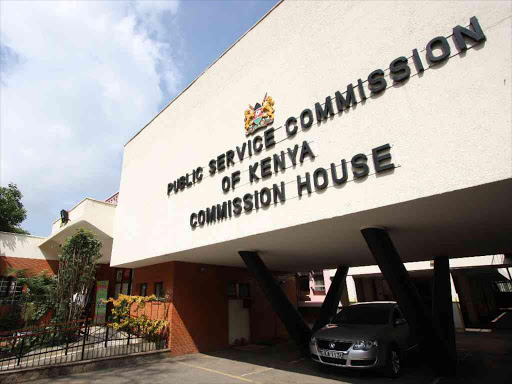
 Public Service Commission/FILE
Kalenjin and Kikuyu communities continue to receive the lion’s share of government jobs as agencies defy Public Service Commission rules aimed at tackling ethnic disparity in the civil service.
A new report by the commission reveals that the two communities accounted for over one-third of all new appointments state agencies made in the period ended June 30, 2025.
At least 7,224 new employees were hired across ministries, state departments, and agencies (MDAs).
Of these, the Kalenjin community led with 1,250 appointments (17.3 per cent), followed closely by the Kikuyu with 1,208 (16.7 per cent).
Combined, the two communities, which have been dominant in the country’s political and demographic landscape for decades, secured 2,458 positions (34 per cent) of all new jobs.
The Luhya (924), Luo (839), Kamba (551), and Kisii (517) communities trailed behind. At least 371 Merus, 232 Mijikendas, 224 Maasais, 208 Somalis, and Embu (100) were hired during the period.
Minority and marginalised groups like the Ogiek, Elmolo, and Sakuye played within the range of single or double digits.
As per the PSC data, only one Ogiek was hired in the period under review, the same case for Waat, Wardei (2), Taveta (2) and Elmolos (3).
Tharakas got 66 new jobs, 64 for the case of Teso, 67 Pokots, while 54 Boranas were also hired.
Several previous reports have highlighted how Kikuyu and Kalenjin communities that have held the presidency since independence, are grossly overrepresented in the civil service.
In what’s evolving into a predictable pattern, the two communities also dominated the 8,447 new appointments that Kenya Kwanza made in the period to December 2024.
In the wake of the glaring disparities, the PSC directed agencies to comply, and even set a formula for achieving a near-perfect ethnic balance.
PSC directed all public institutions to develop affirmative action programmes to redress ethnic representation gaps by June 30, 2025.
The disparities have, however, continued to play out, with reports indicating that 10 ethnic communities occupy almost 90 per cent of public service jobs, while five occupy 70 per cent of jobs in state corporations.
As of December 2024, there were 47,543 Kikuyus and 40,820 Kalenjins in the public service, being 20 per cent and 17.6 per cent respectively.
In the same reporting period, PSC revealed that 29 state institutions had one ethnic community constituting over half of its workforce.
The situation was attributed to non-competitive recruitments, and was reported at state corporations, ministries and public universities.
Public institutions are required to adhere to the principle of fair competition and merit in appointments and promotions.
The only exception is “where an appointment is made to address the underrepresentation of gender, an ethnic community, or persons with disability”.
A regulation that is to restrict hiring to achieve the balance is yet to successfully undergo the necessary approvals.
PSC has defended its processes, stating that appointments are guided by ‘meritocracy, fairness, transparency, and inclusivity’.
The report reveals an array of institutional crises crippling the PSC’s operations, to the detriment of job seekers.
It argues that it is chronically underfunded – amid a shortfall of 41 per cent of its budget needs, and critically understaffed – 44 per cent vacancy rate.
“The commission’s wide mandate scope covering 585 public organisations, coupled with disproportionately low budget allocation, contributes to significant delivery frictions and missed targets.”
The commission says in the report that its operations in Nairobi are hampered by office space shortages, therefore limiting interview scheduling.
These constraints inherently favour candidates with greater access. Recruitment is overwhelmingly advertised and managed online.
Applicants from regions with strong internet access, wide informational networks about government jobs, and higher tertiary education attainment naturally navigate the process more successfully.
The PSC admits its “centralised operational delivery model… runs counter to the efficiency and effectiveness promise of decentralisation.”
“The commission continues to address challenges related to digital literacy and inconsistent internet access among citizens, with efforts underway to make its platforms more accessible and user-friendly,” the report reads.
To address the gaps, PSC says it has designed initiatives to broaden access.
The report highlights the Public Service Internship Programme (PSIP), which placed 4,411 graduates from all 290 constituencies into MDAs.
It adds that the Public Service Emerging Leaders Fellowship attracted applicants from all 46 counties.
Even so, the report reveals that the thousands of interns are yet to transition to permanent appointee positions.
It emerged that the fellowship’s third cohort is stalled due to lack of funding, dashing the hopes of 250 people who were shortlisted.
INSTANT ANALYSIS
Achieving a public service with the face of Kenya, where a qualified candidate from the Ogiek community has the same shot as one from Kiambu or Uasin Gishu, requires conscious consideration. It will demand a radical overhaul of resources, outreach, and perhaps, a national reckoning on the importance of equity itself.