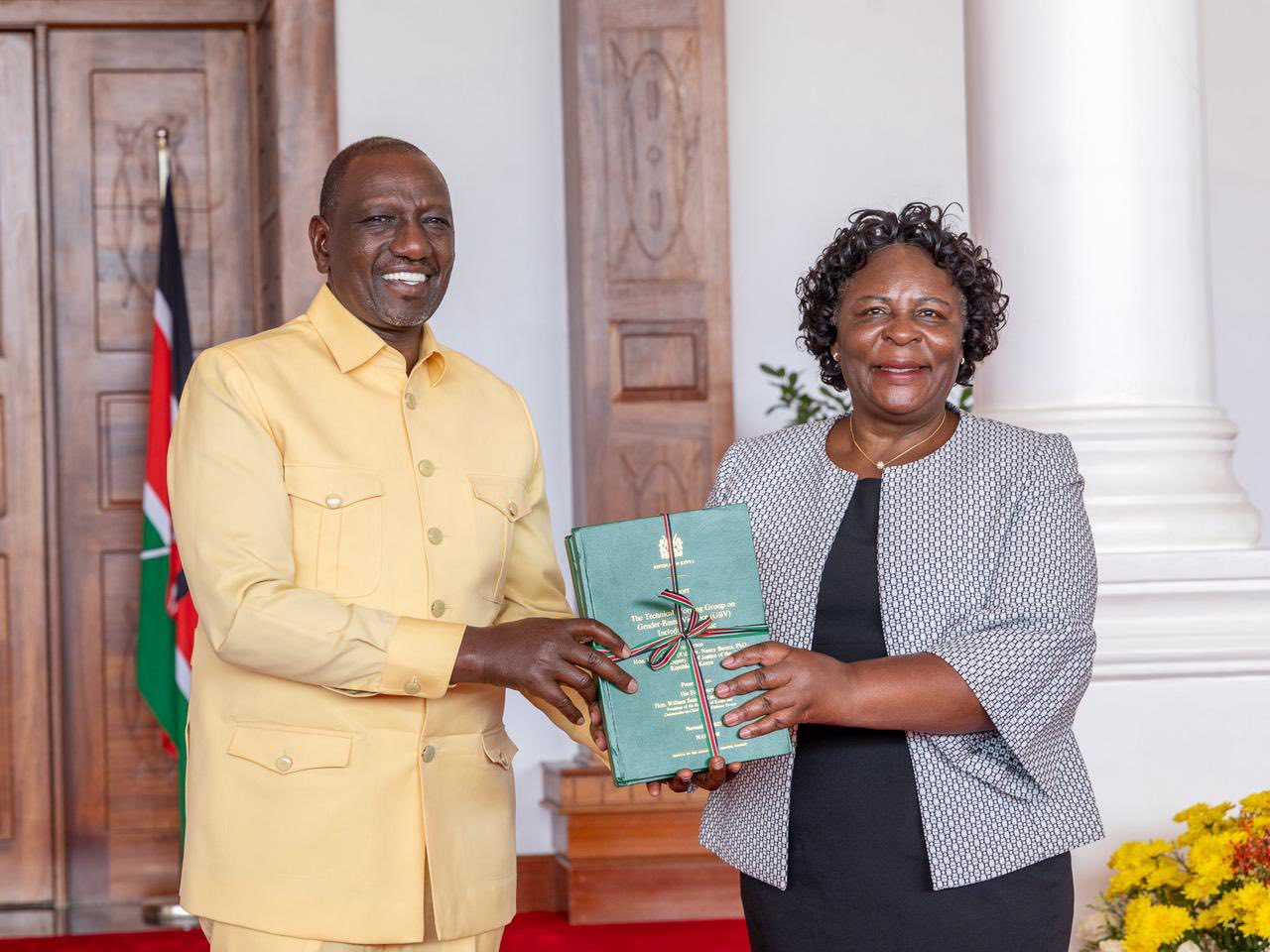
A task force assigned by President William Ruto to look into rising cases of femicide and other forms of gender-based violence has proposed chemical castration for sexual offenders.
In a report handed to the President on Monday, the team has proposed that Sexual Offences Act of 2006 be amended to introduce the drastic measure to nip sex pests on the bud.
Chemical castration involves the use of chemicals or medicine to stop the production of sex hormones, leaving the offender with no urge.
It is used in France, parts of the USA, Indonesia and South Korea.
Castration for sexual offences has often been floated in Kenya as a radical measure to tame the vice but the proposals have never been adopted by Parliament.
In 2020, Kibera Young Women's Network petitioned Parliament proposing castration for men who sexually abuse children, citing high rates of defilement in the slums.
In 2005, MPs debated a bill by current Supreme Court judge Njoki Ndung'u (then nominated MP) that spelled tough action on sexual offenders, famed at that time as the Castration Bill.
Despite rampant abuses, the proposed law never saw the light of day. A new one sponsored by Kisii Woman Rep Doris Donya is currently before Parliament.
Ruto's task force, spearheaded by former Deputy Chief Justice Nancy Barasa, has also come to a similar conclusion and wants perpetrators of sexual offences castrated.
The task force wants Ruto’s immediate nod on the report among other radical measures to deter sex-related crimes.
“Amend the Sexual Offences Act 2006 to include chemical castration for both male and female child defilers and defilers of PWDs (people with disability),” the report obtained by the Star reads in part.
The team also wants a specialised police unit created to tackle the rampant cases.
The task force says its findings point to a scourge, with women and children bearing the greatest brunt. Men are not spared either.
Among the harrowing tales was how disabled women are molested.
In the quiet villages of Trans Nzoia, women who are blind are systemically preyed upon by men who enter their homes at night.
These attackers, unknown to the victims because they cannot see them, are referred to as “visitors who come at night.”
The result is a chain of children born out of rape, by people they don’t know.
In Wajir, a four-year-old girl was defiled and left by the roadside, with intestines dangling out.
In Migori’s gold mines, desperate girls submit to a practice known as ‘soil for sex’, trading their bodies for a chance to sift through gold-rich earth.
In university halls in Siaya, female students face a predatory ‘sex for marks’ culture, where refusal can lead to the harassment of their loved ones.
A woman was “brutally beaten and gang raped by men sent by her estranged husband” in Mombasa.
In Kakamega, it is a commonplace for women to be publicly undressed as a form of community punishment and shaming.
Kilifi’s old women are also living in fear of being killed by members of their community who easily brand them as witches.
These are some of the harrowing testimonies that were unearthed by Barasa-led team, officially known as the Presidential Technical Working Group on Gender-Based Violence and Femicide.
The task force uncovered a femicide crisis of huge proportions, revealing that 1,639 Kenyan women were murdered in just two years.
Central to the findings is that the family home was identified as the epicentre of the killing fields.
"These are not just numbers; they are mothers, daughters, and sisters whose lives were cut short by those they trust most,” Barasa said.
“The home has become the most dangerous place for a woman in Kenya”The findings paint a picture of a nation at war with its women, where every eight hours, a woman is killed in Kenya, with 578 deaths in 2024 alone.
Nairobi, Meru and Nakuru emerged as the deadliest counties for women, with alarmingly high numbers reported in Kiambu as well
Regions like Kisii, Narok and Samburu were flagged for femicide linked to harmful cultural practices like female genital mutilation and witchcraft accusations against elderly women.
In a sharp contrast, counties like Garissa, Lamu and Mandera reported no femicide cases in official police records.
The experts, however, said it could be due to underreporting and families opting for an alternative justice system, not an absence of violence.
The team established that the killings have taken a pattern where bodies are increasingly dismembered “as violence becomes more ritualistic”.
"The brutality has evolved beyond murder to dehumanisation," Baraza told the President during the handover.
"We're seeing torture, dismemberment, which are acts designed to erase women's humanity."The report says these killings are not random acts but the deadly culmination of sustained abuse, often hidden behind closed doors.
“The home, assumed to be a sanctuary, is increasingly becoming the most dangerous place for women and girls,” Barasa said.
The team thus wants mandatory minimum sentences for culprits of sexual offences, and an explicit definition of femicide in the law.
“Introduce strict, non-discretionary minimum sentences for aggravated sexual offences and repeat offenders,” the taskforce urges.
President Ruto has committed to action, saying, “We are better getting started on what needs to be done.”
He added, “Listening to the recommendations, I am persuaded you have identified the critical areas that, if addressed, will mitigate the challenge.”
The head of state acknowledged the “deeply troubling” findings and the resonant call to treat GBV as a national crisis.
“The findings on femicide, domestic violence, harmful cultural practices, and technology-facilitated abuse demand collective national reflection and action,” the President said.
“All the recommendations will be considered and subjected to due process in accordance with the constitution and the law.
“Change must begin at home, with parents bringing up their children in a peaceful and respectful environment."
Alternative dispute resolution mechanisms in GBV cases were singled out as a part of the problem. “The kangaroo courts trivialise the gravity of violence.”
The alternative justice system, the group found, is deeply flawed, with families identified as “the greatest barrier to justice.”
Crimes like murder are withdrawn and settled using clan-based systems, where compensation, say a cow, some goats, or money, is deemed equivalent to a woman’s life.
“In some communities, practices such as wife beating, FGM, child marriage and sexual exploitation are deeply embedded and reported not as violence but normal behaviour,” Baraza said.
The panel also identified challenges with the legal framework.
“Our laws treat the targeted killing of a woman as murder,” Baraza said.
The legal gap, the panel argues, prevents the country from tracking the true scale of the problem and understanding its gendered motives.
A culture of impunity where a husband killing his wife is seen as a “crime of passion” has developed, they note.
It also emerged that children as young as three years old, both boys and girls, are facing a severe scourge.
“We came across horrific examples. The abuse of children is shrouded in silence because people opt to protect the family name,” she said.
“Men’s experiences are hidden or underreported due to stigma, social expectations of masculinity and limited support services.”
The panel wants funds for tackling GBV to be centrally allocated. It emerged that efforts by the government and NGOs are “siloed and uncoordinated”.
“Insufficient resource allocation hinders survivors’ access to medical and psychosocial support,” Baraza said.
“The Judiciary, police and other social institutions remain underfunded to respond,” the task force noted.
The data system, the report adds, is “inadequate,” rendering countless survivors invisible in the national interventions.
The team asked President Ruto to declare GBV and femicide a national crisis.
“Because it is,” Baraza stated firmly. “Once declared, it will get the highest response and urgent, coordinated, survivor-centred action.”
The panel wants femicide named as a distinct, aggravated offence in the Penal Code, separate from murder.
Among the grounds is that it would see a specialised investigation and harsher sentencing, recognising the hate-based and gendered motive.
To ensure justice, they propose a dedicated, specialised GBV police unit.
“To recognise the vice as a distinct, complex offence requiring specialised skills,” Baraza said.
The panel also wants legislation to criminalise the out-of-court settlement of GBV and femicide cases.
On prevention, they call for a presidentially championed, nationwide awareness campaign to reshape public attitudes.
An immediate safety measure is the mandatory installation of CCTV cameras in short-term rentals like Airbnbs, identified as emerging crime scenes.
“This is where most of the femicide is taking place,” Baraza revealed, further proposing a ring-fenced GBV and Femicide Response Fund, resourced by the government, private sector, and development partners.
Gender Cabinet Secretary Hannah Cheptumo called the report “a collective hope and expectation of millions of Kenyans,” pledging her ministry’s dedication to coordinating its implementation.