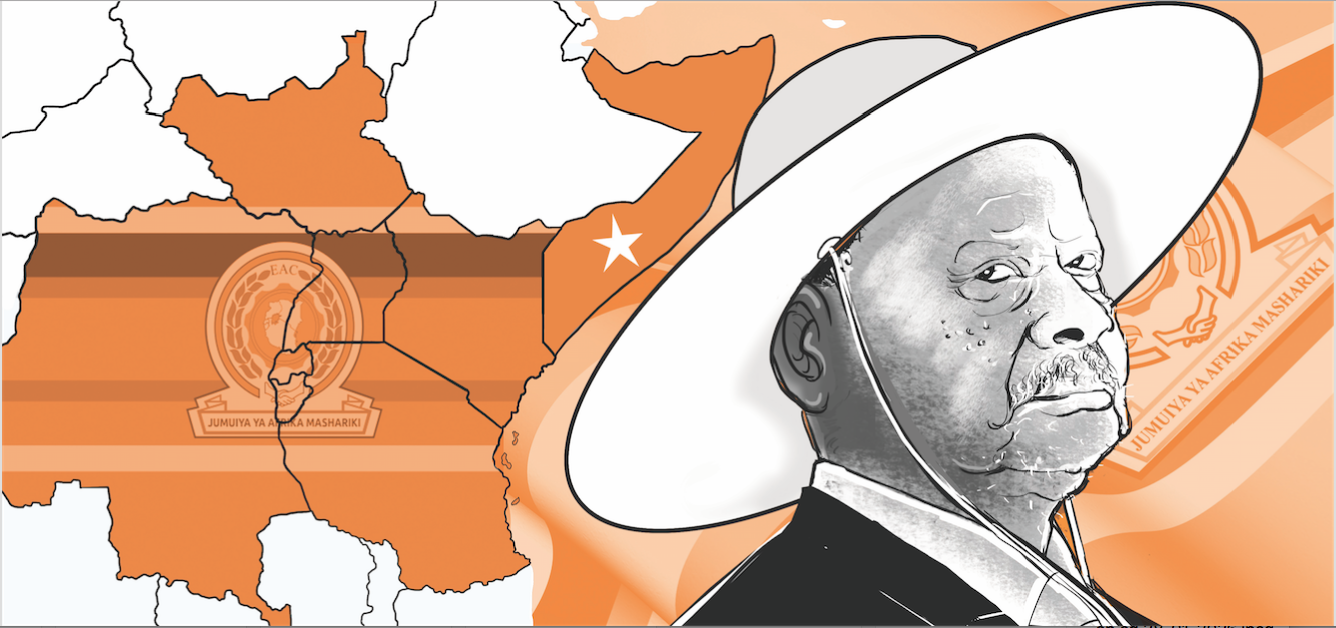
Late last year, Uganda’s President Yoweri Kaguta Museveni sparked heated debate across East Africa when he declared on a radio show that the Indian Ocean belongs to him. In apparent frustration with Kenya, he warned that Uganda and other landlocked African countries could go to war in the future if their access to the Indian Ocean were obstructed.
At first, the remarks seemed like the provocations of a strongman angling for attention ahead of the January 15 Ugandan general election, which he 'won'. But beneath that frustration lies a strategic vulnerability rooted in colonial borders.
Uganda is landlocked and depends entirely on Kenyan and Tanzanian ports for trade. When these routes are disrupted, Uganda’s economy is disrupted as well.
Museveni argued that a unified East Africa would better defend collective strategic security and economic interests. For him, an East African federation remains the solution to these structural challenges.
On this point, he was right.
As a strong advocate for deeper East African integration, I must give the son of Kaguta his flowers. He has been a consistent, and at times lone, voice in pushing for the federation. That political union is the life insurance for securing East Africa’s long-term security and economic interests in a dynamic and interconnected world.
Sadly, that is where our common ground ends.
Museveni must know that he is one of the biggest obstacles to the federation he champions. Many in Kenya fear that his push is driven by a desire to become the federation’s president, perhaps for life.
The dominant-party system he has built, with its low regard for human rights and free speech, gives Kenyans little confidence that a federation would be democratic, let alone prosperous.
Firstly, Museveni has been president since 1986. He once declared that “the problem in Africa is leaders who want to overstay in power”. Yet, despite promising not to cling to office, he removed presidential term limits and later age limits for presidential candidates.
Nearly 40 years on, he has become the very problem he once diagnosed. Why, then, should any Kenyan trust that a federation under his leadership would be different?
Museveni has complained that discussions with Kenya about Indian Ocean access have always been frustrated because “this one comes, then another one comes, and the discussions start afresh”. But this is the essence of democracy: regular leadership transitions through free and fair elections.
His apparent discomfort with government changes in Nairobi raises deeper questions about his views on accountability and political renewal. It reinforces fears that he wants a federation in order to rule it indefinitely.
Secondly, the way Museveni has built the Ugandan state into a militarised dominant-party system inspires no confidence. Where such a system evolves into a family enterprise, with relatives occupying top positions, democracy dies.
The so-called “Muhoozi Project”, the apparent grooming of his son as successor, suggests that Uganda is headed not toward democratic transition but hereditary rule. Kenyans are right to be alarmed.
Thirdly, Museveni witnessed Kenya’s bloody Second Liberation. Many Kenyans lost life and limb fighting one-party rule and demanding civil liberties and the rule of law. How, then, does he expect Kenyans to accept a return to those dark days through federal arrangements?
The contradiction is stark. Museveni wants Kenya and Uganda to be borderless to secure his access to the Indian Ocean. Yet when Kenyans such as Bob Njagi and Nicholas Oyoo crossed into Uganda to support opposition comrades exercising political rights, they were abducted and abruptly reminded of borders.
Museveni should understand that his access to the sea depends on sustainable peace and stability in Kenya and Tanzania. That stability requires freedom and justice. Without them, violence erupts—as seen in Kenya in 2007 and recently in Tanzania—cutting off Uganda.
If he wants reliable access to the Indian Ocean, he should champion democracy and political freedom and support East Africans in protecting hard-won rights. There can be no federation without respect for the rule of law and fundamental human rights and freedoms.
No EAC leader has been better positioned to build this federation. Museveni witnessed the collapse of the first East African Community in 1977. Nine years later, he took power when regional institutions, laws and practices were still closely aligned.
For four decades, he has had the platform, experience, institutional memory and credibility to lay the democratic foundations a federation requires. Instead, he built the opposite.
East Africans want the political union. Our futures are intertwined. But Museveni’s leadership—both its length and style—has frightened even staunch federation advocates and given Kenyans reason to resist.
If he truly wants the federation, the best he can do is leave the stage to equally committed leaders to carry it forward. That would be a gain worth protecting, not only by Ugandans but by all East Africans.
Actuary and public policy analyst. [email protected] X: @Nyagacm