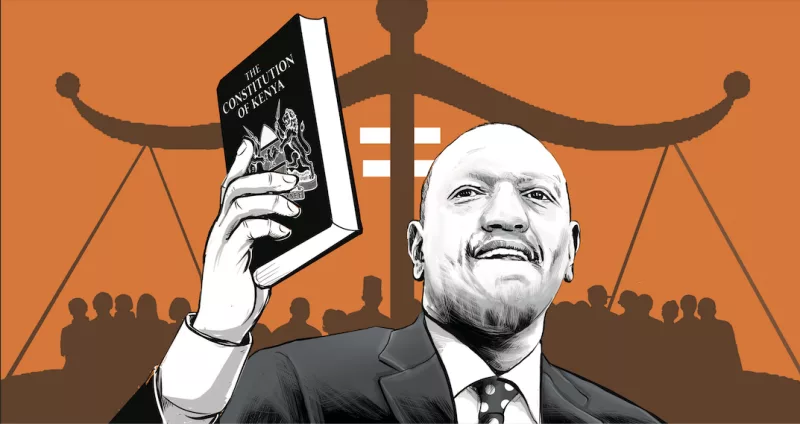
Over the past few weeks, development talk has dominated Kenya’s political and media space, with leaders publicly defending or showcasing their records across press briefings, conferences, talk shows and digital platforms. This mirrors a long-standing reality on the ground, that development is perceived to be courtesy of leaders.
The shaping of development narratives along individuals is understandable. Visibility plays an important role in competitive politics. However, behavioural research on tax compliance suggests that narratives around who finances a country’s development matter significantly, and that they can affect willingness to cooperate with state authority when it comes to taxes.
When development is not clearly presented as a collective outcome funded by taxpayers, citizens may struggle to see their own role in financing the state.
Evidence from leading tax authorities indicates that how development is communicated shapes how people relate to taxation.
For this reason, they advocate that the connection between public contributions and public services must be direct and explicit, and unchallenged by other narratives.
When Sweden faced a financial crisis in the 1970s and needed to raise tax revenue nearly tenfold to finance the government, authorities recognised that improving efficiency and fairness within the tax system, without reshaping how citizens perceived taxation, would have been difficult.
Rather than relying solely on civic education, Sweden adopted a deliberate communication strategy. It deployed direct messaging to challenge popular assumptions and explicitly reposition taxpayers at the centre of national development.
This shift extended beyond policy statements into the physical environment. Public facilities such as parks, stadiums and other taxpayer-funded infrastructure were identified and marked with a simple message that addressed the taxpayer directly: Paid for by you. Beyond print, the same message was reinforced across other communication channels, including radio and television.
The campaign drew mixed reactions, attracting both support and criticism, particularly over whether governments should actively advertise development.
Nonetheless, behavioural scholars and practitioners Anders Stridh and Lennart Wittberg, authors of a book titled From a feared tax collector to a popular service agency, identify the initiative as a pivotal moment in the transformation of the Swedish Tax Agency.
It opened a national dialogue that reframed taxation from extraction to contribution, explicitly positioning the taxpayer as the financier of his own development.
Combined with reforms focused on fair treatment and service orientation, the approach proved effective. Today, the Swedish Tax Agency consistently ranks among the most trusted public institutions in Sweden, often more popular than agencies that distribute direct benefits.
Insights from organisational change scholarship help explain why this direct communication approach was effective. John Kotter, a Harvard Business School professor and one of the most influential global authorities on leadership and change, argues in Leading Change that meaning is not something audiences infer on their own; it must be direct.
Kotter’s work, which has informed change initiatives across governments, corporations and international institutions, highlights that people rarely connect dots that are unlinked. Where behaviour change is required, direct and visible messaging consistently outperforms abstract instruction.
Civic education, however well intentioned, struggles to compete against direct, visual messaging. A school branded with a member of Parliament’s name will almost always be more persuasive than a public forum explaining that taxes fund education. Personalised development messaging overwhelms abstract civics every time.
This insight that deliberately repositions taxpayers at the centre of development is particularly relevant in Kenya, where data from the Kenya National Bureau of Statistics – the state agency legally mandated to produce national economic and social statistics – shows that a large share of economic activity occurs in the informal sector. Informal economic activity is dispersed, mobile and difficult to monitor.
None of this is to castigate politicians or government institutions for publicising their records. Political and institutional survival often depends on visibility, and the public is entitled to know what leaders have done while in office.
The issue, therefore, is not communication itself, but calibration specifically, ensuring that development narratives do not obscure the taxpayer. When the story tilts too far toward individual ownership of development, it weakens the collective logic that underpins taxation.
The challenge is not to silence leaders, but to balance political storytelling with a stronger taxpayer-centred narrative—one that recognises leadership while consistently reminding citizens directly that their development is ultimately financed by themselves.
Social reformer who specialises in change management and has contributed to tax compliance reform initiatives in Kenya. [email protected]