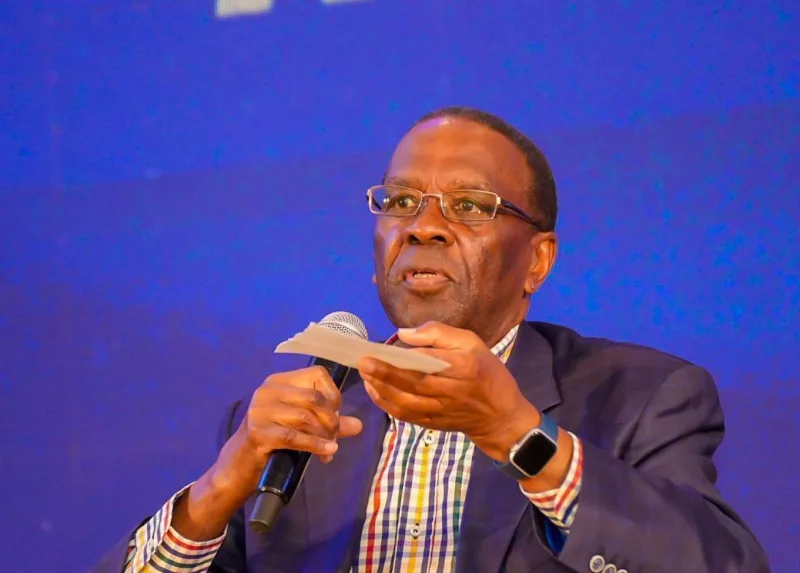
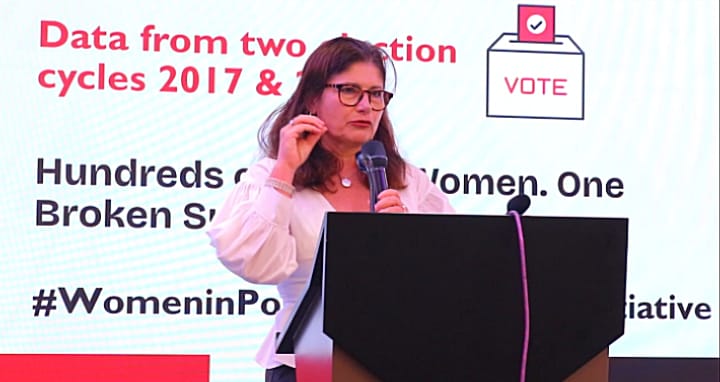
 European Union Ambassador to Kenya Henriette Geiger speaking at a forum in Nairobi/FELIX ASOHA
Kenya’s political space remains largely hostile to young women, with intimidation, abuse, and humiliation continuing to discourage their participation in leadership.
This challenge took centre stage at a forum held in Nairobi on Wednesday, where stakeholders examined the persistent barriers locking young women out of politics and called for urgent reforms to make political spaces safer and more inclusive.
Speaking at the forum, European Union Ambassador to Kenya Henriette Geiger said many young women face sexual intimidation, online abuse, and threats when they attempt to engage in politics.
“Women can be in the political space, but there is a lot of sexual intimidation,” she said.
“Women spoke about remarks made live online about their appearance and how they are dressed. Several told me it is very difficult to hold this space because party leaders often hold meetings late at night.”
Participants argued that without deliberate reforms, political systems will continue to disadvantage women, particularly during party nominations and campaign periods.
A newly released study by Badili Afrika found that Kenya’s political ecosystem—from party structures to campaign financing—remains skewed against female aspirants, making it harder for young women to compete on an equal footing.
Chelimo Njoroge of ForumCIV Company said the focus should shift from trying to “fix” women to transforming the political system itself.
“We are often trying to change women to fit into our politics, but transformative change will not come from changing women,” she said.
“We need to change our politics to fit our democracy—so that everyone is included, everyone can afford to run, and everyone is safe to participate.”
Educator and researcher Dr Katindi Sivi noted that many leadership training programmes fail to prepare young women for the informal and often invisible challenges they face in politics.
“When we interviewed about 122 young women, we realised that the trainings do not prepare them for what they must navigate,” she said.
“The cost of women vying for office is high. There is stigma, name-calling, accusations of prostitution, and strained family relationships.”
Bina Maseno, Executive Director of Badili Africa, said the data paints a grim picture of women’s representation and safety in political spaces.
“Since 2013 to 2026, young women represent less than one percent of elected leaders in this country,” she said.
“Gender-based violence in political spaces has been normalised as the cost of participation. Institutions mandated to end GBV must do their jobs. Why are people implicated in violence still allowed to run for office? Some political parties do not even have sexual harassment policies.”
Statistics presented at the forum show that although about 70 per cent of Kenya’s population is under 35, young women account for less than one percent of elected leaders at both national and county levels. In the 2022 General Election, only 20 young women were elected across all seats.
The study further shows a declining success rate for young women candidates, with only 9 per cent elected in 2017 and just 5 per cent in 2022, despite significant investment in political training programmes.
Stakeholders warned that unless Kenya confronts violence, exclusion, and unequal party structures, young women will remain largely shut out of the country’s political leadership.