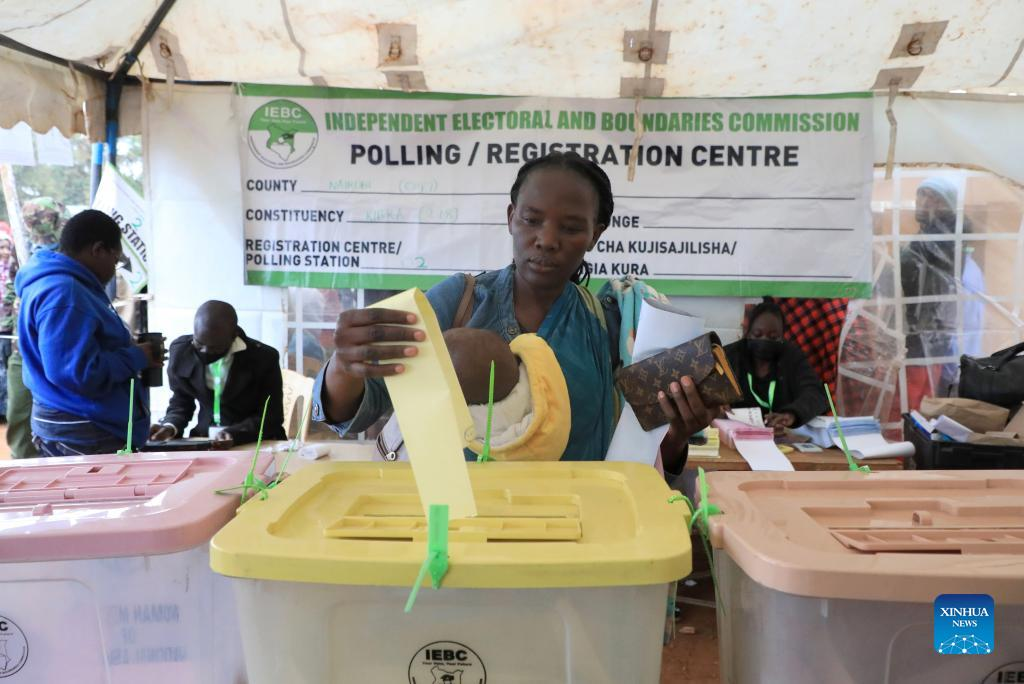
 A voter casts her ballot at a polling station in Nairobi, Kenya, Aug. 9, 2022. Millions of Kenyan citizens on Tuesday morning cast their ballots at about 46,229 polling stations across the country to elect their fifth president as well as members of the National Assembly, senators, and county governors. (Photo by Fred Mutune/Xinhua)
As the country steadily moves toward the 2027 electioneering season, a familiar anxiety has begun to resurface in boardrooms, marketplaces, and small business offices: Will businesses survive an election year?
For decades, election periods have been associated with economic slowdown, cautious spending, and hesitant investors but according to financial expert Keziah Koki, this fear may be less about reality and more about mindset.
“There is a notion we have carried for a long time that election years automatically mean bad business,” Koki says.
“But when you examine it closely, you realise that this belief is largely psychological.”
She argues that many factors that shape financial outcomes are first created in the mind. While politics may dominate headlines during election periods, everyday life continues uninterrupted.
People still need food on their tables, transport to work, healthcare, communication, and shelter, services that form the backbone of most businesses.
“Even in 2027, people will still need the basics,” she explains.
“And those needs do not pause because of politics.”
Koki believes the real challenge lies in the narrative society has accepted. Over time, the idea that businesses are destined to perform poorly during election years has become almost unquestioned truth.
“We need to accept change and intentionally shift that thinking,” she says. “If you are a service provider, your responsibility is to continue offering value, not to retreat because of fear.”
She cautions business owners against slowing operations, scaling back visibility, or delaying plans simply because an election is approaching. Such reactions, she notes, often do more harm than the political environment itself.
“It is about changing the narrative in our mind and ensuring that to we continue doing what we do when there is no election. If you are a service provider, you continue putting your services out there without necessarily buying into that notion that it's an election year.”
However, Koki acknowledges that not all sectors are affected equally.
Larger markets such as foreign exchange and capital markets can experience fluctuations due to investor sensitivity around national stability. Both local and foreign investors tend to watch political signals closely, sometimes reacting with caution.
“Even then, it becomes a collective responsibility that, as a nation, we must work toward political maturity where investment confidence is not shaken every five years.”
She emphasizes that elections should not automatically trigger a reassessment of whether a country is safe for business. Stability, consistency, and strong institutions are what ultimately sustain investor trust.