Kenya stands at a critical juncture where the pace and quality of development will depend less on political alignment and more on the strength of ideas informing government action.
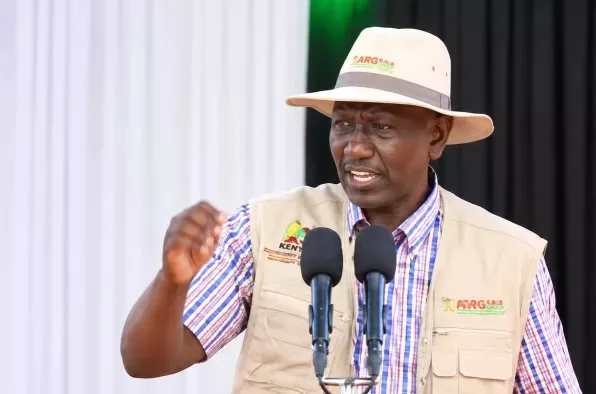
President William Ruto’s decision to integrate economic thinkers historically associated with ODM into the policy space marks a decisive moment in the evolution of governance.
It reflects an understanding that national transformation is neither accidental nor improvised; it is engineered through ideas that are tested, refined and executed with urgency.
The convergence between UDA’s governing framework and ODM’s intellectual tradition represents a deliberate investment in knowledge as a driver of development.
Over time, the President has incorporated ODM figures into government and opened channels for sustained engagement with scholars whose work has interrogated Kenya’s political economy for decades.
This has resulted in a governing environment in which policy is increasingly shaped by people who have studied the state not as a slogan, but as a system, among other dimensions.
At the centre of this intellectual reservoir are figures such as ODM veteran Prof Anyang’ Nyong’o (who is the Kisumu governor) and ODM advisers Prof Peter Wanyande, Prof Karuti Kanyinga and others of similar scholarly status.
These are university-trained academics whose careers have been built on rigorous research, teaching and policy engagement. Their contribution lies not in advocacy, but in analysis; not in rhetoric, but in structure.
Prof Nyong’o exemplifies this tradition. A consummate scholar, his intellectual formation combines political economy, development theory and a deep appreciation of how institutions evolve.
Crucially, his scholarship has been complemented by extensive experience within government, giving him a rare capacity to bridge thought and action.
He understands how policies react once they encounter bureaucracy, fiscal constraints and political reality. This blend of scholarship and statecraft is invaluable at a time when reform must move quickly without becoming reckless.
Prof Wanyande’s work has long focused on governance, institutions and the political foundations of economic performance. His scholarship has consistently highlighted how weak systems, rather than weak intentions, undermine development.
Prof Kanyinga, similarly, has brought sustained analytical attention to land, inequality, citizenship and the social underpinnings of the state.
Together, these perspectives ensure that economic reform is not pursued in isolation from governance, social cohesion and institutional legitimacy.
The value of this convergence lies partly in diversity. When policy is exposed to multiple schools of thought, it becomes more robust. Adversity, disagreement and rigorous interrogation are not weaknesses; they are safeguards.
They reduce the likelihood of idiosyncratic decisions, temper impulsive choices and introduce resilience into the policy process. In this way, the enterprise of ideas functions as a stabilising force, strengthening the quality of decisions taken under pressure.
However, what gives this moment its distinct character is not ideas alone, but urgency. President Ruto has made it clear that the country cannot afford slow, hesitant reform. Demographic pressure, fiscal realities and global economic uncertainty demand acceleration.
This urgency is now reinforced by an administrative structure designed for execution. At the heart of this structure is a Chief of Staff and Head of Public Service Felix Kosgei whose approach is technocratic, disciplined and unapologetically results-oriented.
Under this leadership, Principal Secretaries, as chief accounting officers of State Departments, are required to translate policy into measurable outcomes.
This alignment of intellectual depth with administrative firmness is deliberate. Ideas are developed and stress-tested within government, then driven through a system that demands implementation.
The presence of seasoned scholars improves the quality of policy, while a no-nonsense administrative centre ensures that decisions do not stall in abstraction.
This is how development accelerates. Not through isolated initiatives, but through coherence between thinking and doing.
The ODM-UDA think-tank convergence has also altered the wider political landscape. The concentration of serious economic and governance thinking now resides firmly within government.
Outside the state, public debate remains active, but there is a noticeable absence of a comparable bench of scholars capable of articulating and sustaining alternative national development frameworks.
Critique will persist, but the capacity to design and implement comprehensive reform increasingly resides where authority and expertise intersect.
This matters because Kenya’s challenges are structural. Expanding productive capacity, managing public resources prudently, creating employment and strengthening institutions require sustained intellectual engagement over time.
These are not problems resolved by slogans or episodic mobilisation. They demand minds trained to think in systems and leaders willing to act decisively on that thinking.
History shows that the most effective leaders have never governed alone; they have governed with ideas, often supplied by scholars whose work shaped entire economic eras.
In the United States, President John FKennedy, and later Lyndon B. Johnson, relied heavily on Walt Whitman Rostow, the economist who articulated the stages of economic growth, a framework that profoundly influenced development policy during the post-war period.
Rostow’s scholarship did not replace political leadership; it sharpened it. By embedding academic thinking within executive power, the Kennedy and Johnson administrations were able to pursue industrial expansion, infrastructure development and social reform with conceptual clarity and strategic intent.
That tradition of leadership, whereby presidents surround themselves with thinkers who question assumptions, interrogate policy and stress-test ambition, is what separates confident leadership from defensive authority.
President Ruto’s approach fits squarely within this lineage. His openness to scholars drawn from diverse intellectual traditions reflects political self-assurance rather than vulnerability.
He does not fear challenge; he recognises that disciplined disagreement strengthens policy. By welcoming economists, political scientists and governance scholars into the heart of government, he has signalled that ideas are not threats to authority but instruments for improving it.
This is the mark of a smart and secure President, one who understands that national development accelerates when leadership is informed by rigorous thought, and when power is exercised with intellectual humility and strategic confidence.
Ultimately, national development advances when ideas are treated as instruments of power and power is exercised with intellectual restraint. The ODM-UDA think-tank convergence signals a governing philosophy that values knowledge, embraces scrutiny and prioritises delivery.
If sustained, this fusion of ideas, urgency and execution offers Kenya a credible pathway towards accelerated and durable transformation.