Political leadership in Kenya has, since independence, been deeply intertwined with family lineages.
From the founding generation to the present day, relatives of former and current leaders have repeatedly taken up elective and appointive positions, sustaining political influence across decades.
These families have shaped Kenya’s governance, opposition movements and democratic struggles, often embodying continuity, rivalry and the complex inheritance of power.
At it stands, the families of Jomo Kenyatta and Jaramogi Oginga Odinga continue to define Kenya’s political identity.
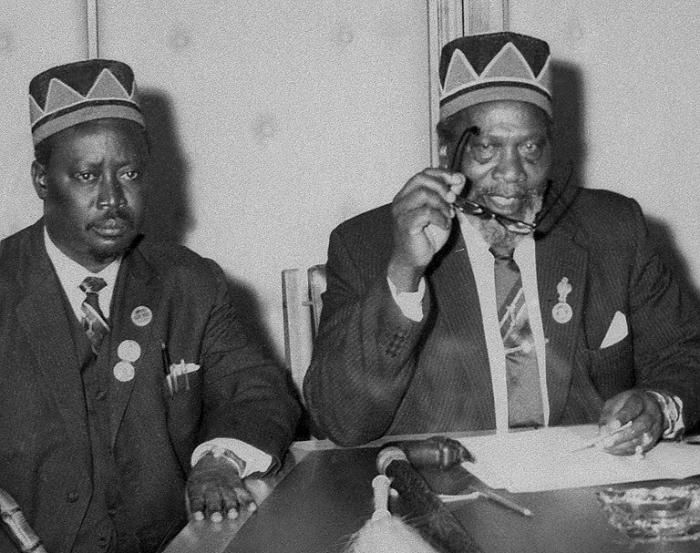
Kenyatta and Jaramogi were towering figures in the independence movement, leading the charge toward self-rule.
Kenyatta, a freedom fighter and symbol of African nationalism, spent the final decade of Kenya’s colonial rule in detention, becoming a rallying figure for anti-colonial resistance.
Jaramogi, a negotiator and nationalist leader, played a crucial role in independence talks with the British government and was a vocal advocate for Kenyatta’s release.
Their collaboration and eventual rivalry shaped the early years of Kenyan politics.
Kenyatta became Kenya’s first president in 1964 and served until his death in 1978. Despite his immense stature, the Kenyatta family did not immediately establish a strong political presence after his passing.
For years, none of his children occupied prominent political roles, and the family appeared content to remain largely outside frontline politics. This changed dramatically in the late 1990s, when Uhuru Kenyatta, Jomo Kenyatta’s son, emerged as a political force.
Uhuru entered active politics during the final years of President Daniel arap Moi’s rule.
Although widely known as the son of the founding president, Uhuru had spent much of his early adulthood in business rather than public office.
His political rise began within the ruling Kenya African National Union, at a time when Moi was grappling with succession politics amid growing pressure for democratic reforms.
In 2001, Moi nominated Uhuru to Parliament and appointed him Minister for Local Government, a move widely interpreted as an effort to groom him as a successor.
Uhuru’s ascent was swift and controversial. In 2002, despite limited political experience compared to Kanu heavyweights, he was named the party’s presidential candidate. The decision split the Independence party and alienated veteran politicians, contributing to its defeat in the general election.
Uhuru lost to Mwai Kibaki of the National Rainbow Coalition, marking the end of Kanu’s long dominance. Nevertheless, his entry into politics during the Moi era laid the foundation for a long-term political career that would eventually culminate in the presidency.
In 2013, Uhuru Kenyatta achieved what had once seemed impossible. He became president, defeating Raila Odinga, who died last October, in a fiercely contested and often violent election.
The contest was symbolic, pitting the son of Kenya’s first president against the son of its first vice president.
Political analyst Martin Andati argues that the prolonged concentration of political power within a small number of families gradually transforms democratic governance into a de facto monarchical system. He dismisses the idea that political dynasties offer any benefit to a country, warning that they undermine inclusive leadership.
“It is not good because it means you deny other people who would also have had an opportunity to be in power,” Andati says.
He notes that in many African countries, leaders often position their relatives as successors without subjecting them to open and competitive transitional processes.
According to Andati, this practice breeds resentment, heightens political tensions and can ultimately trigger instability and upheaval.
After Uhuru’s retirement from active electoral politics, no other member of the Kenyatta family appears eager to venture into the political arena.
Unlike other dynasties, the Kenyatta lineage currently shows little sign of continuity in elective politics beyond Uhuru himself, leaving open questions about whether the family’s political influence will persist in future generations.
In contrast, the Odinga family has maintained a deep and continuous engagement with politics.
Raila entered active politics in the late 1980s and early 1990s while his father, Jaramogi Oginga Odinga, was still alive and politically influential.
The former ODM chief’s political consciousness had been shaped earlier through his opposition to the Kanu regime under Moi, including detention without trial.
However, his formal entry into frontline politics was closely linked to Jaramogi’s long-standing struggle against authoritarianism and single-party rule.
Raila worked alongside his father during the push for multiparty democracy, particularly through the Forum for the Restoration of Democracy.
This period cemented his reputation as a reformist and resistance figure rather than a product of the political establishment.
Over time, Raila emerged as a leader in his own right, eventually serving as Prime Minister and contesting the presidency multiple times.
Until his death, Raila was arguably the most widely known and enduring politician of his generation in Kenya. His career spanned decades of activism, opposition leadership, government participationand constitutional reform.
From the struggle against authoritarian rule to the enactment of the 2010 Constitution, Raila consistently shaped national political discourse.
Beyond Raila, the Odinga family continues to wield influence. Oburu Odinga, Jaramogi’s son and Raila’s brother, has served as a legislator, assistant minister and is currently a senator and ODM party leader.
Ruth Odinga has been active in grassroots politics and social advocacy, while Winnie Odinga represents a younger, more firebrand generation.
Known for her unapologetic activism and sharp political rhetoric, Winnie embodies the combative and reformist style long associated with the Odinga lineage.
As Oburu and Ruth approach political retirement, attention increasingly turns to the East Africa Legislative Assembly MP and whether she will carry forward the family’s political tradition.
Another prominent political dynasty is that of Daniel arap Moi, Kenya’s second president, who ruled from 1978 to 2002.
After Moi’s presidency, his sons ventured into active politics, ensuring the family’s continued public presence. Gideon Moi emerged as the most prominent, first serving as a nominated MP and later winning election as senator for Baringo county.
He also succeeded his father as a central figure in Kanu, serving as the party’s chairman and positioning himself as a national political player.
Raymond Moi, another son of the former president, chose a different path within elective politics. He was elected MP for Rongai, adding to the Moi family’s political footprint.
However, neither son has achieved the level of dominance their father once held.
Kenya’s political families extend beyond presidents and VPs. In Mombasa, Governor Abdulswamad Nassir represents another notable lineage.
He is the son of Shariff Nassir bin Taib, a powerful Nyayo-era minister and the longest-serving Kanu chairperson in Mombasa.
The elder Nassir represented Mvita constituency for 24 years until 2002 and was famed for his defiant “Wapende Wasipende” slogan, dismissing critics who opposed Kanu.
His son rose to become Mvita MP and then governor.
Similarly, Prime Cabinet Secretary Musalia Mudavadi’s political journey is rooted in family legacy.
Mudavadi became a MP at just 29 following the death of his father, Moses Mudavadi, an influential politician from Sabatia and a former colonial district education officer.
Mudavadi senior was respected for his intellect and public service, and his son has gone on to become one of Kenya’s most consistent political figures, serving in various senior government roles across different administrations.
Political observer Joseph Mutua says many African leaders often groom their relatives to take over power without undergoing a competitive or transparent transition.
He notes that this practice fuels political tension and, in some cases, chaos that can culminate in upheavals.
“Leaders are often driven by fear of leaving office and facing accountability, prompting them to entrench their families in power as a form of self-protection,” he says.
He adds that having made significant investments while in office, such leaders prefer successors who will either continue the projects they initiated or safeguard the family’s political and economic interests tied to state resources.
According to Mutua, political dynasties tend to flourish in environments where competitiveness and transparency are weak, a situation that often goes hand in hand with poor governance and economic mismanagement.
He argues that dynastic politics frequently undermines accountability and entrenches bad governance.
Mutua further points out that, since there are no laws barring individuals from succeeding their relatives in political office, the responsibility of ending the dominance of political dynasties ultimately lies with citizens.