

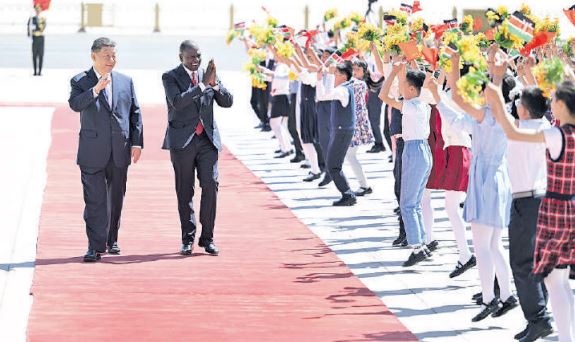
 President William Ruto, with his Chinese counterpart Xi Jinping acknowledge greetings from school children at the Great Hall of the People in Beijing, China/REBECCA NDUKU/PCS
In recent years, China’s trade surplus has often been
framed by some commentators as an imbalance that distorts global trade. This
narrative, while politically convenient, overlooks a more fundamental reality:
China’s surplus is not the result of deliberate manipulation, but a reflection
of market-driven global demand and it is delivering tangible benefits to
economies around the world.
First, China does not set out to engineer a trade surplus. International trade is shaped by comparative advantage, consumer choice, and competitive pricing, not by unilateral intent. The scale of China’s exports today mirrors the scale of demand for its products. From machinery and steel to renewable energy equipment, buyers across continents turn to China because its products combine quality, reliability, and affordability. In an intensely competitive global market, no country can force others to buy its goods. The sustained rise in Chinese exports is, in essence, a vote of confidence from global consumers and industries.
Nowhere is this clearer than in developing regions. As countries accelerate infrastructure development and energy transitions, the demand for industrial inputs has surged. From January to November 2025, China’s steel exports surpassed 100 million metric tons, rising 7.6 percent year-on-year. Southeast Asia, the Middle East, Africa, and South America have emerged as key destinations, underscoring how Chinese industrial capacity is helping meet urgent development needs elsewhere. This is not excess supply being dumped abroad; it is supply responding to real, unmet demand.
More importantly, China’s trade surplus delivers concrete gains to its trading partners. A significant share of Chinese exports consists of intermediate goods—inputs that fuel local production rather than displace it. In Africa, this dynamic is especially visible. China–Africa trade reached over $222 billion between January and August 2025, with Chinese exports largely concentrated in industrial production-related goods. These inputs help African manufacturers lower costs, improve efficiency, and become more competitive both regionally and globally. Many Chinese products are further processed locally, integrating African economies into broader value chains instead of locking them at the bottom.
Investment reinforces this trade relationship. Chinese enterprises have undertaken extensive projects in Africa’s industrial, agricultural, and infrastructure sectors, strengthening local production capacity. According to an International Monetary Fund report released in July 2025, Chinese investment has helped raise Africa’s local processing rate from 15 percent to 45 percent—a substantial leap that directly supports industrialization. In the green energy sector, affordable Chinese photovoltaic equipment has enabled many developing countries to ease electricity shortages and accelerate their transition toward cleaner energy systems.
China’s surplus also masks a reality often ignored in headline debates: multinational corporations are among its largest beneficiaries. Western firms deeply embedded in China’s manufacturing ecosystem use the country as a production base to serve global markets. Their exports are statistically counted as “Chinese,” even though profits often flow back to corporate headquarters overseas. In the first ten months of 2025 alone, foreign-invested enterprises in China accounted for roughly 27 percent of total exports. In this sense, the surplus appears on China’s books, while substantial returns accrue abroad.
Beyond production and profits, Chinese exports have improved everyday life for consumers worldwide. By supplying high-quality goods at competitive prices, China has helped contain inflation and expand consumer choice—an especially critical contribution during periods of global economic uncertainty. For millions of households, lower costs translate into higher real purchasing power and improved living standards.
Equally important is what lies ahead. China’s economic growth is increasingly anchored in domestic demand rather than exports. Between 2021 and 2024, domestic demand contributed an average of 86.4 percent to growth, with consumption playing a central role. As the world’s second-largest consumer market—and the largest by purchasing power parity—China is becoming a major source of demand for global producers.
This shift is backed by policy. China continues to expand imports, maintain relatively low tariffs, and deepen opening-up. Zero-tariff treatment for least developed countries, expanded free trade zones like the Hainan Free Trade Port, and platforms such as the China International Import Expo all signal a clear direction: China’s market is opening wider, not closing.
With a population exceeding 1.4 billion and a growing middle-income group, China’s consumption potential represents one of the world’s most significant growth opportunities. Seen in this light, China’s trade surplus is not a zero-sum challenge—it is part of a broader ecosystem of shared growth. Rather than fearing China’s capacity to produce, the world stands to gain far more by engaging with its capacity to consume, invest, and cooperate.





