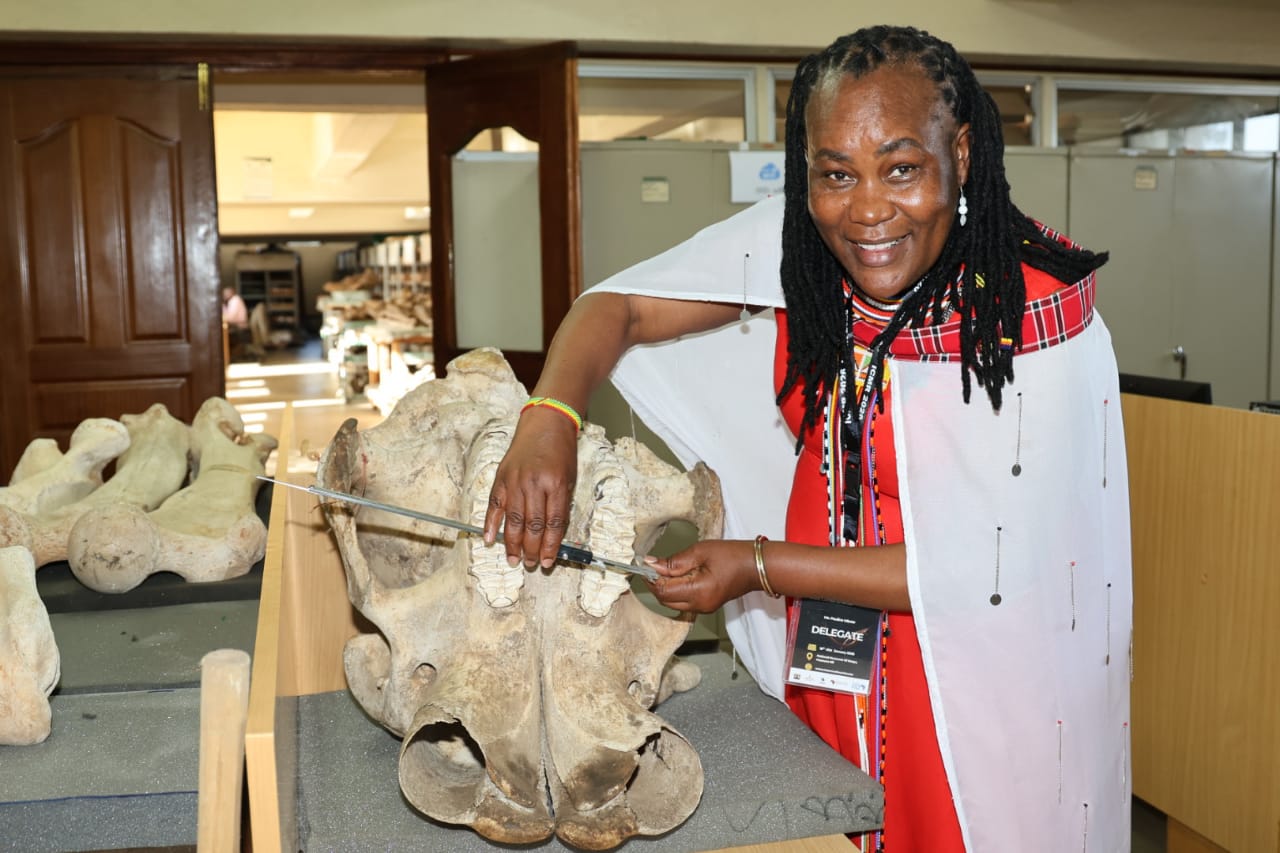
Doctoral Researcher at the University of Helsinki, Finland and a Palaeontologist, Department of Earth Sciences at NMK, Pauline Mbatha at the National Museums of Kenya
Experts studying the evolutionary history of elephants from across the world are meeting at the National Museums of Kenya in Nairobi for the 9th International Conference on mammoths and their relatives.
The conference comes at a time when the iconic species are faced with a number of challenges.
National Museums of Kenya Director General Prof. Mary Gikungu said bringing the conference to Africa and Kenya in particular is symbolic and necessary.
She said it connects global science to the landscapes and histories where much of this story began.
“The African continent holds deep evidence of the evolutionary journey of the proboscideans, the ancient family of animals that includes today’s elephants and their long-extinct relatives,” she said.
The theme for this year's conference is “Africa, the Evolutionary Cradle of Proboscideans.”
The conference began on January 18 and ends on Wednesday January 21, 2026 with international participants from diverse backgrounds and disciplines. It is being held in Africa for the first time.
Proboscideans are a group of mammals characterised by having a trunk (called a proboscis). They include elephants.
NMK director for National Repository and Research, Taita Terer, said the role of the National Museums of Kenya in elephant conservation goes beyond research and collections.
“It supports understanding of ecosystems, informs policy, educates communities and helps connect people to the natural heritage that surrounds them. In doing so, it strengthens the relationship between science and the communities that live alongside wildlife,” Terer said.
Terer said when scientists study proboscideans, they are not only studying animals.
“They are studying climate change over time, movement across landscapes, survival, adaptation and extinction – stories that help us understand how life responds to change. While this research may sound technical, its meaning is very human. It helps understand our natural heritage, the environment we depend on, and the responsibility we carry to protect what remains,” Terer said.
Terer said the conference is an opportunity to connect knowledge with people, research with reality and ideas with action.
Doctoral Researcher at the University of Helsinki, Finland and a Palaeontologist, Department of Earth Sciences at NMK, Pauline Mbatha said elephants could go extinct if action is not taken.
“Now that I'm in that field, I will be the ambassador, a Kenyan ambassador, strong enough to see what we can do in terms of proboscideans,” she said.
Mbatha said she is studying the morphology of their bones and seeing where they place them in terms of the savanna versus the forest.
She said some of the challenges include poaching and encroachment of their territories.
Mbatha said Kenya has rich historical sites such as Turkana.
She said elephants started when they were small in size, but are now larger.
Mbatha said elephants used to have curved tusks.