My son Joshua and his classmates recently launched an online business selling perfume. They researched their market, set pricing, built a digital presence, handled customer enquiries and made actual sales. They were in Junior School.
My only regret? They did not keep it going. The business was viable, but some teammates handling supply chain and logistics gave up. The venture collapsed not because of the curriculum, but because of a lesson every entrepreneur learns: your business is only as strong as your team's commitment. CBC taught them that, too.
I think of this when I read Wanja Kavengi's recent commentary on the Competency-Based Curriculum. She describes the pathway system as "a violent attack on knowledge and maturity, a chain seeking to incarcerate the pupil in the wastelands of intellectual impotence". She calls it "a sinister plot engineered to making him a product to be sold in the market of capitalists and imperialists." The rhetoric is seductive. It is also detached from what is actually happening in CBC classrooms.
Kavengi claims pathways will fragment knowledge and produce narrow-minded graduates. Let us examine the facts.
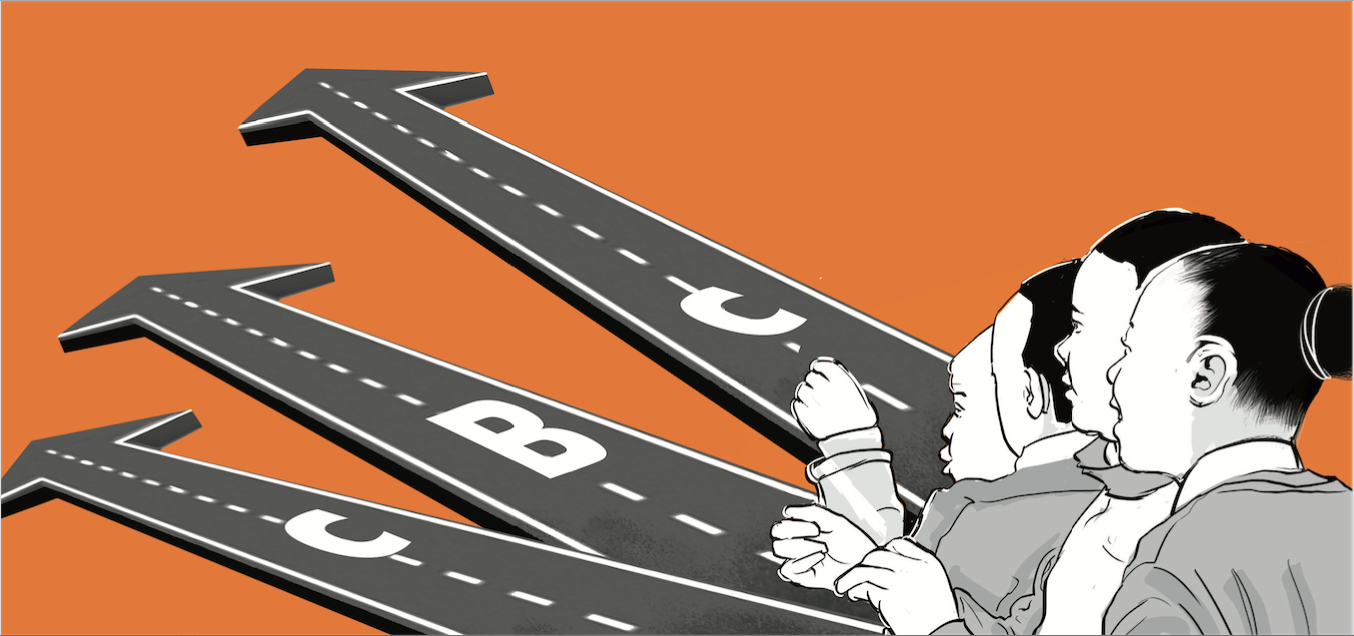
Every Grade 10 student, regardless of pathway, must take five compulsory subjects: English, Kiswahili or Kenya Sign Language, Mathematics, Community Service Learning and Physical Education. This is the shared foundation, the common intellectual heritage binding Kenyan students, whether they pursue sciences, humanities or arts. Five subjects. Compulsory. For everyone.
Students then select three electives from their chosen pathway. Here is what critics miss entirely: the Kenya Institute of Curriculum Development has approved 571 subject combinations. The curriculum explicitly permits students to take "one learning area from the chosen pathway and a maximum of two learning areas from any of the three pathways." A STEM student can include Literature and History. An Arts student can take Biology and Business Studies.
This is not intellectual imprisonment. It is structured flexibility, more than the British A-Level system offers, with pathway selection occurring at 15-16. This is no earlier than international norms. Germany tracks students at 10. Singapore begins streaming at Primary 4.
The perfume business was not an anomaly. It was CBC working as designed. To launch that venture, Joshua's group had to integrate multiple knowledge domains: market research, pricing and margins, persuasive writing, digital tools, supply chain basics and teamwork. They were not memorising facts for an exam. They were applying knowledge to solve a real problem.
Kavengi invokes the ideal of holistic education, knowledge as "a web, not a singular string". She argues that to truly understand something, one must grasp its connections to everything else. I agree entirely. And I watched my son weave exactly that web while building a business before he turned 15.
What did 8-4-4 produce? I am old enough to remember. Rote learners memorising past papers. Students who could regurgitate the definition of entrepreneurship but had never priced a product. Exam anxiety as a permanent condition. If knowledge is a web, 8-4-4 gave us disconnected nodes floating in stress, not the integrated understanding critics now demand of CBC while implicitly defending its predecessor.
The irony is acute: CBC is being attacked for failing to deliver something 8-4-4 never attempted.
I am a surgeon. I studied biology, anatomy and physiology. Nobody taught me how to be an entrepreneur. Not in secondary school, not in medical school, not in my postgraduate training. Yet today I run healthcare businesses. I have founded and exited companies. I write a newspaper column. None of this was in my "pathway".
Learning does not end when you leave school. It does not respect the boundaries of a syllabus. A biology student can own a tour company. A literature graduate can build a tech startup. A doctor can become a bestselling author of fiction. The only person who decides what you cannot do is you.
This is the deeper fallacy in the anti-pathway argument: the assumption that what you study at 15 determines what you become at 40. It does not. Education opens doors; it does not lock them. The students who will thrive under CBC, or any system, are those who understand that learning is a lifelong endeavour, not a three-year sentence.
Do not blame the education system for limitations you impose on yourself.
None of this means CBC is beyond criticism. But the legitimate concerns are about implementation, not architecture. Does every school have teachers trained for competency-based pedagogy? Can a student in Turkana access Marine and Fisheries tracks? Do rural schools have the infrastructure for technical subjects? Are we funding laboratories and studios, or just printing new syllabi?
These are serious questions deserving serious engagement. They are also questions that can be answered with investment, training and political will. "Sinister plots" and "imperialist engineering" are not policy arguments. They are distractions.
Five compulsory subjects for all students. Cross-pathway flexibility built into the design. 571 approved subject combinations. Students launching actual businesses in Junior School. A surgeon who became an entrepreneur without a single business class. This is not intellectual impotence. This is education that finally asks students to do something with what they learn, and a reminder that what you do after school is up to you.
Kenya's 1.2 million students entering Senior School this year deserve a debate grounded in evidence, not emotion. They deserve critics who have read the curriculum design, not just invented a caricature to attack. And they deserve to know that their futures are not determined by a pathway, but by their own ambition, curiosity and willingness to keep learning long after the last exam is written.
My son built a business before he turned 15. I built mine after 40. Tell me again how pathways limit our children.
Surgeon, writer and advocate of healthcare reform and leadership in Africa