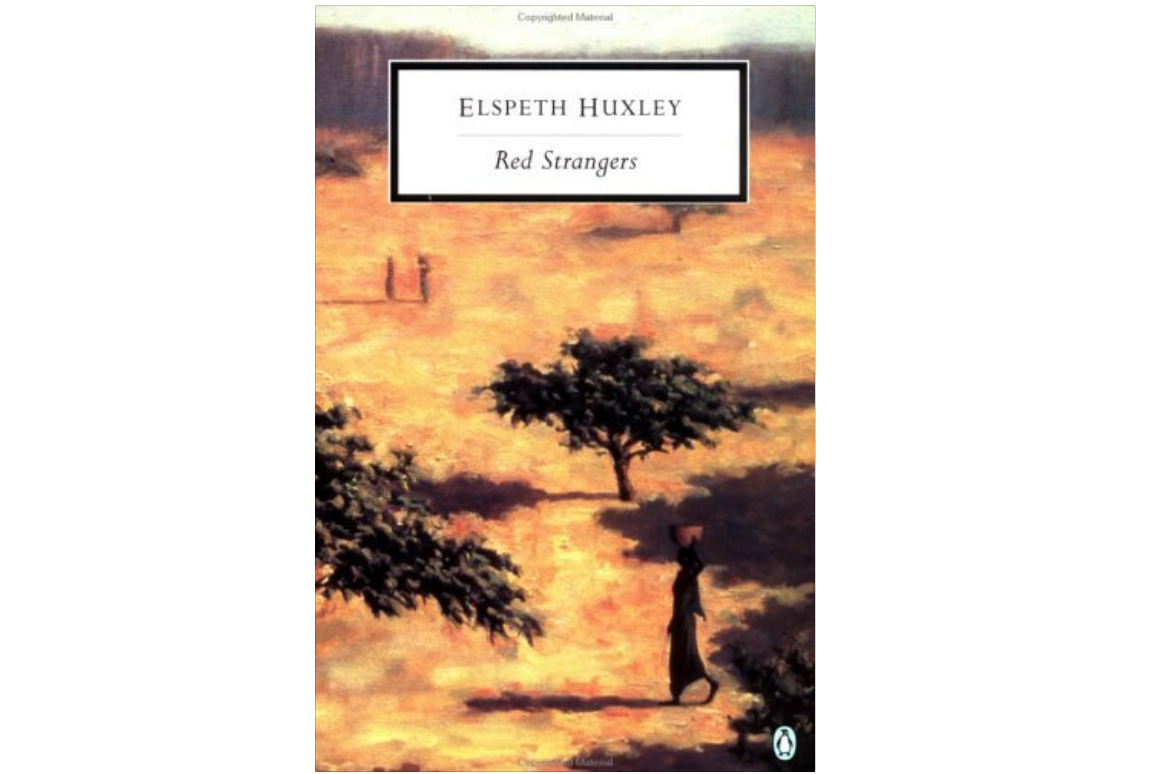
Every empire begins as a story told by strangers. In Elspeth Huxley’s Red Strangers, we watch that story written across the soil and souls of Kenya.
In this extraordinary novel, Huxley plunges us into a vast, sweeping panorama of pre-colonial and colonial East Africa, told through the eyes of the Kikuyu.
She traces, with precision and compassion, the slow intrusion of the European “red” strangers (so-called for their sunburnt faces) into the intricate rhythms and rituals of an ancient culture, and the devastating consequences that unfold over four generations.
This is not merely a story of conquest but of collision, of what happens when one world built on ritual and community meets another built on money, law and restless ambition.
The novel opens in the deep pulse of Kikuyu life: a world of goat-herding boys, sacred fig trees whose roots descend from heaven, and elders whose words carry the weight of cosmic order. It is a universe believed to have existed ‘since the beginning of the world’, where harmony depends on balance between people, land and ancestors.
Into this balanced world the strangers come, carrying metal coins, guns and a new kind of faith. To the Kikuyu, these pale visitors seem not quite human: their skin burns red under the sun, their eyes are pale, their God invisible. Yet they bring power, and with power comes disruption.
Matu and Muthegi, two young men caught between tradition and change, embody the confusion of a generation whose certainties crumble. When a colonial court intervenes in what was once clan justice, the collision of moral systems becomes heartbreakingly clear.
“The affair of the young man’s death is between Karue and my father Waseru. What has the stranger to do with it?” one character asks. Only to hear the foreign verdict: “That is stranger’s law. Matu killed, he evil man. Therefore, he stays with stranger.”
The Kikuyu understand justice as restoration; the strangers call it punishment. Later, the narrator reflects bitterly, “Then the stranger gets something for Karue’s loss, and Karue’s clan gets nothing at all.” In a few sentences, Huxley captures an entire civilisation losing control over its own logic.
Through these intimate conflicts, Red Strangers reveals the grand machinery of cultural transformation. Goats give way to coins, elders’ wisdom to magistrates, the ancient gods to a single foreign deity. The Kikuyu learn to trade, to work for wages, to pay taxes for land they already own.
Huxley writes not of battles but of smaller violence: the slow unravelling of meaning, the quiet despair of a people watching their world turn strange. The tragedy here is not simply colonisation; it is the erasure of comprehension itself.
Huxley’s prose is breathtaking in its clarity. She writes with the precision of an ethnographer and the lyricism of a poet. Her descriptions are rich with texture and rhythm: the sacred fig trees “whose roots descend from heaven,” the red earth “that burned beneath the feet of herdsmen,” and Nairobi “swollen like a tick on the neck of a cow, the houses grown upwards as quickly as eucalyptus trees”. Each line is vivid, sensory, exacting. She lets the reader feel the heat pressing on skin, the scent of rain, the silence of ritual before dawn. Her narrative moves slowly, patiently, in the same rhythm as the Kikuyu lives she portrays. Reading it feels like stepping into a landscape that is at once foreign and heartbreakingly familiar.
Huxley’s genius lies in her ability to balance empathy with restraint. She does not romanticise the Kikuyu world, nor does she vilify the Europeans. Instead, she allows the tragedy to emerge naturally from contact itself — the simple impossibility of coexistence between two incompatible orders. The result is a novel that feels both anthropological and mythic, personal and panoramic. Her writing extends beyond observation, it becomes an act of mourning.
Still, for all its sensitivity, Red Strangers remains the work of an outsider speaking for a culture not her own. Huxley, though steeped in Kikuyu customs and fluent in Kiswahili, could never fully inhabit the interior consciousness of her characters. At times, the Kikuyu voices sound filtered through a Western sensibility — eloquent but curiously detached, their inner lives smoothed into allegory. Rituals, though meticulously described, occasionally read like spectacle rather than lived experience.
At once lyrical and devastating, Red Strangers is not just a novel, it is an elegy for a vanishing way of seeing. Huxley’s Kenya is both specific and universal, her prose gleaming with the light of a world that will never return. This is a book to read slowly, to absorb in silence and to remember as a mirror of how history begins: not with conquest, but with the quiet arrival of strangers who tell new stories about the world.