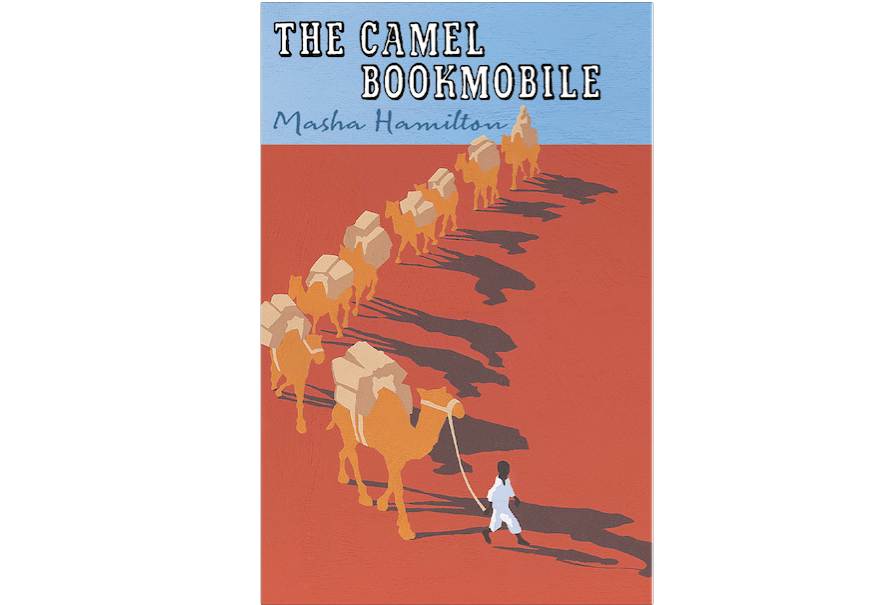
Masha Hamilton’s The Camel Bookmobile is one of those rare novels that takes a premise so unusual — books carried on camelback into remote Kenyan villages — and transforms it into a layered, emotionally resonant story about culture, conflict and the fragile hope tucked inside every act of idealism.
The result is a narrative that moves with the same mesmerising rhythm as the camels themselves: steady, deliberate and impossible to look away from once you’ve begun the journey.
The novel follows Fi Sweeney, a librarian from New York driven by an earnest conviction that books shouldchange the world. She travels to Kenya to join a mobile library project that aims to bring stories, knowledge and possibility to isolated communities.
Fi’s worldview is shaped by a lifelong devotion to reading. She sees books as portals, companions and liberators. Hamilton captures this beautifully in a moment of internal reflection when Fi realises that “books allowed her vicarious tastes of infinite variety, but they didn’t supplant the need to venture out into the big and the messy”. That line strikes at the core of the novel: Books can awaken longing, but they can’t protect anyone from the complications of the real world.
And complications arrive swiftly in Mididima, a village with its own traditions, tensions and unspoken wounds. Among the villagers, three figures take the emotional lead: Matani, the idealistic teacher desperate to foster education; Kanika, a brilliant young girl whose hunger for learning clashes with cultural expectations; and Taban, whose disfigurement from a hyena attack has not dimmed his quiet wisdom.
Through these intertwined lives, Hamilton reveals the profound ways a seemingly simple arrival of books piled onto camel saddles can unsettle an entire community.
The narrative turns when several books go missing. Fi arrives with rules, one of which states that if a book is lost, the entire village will be boycotted. It’s a policy she believes necessary to preserve the fragile library system. But in a place where survival itself is tenuous, the concept of propertybecomes something more complicated. Here, Hamilton shows her greatest strength: an ability to depict cultural collision without judging either side. Fi is determined, hopeful and well-intentioned, yet Hamilton doesn’t shield her from the consequences of her rigidity. The missing books become a symbol of misunderstanding, resentment, aspiration and a clash between preservation and progress.
Hamilton’s writing style is a major reason the novel resonates as deeply as it does. Her prose is lush without being indulgent, vivid without feeling forced. She paints the Kenyan landscape with journalistic authenticity and a novelist’s sensitivity: acacia thorns scratching the sky, the red dust rising behind the camel caravan, the quiet press of heat that slows thought and movement alike.
But her greatest gift is her ability to shift perspectives seamlessly. Readers slip inside the thoughts of villagers and outsiders, elders and children, men and women, each voice distinct and tenderly crafted. Rather than building a single protagonist’s arc, Hamilton creates a chorus, and each voice adds weight to the novel’s emotional terrain.
That said, Fi, despite being central to the plot, is often overshadowed by the villagers, whose lives are far more complex and compelling. This leads into one of the novel’s significant shortcomings: Fi’s character is comparatively underdeveloped. Her inner life lacks some of the nuance granted to characters like Taban or Kanika, and her personal evolution feels muted where it should feel revelatory.
It’s not simply that she is flawed — flaws are interesting — but that the narrative seems less invested in plumbing her depths than in exploring the world around her. At times, she reads more as a narrative device than a fully realised person, and this weakens the emotional payoff of her storyline. When she promises, “I’ll be back… very soon,” Hamilton writes that “there were limitations to words — words in the air or on a page,” a statement that hints at Fi’s struggle to communicate and connect. But those limitations are never fully explored, leaving her arc feeling thinner than those of the people she hopes to help.
All in all, The Camel Bookmobile is richly rewarding. It’s a novel about the unexpected costs of good intentions, the ways stories can heal or disrupt, and the fragile bridges built between cultures.
Hamilton invites readers to question not only the power of books but also the consequences of imposing one’s ideals on another’s world. The journey is striking, immersive and emotionally lingering, a testament to Hamilton’s talent for infusing compassion and complexity into every chapter.