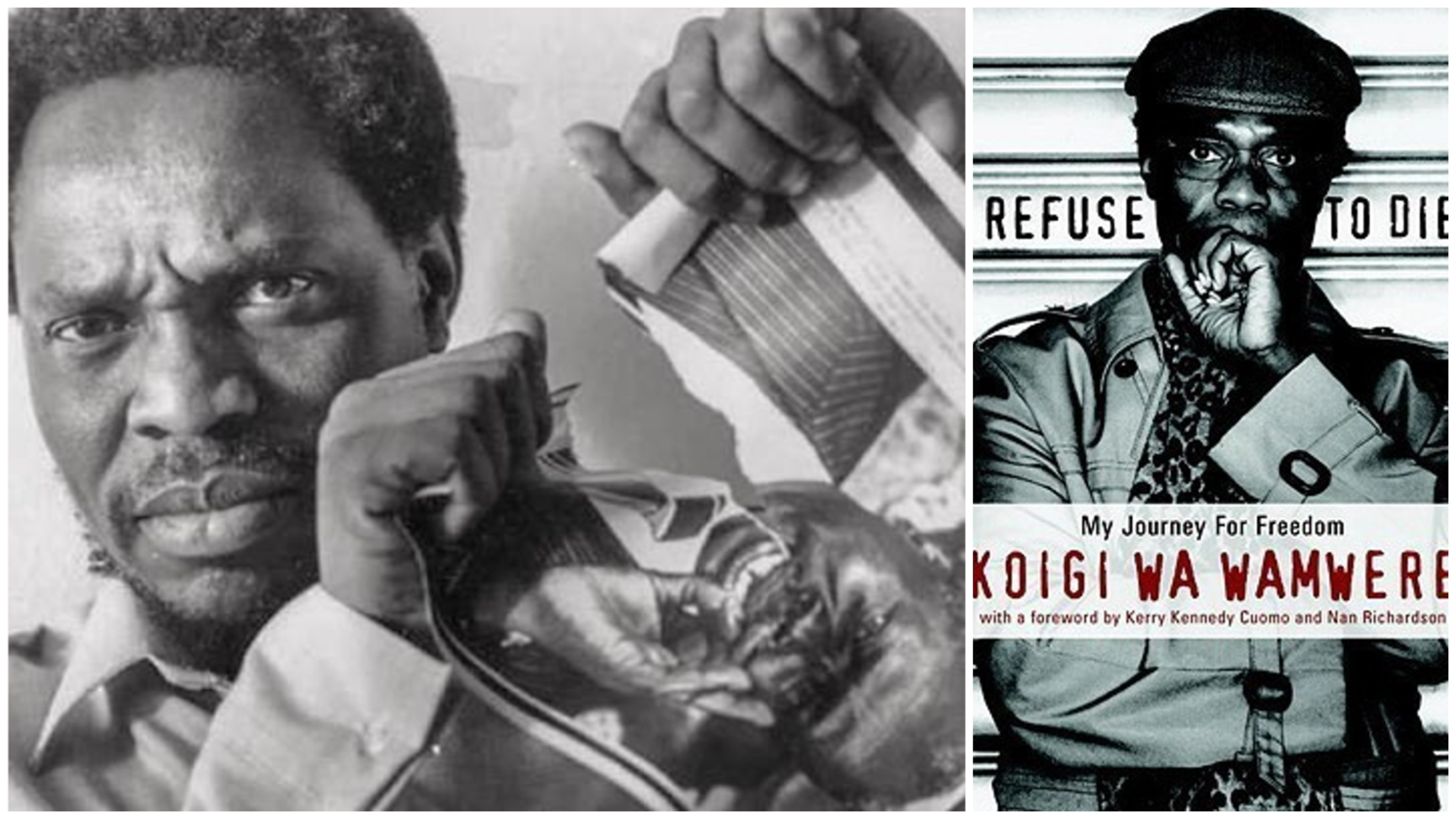
Koigi wa Wamwere’s I Refuse to Die is the literary equivalent of a clenched fist — unyielding, defiant and burning with conviction. It is not just a memoir of a political prisoner; it’s a survivor’s manifesto, a meticulously carved testimony of what it means to live under the weight of a ruthless regime and still insist on the dignity of one’s voice.
The book does not merely tell a story of oppression; it pulls you into the cell with him, makes you breathe the damp air and forces you to reckon with the brutal machinery of authoritarianism. And then, startlingly, it makes you feel the stubborn heat of hope.
At its heart, the book follows Koigi through multiple arrests under Kenya’s Moi regime, where dissent was treated as treason and truth was something to be beaten out of people. He recounts the stifling cells, the interrogations that blur into nightmare, and the attempts, subtle and brutal, to crush his will.
What grips you immediately is not the spectacle of suffering but the stubborn refusal at the centre of it. It appears in the book’s title and in his own unwavering assertion: “I refuse to die.” It’s a line that becomes the emotional axis around which the entire narrative spins.
Koigi does not rely on dramatic embellishment. The events are dramatic enough. He writes of prison as a psychological battlefield, a place where every humiliation is designed to make one surrender the idea of self. What he captures most powerfully is the slow corrosion of hope and the extraordinary labour required to keep that hope alive. In one moment of vulnerable quiet, he reflects, “Fear is their weapon; courage must be mine,” a simple line that cuts straight into the essence of his struggle.
But what truly elevates this memoir is Koigi’s writing style: a fusion of journalist precision, storyteller rhythm and activist fire. He has a way of describing a prison cell not as a static space but as a living antagonist: walls that sweat cold, iron that listens, silence that taunts. His language carries the ache of lived experience, yet he never sinks into melodrama. Instead, he documents with a clarity that makes the horror vivid without sensationalising it. The emotional power comes from the starkness, the details, the grounded humanity.
Koigi also writes with a restlessness that mirrors the tension of the story. He shifts between memory and reflection with a fluidity that feels natural; one moment recounting a beating, the next contemplating the architecture of oppression or the psychology of resistance. This fluid style keeps the reader alert, engaged and emotionally tethered to his internal landscape. It is the kind of writing that does not allow you to sit comfortably at a distance; it pulls you into the darkness and insists that you look around.
The memoir is also rich with political insight. Koigi reveals how systems of oppression sustain themselves not only through brute force but through the complicity of the fearful, the silence of the comfortable and the calculated manipulation of the law. He exposes the machinery behind dictatorship: the propaganda, the secrecy, the rewriting of history. For readers who want more than a personal narrative, these moments offer a deeper understanding of how fragile democracy can be, and how easily it can be twisted into a tool of violence.
However, the book is not without fault. Its pacing suffers from noticeable imbalances, particularly in sections where Koigi shifts from personal narrative to dense political exposition. These passages, though informative, can feel heavy and disruptive to the emotional continuity of the memoir. There are moments when the flow of the story slows to a crawl under the weight of ideological analysis or historical detail. Readers who come to the book seeking the immediacy of lived experience may find these slower sections difficult to move through. The imbalance creates an uneven rhythm that occasionally distances the reader from the raw heartbeat of Koigi’s story.
Koigi wa Wamwere’s memoir does not ask for admiration; it demands reckoning. It forces readers to confront what it means to stand for truth in a world where truth can cost everything. And it asks a question that lingers long after the final page: If a man can emerge from the darkest cell and still declare, “I refuse to die,” what, then, do we allow ourselves to survive — and to fight for?